
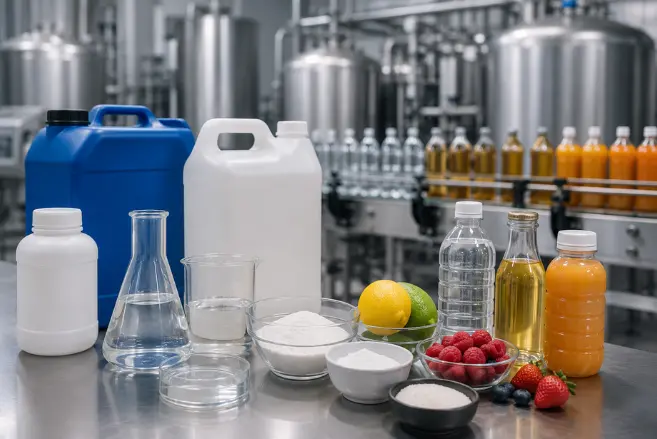
A pallet of citric acid lands on your receiving dock for a beverage line, and the paperwork stapled to the shrink-wrap is a technical-grade Certificate of Analysis — heavy-metals tested to an industrial limit, no reference to the Food Chemicals Codex, no lot-level allergen statement. The headline assay reads 99.7%. It looks fine. It is not fine. That lot cannot enter a food process, because grade is not a marketing tier; it is the legal specification, and a 99.7% technical lot and a 99.5% FCC lot are not interchangeable no matter what the purity number says.
If you run procurement, QA, or food safety at a food, beverage, or ingredient manufacturer, you already know the failure modes: a supplier swaps origin on a tight week, an antifoam shows up without its 21 CFR clearance, a kosher letter expired three audits ago. This piece is about the controls that keep those off your floor, written for people who already know what a HACCP plan and an Incoterm are.
Why is food-grade vs. technical-grade the whole ballgame?
Because the grade is the specification. Two lots of the same CAS number can have nearly identical headline assays and still be legally and functionally different products. Citric acid (CAS 77-92-9) sold as a descaling acid and citric acid sold as an acidulant share a molecule, not a control regime. The food-grade lot is tested and limited against the Food Chemicals Codex monograph (heavy metals such as lead and arsenic, residual solvents, microbial limits where relevant), and the FCC is incorporated by reference into FDA food-additive regulations, so the monograph carries regulatory weight, not just trade convention.
The trap is the purity number. A technical lot at 99.7% can still carry impurities the food monograph caps and the technical spec ignores. So the rule is blunt: the grade standard named in your specification is non-negotiable, and “we were short, so we shipped the industrial lot” is a deviation that should trigger rejection and a supplier corrective action, not a quiet acceptance because the line was running.
One honest trade-off: compendial grade costs more and sometimes has longer lead times, especially for FCC/USP dual-grade material on a tight market. That premium is the cost of a defensible specification. Designing it out by accepting technical grade “just this once” is how a recall starts.
| Attribute | Food-grade (FCC / USP-NF / E-number) | Technical / industrial-grade |
|---|---|---|
| Governing standard | Named compendial monograph (FCC, USP/NF) or EU Reg (EU) 231/2012 purity criteria | Manufacturer or industry spec; no food-contact assurance |
| Impurity controls | Heavy metals, As/Pb, residual solvents, microbial limits per monograph | Assay-focused; trace contaminants often unbounded |
| CoA reference | Cites the food standard and lot test data | Cites internal spec only |
| Allergen / kosher / halal docs | Available and lot-current | Typically absent |
| Legal status in food | Permitted when used per the applicable additive rule | Adulteration risk; not for food contact |
For the broader landscape of grade designations and how they map across regions, see our chemical grades guide.
How do you qualify a supplier for food, not just chemistry?
Qualify the food-safety system, then the molecule. The fast screen: a current certification recognized under the Global Food Safety Initiative (GFSI). FSSC 22000 (built on ISO 22000 plus sector prerequisite programs), SQF, and BRCGS are the common ones; the certificate tells you an accredited body has audited the supplier’s hazard controls. Verify the certificate number, scope, and expiry directly; scope matters, because a plant certified for one product line is not certified for the line that made your lot.
Beyond the certificate, three documents do real work. An allergen statement declaring presence or absence of the major allergens and the controls preventing cross-contact. Kosher and halal certification letters where your customers or export markets require them; check the certifying agency and expiry, not just that a PDF exists. And food-contact compliance for any processing aid: a defoamer used in your process must be cleared under 21 CFR 173.340, and “it’s basically the same product” is not a clearance.
Run this as a documented qualification with the same rigor you bring to a finished-ingredient supplier.
What documentation must travel with every food-grade lot?
Lot-level documentation, not a one-time qualification packet. The relationship being approved does not make a given drum compliant; the paper that ships with that drum does. At minimum, every food-grade shipment should carry:
- Food-grade Certificate of Analysis citing the applicable standard (e.g., “conforms to FCC” or the relevant USP/NF monograph) with lot-specific test results, not a generic spec sheet.
- Allergen statement for the lot, covering the major allergens and cross-contact controls.
- Country of origin and, for traceability, the actual manufacturing site, relevant to both customs and your own supplier-approval scope.
- BSE/TSE statement where the material is or could be animal-derived (certain gelatins, stearates, glycerine, lactic acid feedstocks). For non-animal-origin synthetics, a statement of non-animal origin closes the question.
- Safety Data Sheet and, where applicable, a kosher/halal certificate and a food-grade compliance declaration referencing the FDA part, E-number specification, or Codex GSFA entry.
Build the required document set into the purchase order and make a missing or non-conforming document a receiving hold, not a “we’ll get it later.” The CoA-versus-actual dispute (supplier says it met their spec, your incoming lab disagrees) is the single most common quality argument in food chemical procurement, and it is won upfront by specifying which standard the CoA must reference and reserving third-party retest rights at supplier cost.
How do you control segregation and cross-contamination in transit and storage?
Treat shared equipment as a hazard, because it is. A bulk-liquid acidulant moved in a tanker that last carried a non-food chemical, or an IBC of food-grade propylene glycol stored next to its industrial twin with look-alike labels, is exactly how non-conforming material reaches a batch. The controls are unglamorous and they work:
- Dedicated or validated-clean conveyance for bulk liquids. For ISO tanks and flexitanks, require the prior-cargo history (the “tank wash” or food-grade load record) and a cleaning certificate. Many buyers specify food-grade-only or “last three cargoes food” for liquid sweeteners, glycols, and acids.
- Physical and label segregation in the warehouse between food and non-food grades, with grade called out on the label, not just the SDS.
- Supplier-side run segregation: if a supplier makes both grades on shared equipment, get the changeover cleaning and verification procedure in writing before you qualify them for the food grade.
- Tamper-evidence and seal records on totes, drums, and tankers, captured at receiving against the shipping documents.
The trade-off worth naming: dedicated food-grade logistics narrows your carrier and tank pool and can lengthen lead time, particularly for liquid bulk. That is a real cost. It is smaller than a hold-and-recall triggered by a tanker that carried solvent two loads ago.
What do the common F&B chemical inputs actually require?
Most food and beverage plants buy from a short, recurring list (acidulants, gases, CIP caustic, processing aids, and carrier glycols), and each one has a specific grade standard and a specific document that has to be right. The molecule is the easy part; the grade and clearance are where lots get rejected.
| Input (CAS) | Typical use | Grade standard | Key control / document |
|---|---|---|---|
| Citric acid (77-92-9) | Acidulant, pH control, chelation | FCC; E330 under EU Reg 231/2012 | FCC-referenced CoA; anhydrous vs. monohydrate specified |
| Phosphoric acid (7664-38-2) | Acidulant (colas), CIP descaling | FCC food-grade; E338 | Food-grade CoA; distinct lot from technical descaler |
| Carbon dioxide (124-38-9) | Carbonation, inerting | Beverage-grade CO2 (ISBT / EIGA purity guidelines) | Beverage-grade CoA; source and impurity profile (benzene, sulfur) |
| Sodium hydroxide (1310-73-2) | CIP caustic, pH adjustment | Food-grade where contacting product; FCC | CoA; mercury-free / membrane-cell origin statement |
| Dimethylpolysiloxane antifoam | Defoaming in processing | Cleared under 21 CFR 173.340 | Clearance citation; 10 ppm-in-food use limit respected |
| Propylene glycol (57-55-6) | Carrier, humectant, antifreeze in food systems | USP/FCC (PG USP), never industrial PG or MEG | USP/FCC CoA; explicit “not ethylene glycol” confirmation |
Two of these carry specific, easily-missed limits. Defoamers cleared under 21 CFR 173.340 carry a use limit (dimethylpolysiloxane is generally capped at 10 ppm in finished food), so the clearance is a usage condition, not a blanket approval. And propylene glycol is the canonical “grade is the spec” case: industrial PG and mono-ethylene glycol look and pour similarly, and substituting on availability is the kind of error that ends in a public-health event. Specify PG USP/FCC and verify the CoA says so.
Beverage-grade CO2 deserves its own note: purity guidance from ISBT and EIGA addresses trace contaminants (benzene, total sulfur, NOx) that a generic industrial CO2 spec ignores, and source matters because CO2 recovered from different industrial streams carries different impurity risks. For broader volume-buying mechanics across these inputs, see how to source bulk chemicals.
What changes when you import food-grade chemicals?
You take on regulatory obligations the foreign supplier cannot discharge for you. Two are non-optional for US-bound food shipments. FDA Prior Notice (21 CFR Part 1, Subpart I) must be submitted and confirmed before arrival (no less than 8 hours for ocean, 4 hours for air or land/rail, and 2 hours for road shipments), or the food can be refused and held at the port. The Foreign Supplier Verification Program (FSVP, 21 CFR Part 1, Subpart L) makes you, the importer, responsible for verifying the foreign supplier produces food meeting US safety standards; you must develop and maintain the FSVP and identify yourself with a recognized facility identifier at entry.
Practically: confirm who the FSVP importer of record is before the first PO, line up hazard analysis and supplier verification records, and align Incoterms so responsibility for documentation and customs holds is unambiguous. A clean CoA does not clear customs; a complete, on-time Prior Notice filing and a documented FSVP do. Budget time for it: the common import delay is documentary, not chemical.
Frequently asked questions
Frequently Asked Questions
What is the difference between food-grade and technical-grade chemicals?
Food-grade material conforms to a named compendial or regulatory standard — the Food Chemicals Codex (FCC), USP/NF, or the EU purity criteria under Commission Regulation (EU) No 231/2012 — which set quantified limits on heavy metals, residual solvents, and microbial contamination for food contact. Technical-grade meets an industrial process spec that does not address food safety. A nearly identical headline assay does not make them interchangeable: using a technical lot against a food-grade specification is a deviation and a potential adulteration, regardless of the purity percentage.
What documentation must accompany a food-grade chemical shipment?
Per lot: a food-grade Certificate of Analysis citing the applicable standard (e.g., “conforms to FCC” or the relevant USP/NF monograph) with lot-specific test data; an allergen statement; country of origin and manufacturing site; a Safety Data Sheet; and, where the material is or may be animal-derived, a BSE/TSE statement. Add kosher/halal certificates and a food-grade compliance declaration (referencing the FDA part, E-number specification, or Codex GSFA entry) where your customers or export markets require them. Make a missing or non-conforming document a receiving hold.
Which supplier certification should I require for food-grade chemicals?
Look for a certification recognized under the Global Food Safety Initiative (GFSI) — FSSC 22000, SQF, or BRCGS are the common ones — and verify the certificate number, scope, and expiry directly with the certifying body. Scope is the catch: a plant certified for one line is not certified for the line that made your lot. For processing aids such as defoamers, add food-contact compliance (for example, clearance under 21 CFR 173.340) and current allergen, kosher, and halal documentation as applicable.
Can food-grade and non-food-grade chemicals share transport or storage?
Only under controls. For bulk liquids, require the conveyance to be dedicated food-grade or validated-clean, with prior-cargo history and a cleaning certificate — many buyers specify food-grade-only or “last three cargoes food” for acids, glycols, and sweeteners. In the warehouse, physically separate grades and call out grade on the label, not just the SDS. If a supplier produces both grades on shared equipment, get their changeover cleaning and verification procedure in writing before you qualify them for the food grade. Shared, uncontrolled equipment is a contamination and recall vector.
What are my regulatory obligations when importing food-grade chemicals into the US?
Two apply to the importer regardless of supplier quality. FDA Prior Notice (21 CFR Part 1, Subpart I) must be filed and confirmed before arrival — at least 8 hours for ocean, 4 hours for air or land/rail, and 2 hours for road — or the shipment can be refused at the port. A Foreign Supplier Verification Program (FSVP, 21 CFR Part 1, Subpart L) makes you responsible for verifying the foreign supplier meets US food-safety standards; you must develop and maintain it and identify yourself at entry. Settle who the FSVP importer of record is and align Incoterms before the first purchase order.
Search 1,300+ industrial chemicals by name or CAS, or send us your spec — we quote by the drum, tote, or container.
Browse the Chemical Index → Request a Quote