
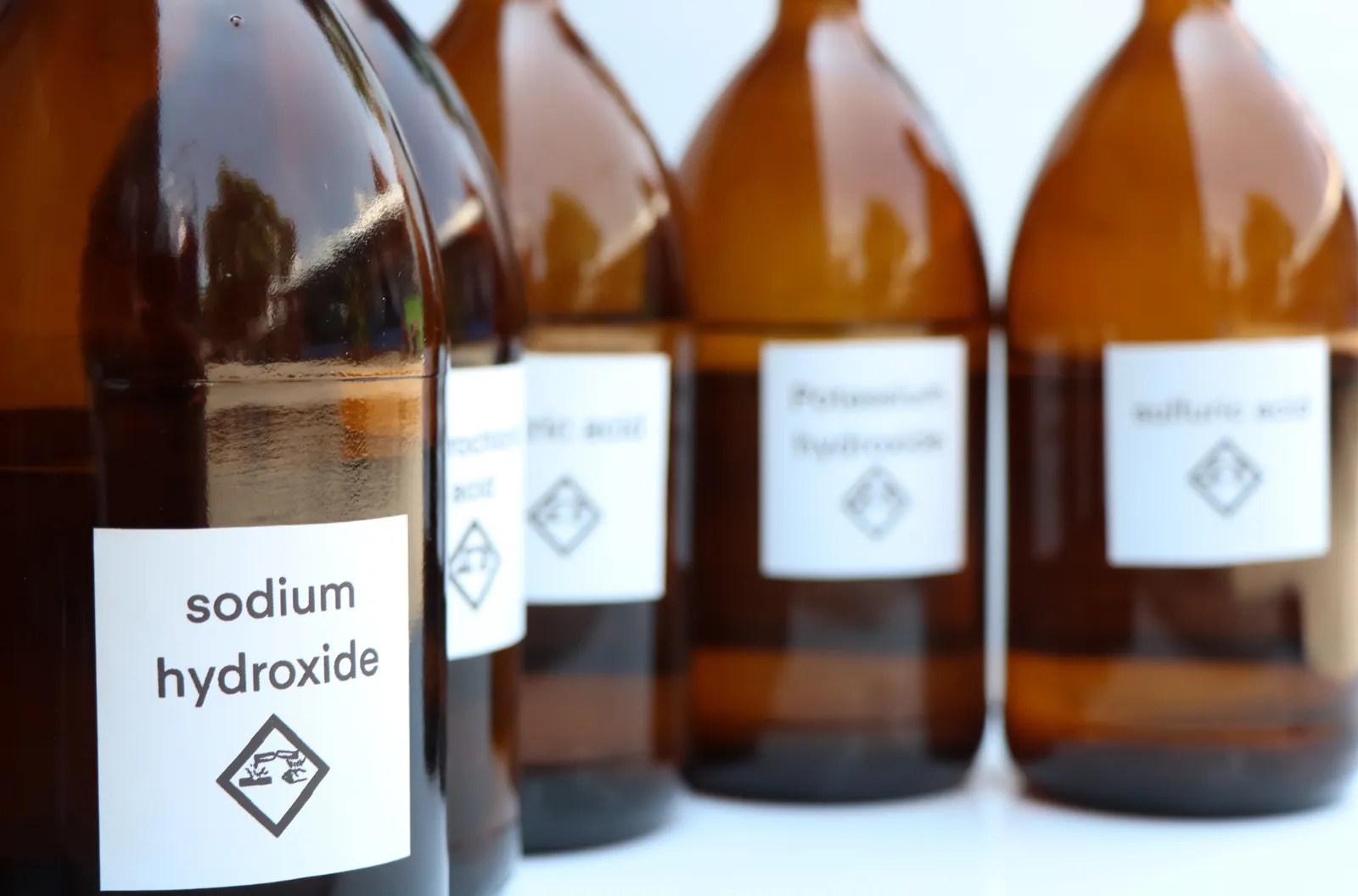
What is Sodium Hydroxide?
Sodium hydroxide (NaOH, CAS 1310-73-2), known in the trade as caustic soda or lye, is a strong inorganic base sold by the tank car, tote, and pallet across nearly every process industry. It moves in two physical forms: solid (flake, prill/bead, or pearl, typically 98–99% NaOH) and liquid (the workhorse 50% solution, plus 25%, 30%, and dilute custom strengths). If you buy it, the form and grade you specify matter more than the chemistry: a chlor-alkali producer makes one molecule, but membrane-cell, diaphragm-cell, and rayon grades carry very different impurity profiles and price points. Caustic soda is a co-product of the chlor-alkali process, so its price tracks chlorine and EDC/PVC demand, not just energy. That coupling is worth understanding before you sign an annual contract.Commercial Grades, Concentrations, and How to Specify Them
The single most common procurement mistake is ordering “caustic soda” without naming a grade. The table below compares the forms and grades you will actually see on a quote. Values are typical reference figures; the supplier’s Certificate of Analysis (CoA) for your lot governs.| Grade / form | NaOH assay | Key impurities | Typical use | Relative cost |
|---|---|---|---|---|
| Membrane-cell 50% liquid | 49.5–51.0 wt% | NaCl <0.005%, Fe <1 ppm, Na₂CO₃ ≤0.10% | Food, pharma, electronics, water treatment | Highest (liquid) |
| Diaphragm-cell 50% liquid | 49.5–51.0 wt% | NaCl 0.8–1.2%, Fe higher | Pulp/paper, general industrial | Lower (liquid) |
| Rayon (mercury) grade 50% | ~50 wt% | Very low Fe and chloride; trace Hg history | Viscose rayon, high-purity uses | Premium |
| Solid flake | 98.0–98.5% | Na₂CO₃ ≤1.0%, NaCl trace | Sites without bulk liquid storage | Higher per kg NaOH |
| Prill / bead / pearl | 98.5–99.0% | Low dust vs flake | Dosing systems, lower dust handling | Highest per kg NaOH |
Chemical Composition and Key Properties
Formula, Structure, and Molar Mass
NaOH is an ionic solid: a sodium cation (Na⁺) and a hydroxide anion (OH⁻) in a 1:1 ratio, molar mass 40.00 g/mol. In water it dissociates fully, which is why even dilute solutions are strongly alkaline (a 1 M solution sits near pH 14).Physical Properties
Pure solid NaOH melts at about 318°C (604°F) and boils near 1,388°C (2,530°F), with a solid density of 2.13 g/cm³. It is deliquescent, so flake and bead grades absorb water and CO₂ from air and must be kept sealed; uptake of CO₂ forms sodium carbonate and raises your Na₂CO₃ assay over time. Dissolution in water is strongly exothermic, releasing roughly 44 kJ per mole, enough to boil a concentrated batch if you add water to caustic instead of caustic to water.Reactivity Worth Designing For
NaOH neutralizes acids exothermically (for example, NaOH + HCl → NaCl + H₂O) and saponifies fats and esters, the basis of soap and many surfactant routes. Critically for materials selection, it attacks aluminum, zinc, tin, and their alloys, releasing flammable hydrogen gas: 2Al + 2NaOH + 6H₂O → 2NaAlO₂ + 3H₂ That reaction is why you never store or transfer caustic in aluminum. Carbon steel handles dilute and 50% caustic at moderate temperatures but is prone to caustic stress-corrosion cracking above roughly 46°C (115°F) at strong concentrations, the classic “caustic embrittlement” zone. Nickel alloys (Alloy 200/201) are the standard for hot, concentrated service.Production: Chlor-Alkali and Why It Sets Your Price
Over 99% of commercial NaOH comes from the electrolysis of brine, the chlor-alkali process. An electric current splits a saturated NaCl solution into chlorine gas at the anode, hydrogen at the cathode, and sodium hydroxide in the cell liquor: 2NaCl + 2H₂O → 2NaOH + Cl₂ + H₂ Three cell technologies exist. Mercury cells (rayon grade, very pure, now largely phased out in the EU/US under the Minamata Convention) and diaphragm cells (cheaper, higher chloride) are legacy; membrane cells dominate new capacity because they yield low-chloride caustic with the best energy efficiency. The commercial consequence: every ton of NaOH comes with about 0.89 tons of chlorine. When chlorine demand (PVC, water treatment) is strong, producers run hard and caustic floods the market, pushing prices down; when chlorine demand softens, caustic tightens. This is the “ECU” (electrochemical unit) economics that drives caustic spot pricing, and it is why caustic contracts often index to a published chlor-alkali benchmark rather than to feedstock cost.Industrial Applications by Volume
Roughly a third of global NaOH goes into organic and inorganic chemical synthesis (propylene oxide, sodium hypochlorite, sodium phenolate, and others). The next-largest pools are pulp and paper, alumina (Bayer process), soaps and surfactants, textiles, and water treatment.- Pulp and paper: kraft pulping dissolves lignin from cellulose; diaphragm-grade 50% is standard.
- Alumina refining: the Bayer process digests bauxite with hot caustic, a very large bulk consumer.
- Water and wastewater: pH adjustment, heavy-metal precipitation, and acid neutralization; food/potable systems specify membrane grade or an NSF/ANSI 60-certified product.
- Petroleum and biodiesel: caustic washing removes sulfur compounds and acids; NaOH catalyzes transesterification to biodiesel and glycerol.
- Textiles: mercerizing cotton improves strength and dye uptake.
- Soaps and surfactants: saponification of fats and oils.
Handling, Materials, and Safety
NaOH is corrosive to skin, eyes, and the respiratory tract; the OSHA permissible exposure limit is 2 mg/m³ as a ceiling, and GHS classifies it as causing severe skin burns and eye damage (signal word “Danger”). Specify the right PPE (chemical splash goggles or face shield, nitrile/neoprene gloves, acid/caustic apron), and always add caustic to water, never the reverse, to control the exotherm. For storage and transfer, the materials rule of thumb: HDPE, FRP, lined steel, and 304/316 stainless for cold dilute-to-50% service; nickel alloy for hot concentrated service; never aluminum, zinc, tin, or brass. Provide secondary containment, and neutralize spills with a weak acid before disposal under your local regulations. First aid for skin or eye contact is immediate flushing with water for at least 15 minutes plus medical attention; do not induce vomiting on ingestion.Regulatory and Transport Snapshot
Sodium hydroxide is regulated as a hazardous material/dangerous good. Key references to cite on your paperwork:- DOT/UN (49 CFR 172.101): UN1823 (solid) and UN1824 (solution), Class 8 corrosive, packing group II.
- OSHA HazCom (29 CFR 1910.1200): SDS and GHS labeling required; PEL ceiling 2 mg/m³.
- EPA: corrosive-waste handling under RCRA; discharge controls under the Clean Water Act.
- REACH: registered in the EU; supplier must furnish safety information.
- Food/potable use: look for NSF/ANSI 60 certification and FDA 21 CFR food-grade documentation where applicable.
Sourcing and RFQ Guidance
When you send an RFQ for caustic soda, name these eight things and you will get clean, comparable quotes back:- Form and grade (membrane 50% liquid, diaphragm 50%, flake 98%, prill 99%, etc.).
- Concentration and assay window you can accept.
- Certifications needed (NSF/ANSI 60, FDA food-grade, Kosher/Halal, ISO 9001 site).
- Impurity limits that matter to you, especially chloride and iron.
- Annual volume and delivery cadence (tank car, tote, drum, pallet).
- Receiving constraints (heated storage for liquid below ~12°C freeze point, dust controls for solids).
- Packaging (bulk, 275/330-gal IBC tote, 55-gal drum, 25-kg bag).
- Indexing basis if you want a formula-priced contract tied to a chlor-alkali benchmark.
FAQs
What is the CAS number of sodium hydroxide?
The CAS number for sodium hydroxide is 1310-73-2.
What is the difference between membrane grade and diaphragm grade caustic soda?
Both are typically 50% NaOH liquid, but membrane-cell caustic has very low chloride (NaCl <0.005%) and iron, making it suitable for food, pharma, and electronics. Diaphragm-cell caustic carries about 1% NaCl and is cheaper, suited to pulp/paper and general industrial use.
What is the molecular weight of sodium hydroxide?
The molar mass of sodium hydroxide is 40.00 g/mol.
What is the freezing point of 50% caustic soda?
50% NaOH solution freezes at about 12°C (54°F), so storage and lines below that temperature need heat tracing and heated tanks.
What is the pH of sodium hydroxide?
A 1 M solution of sodium hydroxide has a pH of approximately 14.
What neutralizes sodium hydroxide?
Acids neutralize sodium hydroxide; a weak acid such as citric or acetic acid is commonly used for spill neutralization before disposal.
What materials should not contact caustic soda?
Avoid aluminum, zinc, tin, and brass, which react with NaOH and release hydrogen gas. Use HDPE, FRP, lined steel, 304/316 stainless for cold service, and nickel alloy for hot concentrated service.
What is the UN number for sodium hydroxide?
Solid sodium hydroxide ships as UN1823 and solution as UN1824, both Class 8 corrosive, packing group II.
Can you mix sodium hydroxide and bleach?
Do not improvise mixtures. Sodium hydroxide is actually used in the manufacture of sodium hypochlorite bleach under controlled conditions, but ad-hoc mixing of caustic with acidic cleaners can release toxic chlorine gas.
What is a common name for sodium hydroxide?
Sodium hydroxide is commonly called caustic soda or lye.
Search 1,300+ industrial chemicals by name or CAS, or send us your spec — we quote by the drum, tote, or container.
Browse the Chemical Index → Request a Quote