China has been the world’s dominant chemical manufacturer for two decades. Over 40% of global chemical exports originate from Chinese producers, serving everything from paints to pharmaceuticals to water treatment. But that dominance is fracturing in 2026, and sourcing managers need to understand where capacity is moving, which suppliers are emerging, and what this reshuffling means for procurement strategy.
The shift isn’t happening because of a single event. It’s driven by four converging forces: rising Chinese labor and environmental costs, geopolitical tensions that make China-dependent supply chains risky, new capacity coming online in cost-competitive regions, and procurement teams actively diversifying away from concentration risk. The result is a rebalancing of global chemical production that creates both opportunities and urgency for bulk buyers.
This article breaks down where chemical manufacturing is migrating, which regions are gaining market share fastest, what you can expect from emerging suppliers, and how to incorporate these sourcing options into your procurement strategy without sacrificing quality or reliability.
Why China’s Chemical Dominance Is Under Pressure
Chinese chemical producers built their competitive position on three pillars: low labor costs, abundant feedstock (especially petrochemicals), and minimal environmental compliance costs. Those advantages are eroding in 2026.
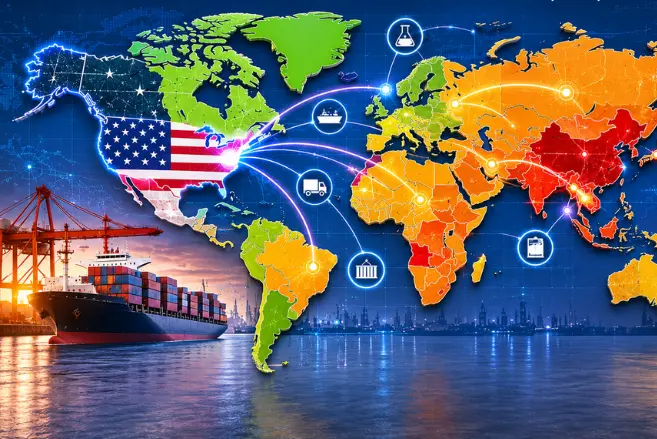
Labor costs in China’s industrial zones have doubled since 2015. Environmental regulations are now enforced aggressively, adding $50-100 per ton in compliance costs for chemicals like caustic soda and TiO2. Electricity costs have risen 35% since 2020. Meanwhile, geopolitical risk has spiked—tariffs on Chinese chemicals in the US and EU, export controls on precursor chemicals, and the general unpredictability of US-China relations have made single-source reliance on China increasingly risky for procurement teams answerable to risk-averse leadership.
The result: Chinese producers are losing margin, and international buyers are actively looking elsewhere. Procurement managers who spent two decades optimizing for “lowest-cost Chinese supplier” now face board-level pressure to diversify geographically. This creates a window for emerging producers in India, the Middle East, Southeast Asia, and Eastern Europe to capture market share from Chinese suppliers.
India: The Emerging Chemical Powerhouse
India is the fastest-growing alternative to China for bulk chemical sourcing. India’s chemical industry is expanding at 8-10% annually, supported by government incentives (the PLI scheme offers subsidies for chemical manufacturing), lower feedstock costs, and an ambitious government goal to capture 15% of global chemical production by 2030.
India’s advantages for bulk buyers are concrete. Labor costs remain 40-50% lower than China. Environmental enforcement is improving (though still weaker than EU/US standards) but suppliers know compliance is increasingly non-negotiable for exports. Feedstock costs for basic chemicals are competitive because India imports crude oil at world prices and has efficient refining capacity.
Where India is competitive right now: caustic soda, soda ash, sodium salts, basic organic acids, and pharmaceutical intermediates. Lead times from Gujarat and Maharashtra ports (JNPT, Mundra) are 4-6 weeks to most markets, comparable to China. Pricing per metric ton for bulk orders is typically $30-50/MT below Chinese equivalents, though quality control is where procurement teams need to focus.
The Indian disadvantage: consistency. Chinese suppliers have spent decades perfecting quality control for commodity chemicals. Indian producers are scaling faster than they’re standardizing quality. This means that when sourcing Indian chemicals in container-load quantities, incoming testing and CoA verification are non-negotiable. But the cost savings and supply diversification benefit often justify the additional quality gate investment.
Sourcing strategy for India: Start with one container of any new Indian supplier, require third-party CoA testing on arrival, and don’t scale to multi-container contracts until you’ve validated quality consistency across three consecutive shipments. The relationship-building investment pays off within 6-12 months.
Middle East: Low-Cost Feedstock, Petrochemical Advantage
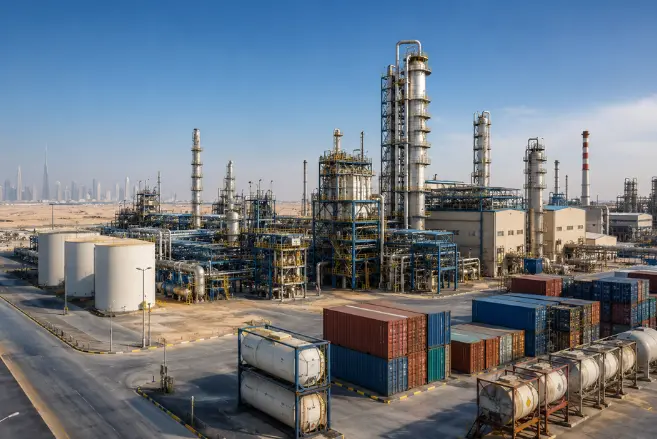
Saudi Arabia, UAE, Oman, and Qatar are investing heavily in chemical downstream production. These countries have three structural advantages: abundant natural gas (the feedstock for ethylene, propylene, and downstream polymers), cost of capital to build modern plants, and willing political support for industrial development.
The Saudi Aramco and SABIC expansion is the headline, but the broader story is capacity creep. Entire petrochemical complexes designed from scratch in the last 5 years now are at full production. These new plants produce to modern ISO standards and compete on cost. New capacity in ethylene crackers in Saudi Arabia and the UAE is generating spot supplies of ethylene and propylene at 20-30% below European levels, which cascades down to derivative pricing across all downstream chemicals.
Where Middle East producers are gaining share: polyolefins, basic aromatics (benzene, toluene, xylene), ethylene glycol (MEG), and ammonia. For buyers of these chemicals, the Middle East is becoming a viable primary source, not an alternative.
The Middle East opportunity is most valuable for companies buying high-volume commodity petrochemicals. Container-load quantities of MEG from Saudi Arabia trade at $450-500/MT CIF Asia, compared to $550-650 from European or US sources. That’s meaningful savings on annual contracts.
Sourcing risk in Middle East: geopolitical concentration. Sourcing 30% of your caustic soda from India and 30% from Middle East means you’re exposed to regional instability (Red Sea disruptions, sanctions regimes, internal political shifts). Procurement teams should view Middle East supplies as cost-advantaged, not as primary diversification. Combine with India or Eastern Europe sources to achieve genuine supply chain resilience.
Vietnam and Southeast Asia: Specialty Chemicals Growth
Vietnam, Thailand, and Indonesia are emerging as regional hubs for specialty chemicals. Vietnam’s government is actively promoting chemical manufacturing as part of its manufacturing diversification strategy (moving away from sole reliance on electronics and textiles).
Vietnam’s competitive advantage is precision manufacturing for fine chemicals, not commodity bulk chemicals. Acetone, methyl ethyl ketone (MEK), and other specialty solvents are areas where Vietnamese producers are becoming internationally competitive. Lead times are 6-8 weeks from Ho Chi Minh City. Pricing is typically 10-15% below Chinese or European equivalents for specialty solvents.
The catch: Vietnamese producers typically operate at smaller scales, so minimum order quantities are often 10-20 MT per shipment rather than full 20-25 MT containers. This makes them less ideal for large-scale bulk procurement but more suitable if you’re sourcing specialty items in multi-ton quantities.
Strategic use for Southeast Asia: Fill specialty chemical gaps in your India/Middle East sourcing strategy. Use Southeast Asia for lower-volume specialty items that don’t warrant container-load orders from China or Europe.
Eastern Europe: Niche Strength in Oleochemicals and Polymers
Poland and Romania are expanding chemical production, particularly in oleochemicals (fatty acid derivatives) and specialty polymers. These countries benefit from lower labor costs than Western Europe, proximity to EU markets (simpler regulatory alignment), and established manufacturing infrastructure.
Eastern European advantage is most pronounced for specialty polymers and oleochemical derivatives. Pricing is typically 15-25% lower than Western European equivalents. Quality standards are high because these plants export primarily to the EU.
Eastern Europe is not yet a cost-competitive alternative for commodity bulk chemicals like caustic soda or TiO2. But for specialty polymers and high-value oleochemical derivatives, Eastern Europe offers a real alternative to China, especially if you’re serving EU customers who prefer EU-origin or EU-compliant sourcing.
Container Load Sourcing Implications
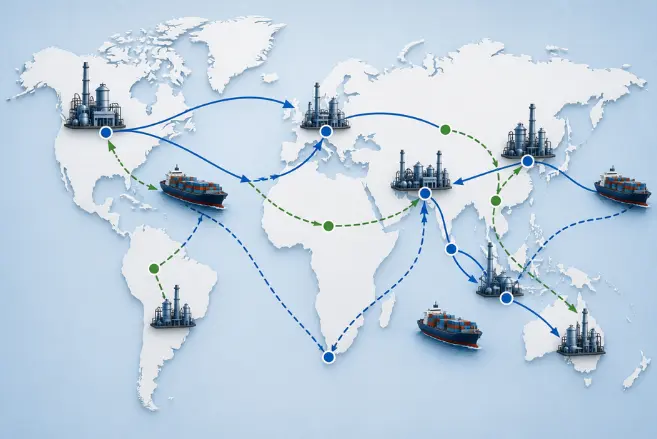
The shift from China to multiple sourcing regions has direct implications for container-load procurement. When 80% of your caustic soda came from China, you could negotiate annual contracts at consistent pricing, consistent quality, and consistent lead times. Multi-region sourcing changes the procurement model.
Here’s what changed: First, lead times are no longer standardized. China to Mumbai is 4 weeks. India to Mumbai is 2 weeks. Middle East to Mumbai is 3 weeks. Vietnam to Mumbai is 5 weeks. Your inventory calculations need to account for route-specific lead times, which means safety stock calculations become more complex.
Second, pricing per metric ton now varies significantly by origin. A kilogram of caustic soda from India costs less per MT than from China, even factoring in different quality specs and purity levels. But Middle East ethylene costs less than anywhere else in commodity petrochemicals. Your procurement team needs granular cost benchmarking by origin and chemical, not just “Chinese competitor pricing.”
Third, quality standards differ. Chinese suppliers have decades of standardization. Indian suppliers are newer to bulk export and less consistent on CoA details. Middle Eastern suppliers operate to exact specifications but sometimes with different test methods. This requires more rigorous incoming inspection and testing protocols, which increases procurement cycle time by 5-10 days per container.
Fourth, minimum container commitments are less standardized. Chinese suppliers expect multi-container contracts. Indian suppliers are flexible on smaller-than-container orders for domestic sourcing but charge premiums. Middle Eastern suppliers prefer committed contracts. Procurement teams need to negotiate MOQ and pricing per sourcing origin.
The practical implication: If you’re currently sourcing caustic soda in 5 annual containers from China at $320/MT, you might now source 2 containers from India at $280/MT, 2 containers from Middle East at $290/MT, and 1 container from China at $320/MT. You’ve cut average cost by $20-30/MT, reduced geopolitical concentration risk, and bought optionality if any single region faces supply disruption. The trade-off is more complex procurement management: more supplier relationships, more incoming testing, more forecast coordination.
Quality, Compliance, and Risk Mitigation
Emerging suppliers offer cost advantages, but procurement teams must not treat quality as a given. Emerging regions (India, Southeast Asia) have rising quality standards but not yet the 30-year track record of Chinese commodity suppliers.
Your procurement strategy should include: First, require third-party CoA testing for the first 3-5 shipments from any new supplier. After validating consistency, you can reduce testing frequency. Second, include detailed quality specifications in purchase contracts, with specific penalties for off-spec shipments. Third, negotiate force majeure terms carefully—emerging suppliers are more vulnerable to regional disruptions (port strikes, environmental inspection shutdowns, currency crises), so define what constitutes force majeure and what remains supplier liability. Fourth, lock in pricing for 12 months when you find a reliable new supplier, because emerging region suppliers often lack the financial stability of established players to absorb large price swings.
Emerging suppliers are also less familiar with buyer compliance requirements (REACH, GHS, import regulations by country). Budget an additional 2-4 weeks for your first order from any new supplier to verify documentation completeness and regulatory compliance for your import country.
Strategic Procurement Decisions
The shift from China presents a one-time strategic opportunity to restructure your supplier base with better resilience and lower cost. But the window is closing—as more procurement teams move to India and Middle East suppliers, prices will compress and lead times will stretch. Sourcing managers who move now gain 12-24 months of advantaged pricing and supply access before competitors catch up.
Here’s a decision framework: If you source a commodity chemical in container-load quantities (caustic soda, soda ash, basic acids), you should actively develop alternative suppliers in India or Middle East within the next 6-12 months. The cost savings (10-25% depending on chemical and destination) offset the procurement complexity. If you source specialty chemicals in lower volumes, focus on developing Southeast Asia relationships to cover specialty items. If you source high-spec chemicals requiring tight quality control, evaluate Eastern European suppliers for specialty polymers.
Don’t eliminate Chinese suppliers entirely. Chinese producers remain price-competitive for some chemicals, delivery is reliable, and relationship continuity has value. Instead, restructure from “majority China with small backup” to “balanced multi-region with no single region above 50%.”
How Raw Source Supports Multi-Region Chemical Sourcing
Sourcing procurement teams across emerging markets is precisely the operational challenge Raw Source exists to solve. We’ve spent years building direct relationships with reliable suppliers in India, Middle East, Southeast Asia, and Eastern Europe specifically for bulk chemical sourcing. We understand the compliance requirements, lead times, quality standards, and pricing dynamics that vary by region and by chemical.
When procurement teams at large manufacturers shift from China-centric sourcing to multi-region models, they face three challenges: First, identifying reliable suppliers in emerging regions—finding suppliers who can consistently meet your quality specs and deliver container-load quantities on schedule. Second, managing compliance and documentation across different regions where regulatory requirements and export procedures vary. Third, negotiating pricing and contract terms when you’re a first-time buyer to a new supplier in a new region.
Raw Source handles all three. Our supply chain team has vetted producers in India’s chemical manufacturing zones (Gujarat, Maharashtra, Rajasthan), Saudi Arabia and UAE’s petrochemical complexes, Vietnam’s fine chemical producers, and Poland/Romania’s specialty polymer manufacturers. We negotiate bulk pricing directly with producers and pass advantaged costs to procurement teams. We manage compliance documentation, arrange logistics from origin to your destination port, and provide CoA backup and quality assurance that new suppliers often can’t provide on day one.
More specifically, if you’re transitioning 50% of your caustic soda sourcing to India, Raw Source can source the container-load equivalent from our vetted Indian suppliers at pricing you couldn’t achieve on your own first-time. If you’re adding MEG or ethylene glycol sourcing from Middle East suppliers, Raw Source can route you to reliable producers, lock in pricing per MT, and manage the complete import logistics. The cost advantage isn’t theoretical. Procurement teams we work with typically see 12-22% total cost reduction when transitioning from 100% China sourcing to a multi-region model with Raw Source managing the sourcing and logistics. The savings come from lower origin-region pricing plus our consolidated freight negotiating leverage.
Beyond cost, there’s the compliance and quality infrastructure. When you source directly from a new Indian supplier for the first time, you’re navigating unknown documentation processes, quality verification requirements, and import regulations. Raw Source’s supply chain team has done this 50+ times. We know which Indian suppliers require additional testing beyond CoA, which regions need advance GHS documentation, which ports have faster customs clearance. That expertise compresses your onboarding timeline from 4-6 whttps://rawsource.com/shop/eeks to 2-3 weeks, which means you’re deploying multi-region sourcing faster and capturing cost advantages sooner.
We also provide risk mitigation that emerging suppliers alone can’t. If an Indian supplier hits an environmental inspection shutdown (common in India) and can’t fulfill a commitment, Raw Source’s supply chain has backup capacity with other vetted suppliers in India and Middle East to cover the gap. If a shipment arrives off-spec from a Middle Eastern supplier, our quality verification team identifies the issue before it reaches your production line, and we arrange replacement capacity from backup sources—all without escalating to your internal quality department.
For procurement teams serious about restructuring toward multi-region sourcing, Raw Source isn’t just a supplier—we’re the operational partner that makes the transition feasible and cost-effective. We manage the complexity of emerging markets so your procurement team can focus on the strategic decision.
If you’re managing a bulk chemical sourcing transition from China to emerging regions, request a sourcing strategy consultation with Raw Source. We’ll assess your current spend, identify which chemicals benefit most from multi-region sourcing, and build a transition plan that captures cost and risk benefits without disrupting your supply continuity.
What chemicals are shifting away from China most aggressively?
Commodity bulk chemicals are shifting fastest: caustic soda, soda ash, basic acids (sulfuric, phosphoric), sodium salts, and petrochemical derivatives like ethylene glycol. These chemicals have enough price sensitivity that 15-25% cost advantages from India or Middle East make sourcing changes justify themselves quickly. Specialty chemicals and high-spec products are shifting more slowly because quality consistency matters more than cost.
How do I know if an Indian or Middle East supplier is reliable?
Third-party CoA verification is the first gate. Require testing from an independent lab on the first 2-3 shipments. If CoA results match supplier claims consistently, the supplier is likely reliable. Also check whether the supplier has other bulk chemical customers with 2+ years of history—if so, they've proven they can sustain quality. Ask for references and actually call them.
Will emerging region suppliers' prices stay low, or will they increase as demand grows?
Prices will gradually increase, but not dramatically. Emerging suppliers have structural cost advantages (lower labor, cheaper feedstock, fewer environmental compliance costs) that will persist for 5-10 years. Expect 3-5% annual price increases as these regions develop, not the 10-15% increases you've seen from European suppliers. This is another reason to lock in supplier relationships now.
Should I consolidate all my sourcing to one emerging region?
No. The whole point of multi-region sourcing is to avoid concentration risk. If you source 80% from India, you're just trading China concentration for India concentration. Instead, aim for 30-35% from India, 25-30% from Middle East, 20-25% from China (if cost-competitive), and 10-15% from Southeast Asia or Eastern Europe. This diversification is worth 3-5% higher cost than going all-in on the lowest-cost single region.
What's the timeline for setting up a new supplier in an emerging region?
First order takes 8-12 weeks from initial contact to receiving the first container because you need to validate quality through independent testing and comply with your import country's documentation requirements. Subsequent orders are 4-6 weeks after you've established the relationship. This is longer than from established China suppliers (4-5 weeks), so build it into your procurement planning.
Will tariffs or trade tensions affect emerging region sourcing?
Possibly. US tariffs on Indian chemicals could emerge, similar to current tariffs on Chinese chemicals. But geopolitical risk is still lower from India or Middle East than from China because the US and India have a strategic partnership, and Middle East suppliers serve global markets diversely. Spreading sourcing across India, Middle East, and Southeast Asia gives you exposure to different geopolitical risk scenarios.