
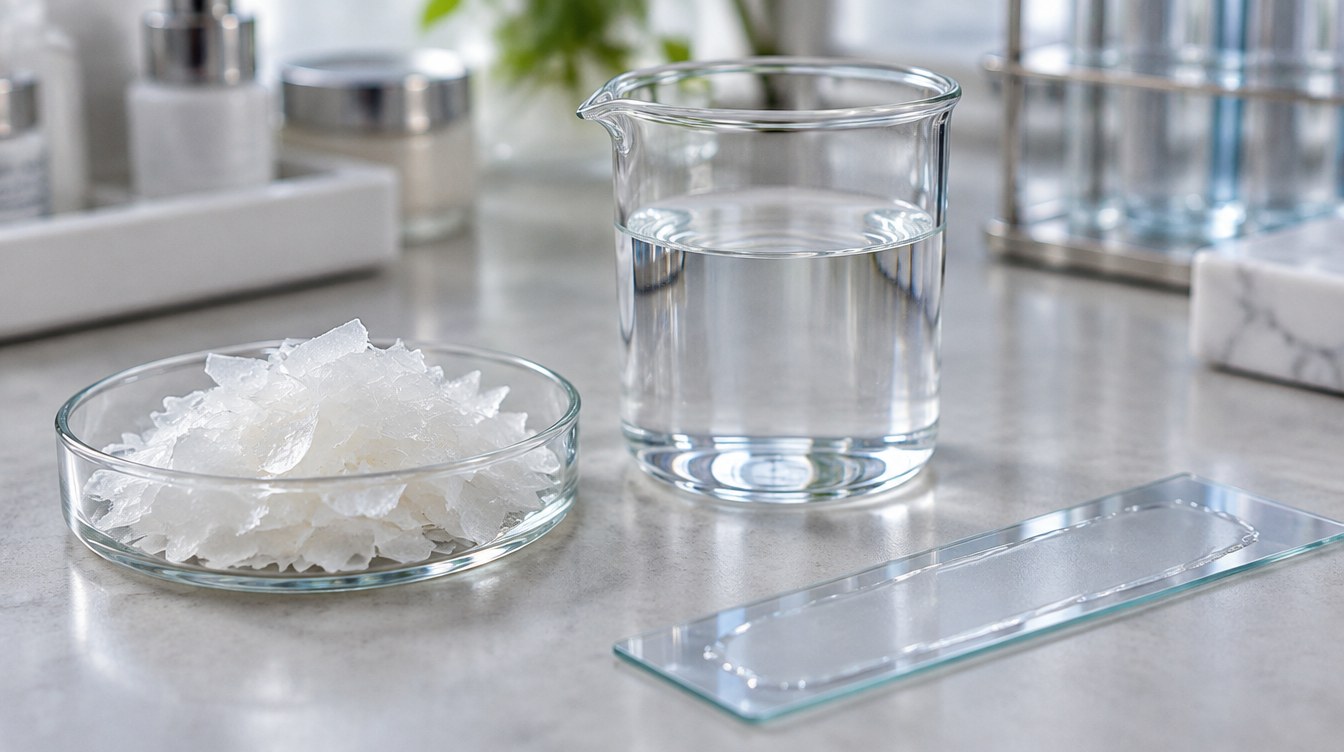
A brand owner signs off a transfer-resistant liquid lipstick and sends three questions with the approval: is trimethylsiloxysilicate a silicone, is it comedogenic, and what exactly should purchasing reorder? The formula sheet carries an INCI name and CAS 56275-01-5, and both look complete.
They are not. Neither tells a supplier whether the resin should arrive as a solid or already dissolved, which carrier comes with it, or whether the lot was made for a cosmetic or for a silicone adhesive. The first question has a one-word answer. The third decides whether the next batch films like the one the brand approved.
What is trimethylsiloxysilicate, and is it a silicone?
Yes. Trimethylsiloxysilicate (CAS 56275-01-5) is a silicone MQ resin: monofunctional trimethylsiloxy (M) units and tetrafunctional silicate (Q) units joined through silicon-oxygen bonds into a hard, three-dimensional network. In cosmetics it works as a film former, leaving a continuous silicone film that gives long-lasting hold and water resistance after the product dries.
The letters name the building blocks. An M unit is a silicon atom carrying three methyl groups and a single oxygen, so it can bond to the network only once and caps it. A Q unit is a silicon atom bonded to four oxygens that link it to neighboring silicon atoms, the same arrangement as in silica. The Q units build the rigid core, and the M units close it off and coat it in methyl groups.
That structure is why the resin is hard where dimethicone is a fluid. Dimethicone is a linear chain of dimethylsiloxane units, free to flow and spread. Trimethylsiloxysilicate is linked in three dimensions through its Q units, so it sets as a solid film instead of spreading as an oil. Both are silicones, and the methyl coat keeps both out of the water phase.
The name hides this from a quick screen. A silicone-free check that searches only for names ending in -cone or -siloxane will pass trimethylsiloxysilicate, and its -silicate ending is shared with inorganic silicates, such as sodium silicate, that are not silicones. The giveaway is the siloxy inside the name. If a brief promises silicone-free, add that fragment to the screen and read every hit.
Why PubChem’s 168.30 g/mol is the wrong number for a resin specification
PubChem’s record for CAS 56275-01-5, CID 91783, gives the IUPAC name trihydroxy(trimethylsilyloxy)silane, the formula C3H12O4Si2 and a molecular weight of 168.30 g/mol. Read the name literally and the record describes one trimethylsilyl group bonded through oxygen to a silicon that carries three hydroxyl groups. In resin terms, that is a single M unit on a single Q unit, with the Q unit’s other bonds ending in hydroxyl instead of reaching more silicon.
That is the smallest piece of the resin, not the resin. The material in the drum is a network of many M and Q units. Its molecular weight is a distribution far above 168.30 g/mol, and it depends on how the manufacturer balances caps against core. If a Safety Data Sheet (SDS) template or an ERP item master pulls its molecular weight from PubChem, every molar calculation built on that field is wrong.
Use the record for identity instead. Its synonym list carries the names a supplier’s SDS or Certificate of Analysis (CoA) may print in place of the INCI name, such as trimethylsilyl silicate and silicic acid, trimethylsilyl ester. The same list also holds two CAS-format numbers other than 56275-01-5. If a supplier document shows a different registry number, compare it with that list and ask the supplier why before the lot is released.
The name and number also travel well outside cosmetics. The catalog record lists the resin as a tackifier and reinforcing resin in silicone pressure-sensitive adhesives and industrial coatings, and as a component of automotive-care and home-maintenance products. The adhesive role is a different job, covered in MQ resin as a tackifier in silicone pressure-sensitive adhesives.
| Where the name appears | What it describes there | What it means for a cosmetic order |
|---|---|---|
| PubChem CID 91783 | One molecule, C3H12O4Si2, 168.30 g/mol | An identity cross-check, never a molecular weight for the item master |
| Cosmetic formulas | A hard network of M and Q units that leaves a continuous film for hold and water resistance | The use you are buying for: state it, with the form and the carrier |
| Silicone pressure-sensitive adhesives and industrial coatings | The same resin type working as a tackifier and reinforcing resin | Another use under the same CAS number, whose documents need not suit a cosmetic |
| Automotive and home care | A component of car-care and home-maintenance products | One more reason the CAS number alone does not identify a cosmetic grade |
How the film makes cosmetics transfer- and water-resistant
The resin does its work after the product goes on. A hard resin cannot be spread as it is, so a formula carries it in solution. Once the product is applied, a volatile carrier evaporates and leaves the resin behind as a thin, continuous film that holds pigment and other ingredients in place. The catalog record describes the result as long-lasting hold and water resistance in cosmetic formulations.
Transfer resistance and water resistance come from the same film. Pigment locked into a dried, hard layer does not smear onto a cup or a collar the way pigment in a soft oil film can. Water meets the methyl groups on the film’s surface and beads up instead of wetting it. Those are the properties that formats sold on wear ask for: long-wear lip color, foundation, mascara and water-resistant sun care, where any water-resistance claim rests on testing the finished product.
More resin does not make a better film. A film built on too much hard resin can feel tight and draggy, and on lips or skin that flex it can crack or flake. Formulators balance the resin against flexible silicone fluids or emollients that plasticize the film, so the right level belongs to the whole formula. Set it on your own wear, transfer and comfort testing, not on a level copied from another product.
Comedogenicity is the question brand owners ask next, and the identity records do not settle it. Neither PubChem’s record nor the catalog record gives trimethylsiloxysilicate a comedogenic rating, and no rating belongs on a label without a test behind it. If the finished product will carry a non-comedogenic claim, that product’s own testing decides it.
Solid resin or solution: which form are you buying?
The INCI name and CAS 56275-01-5 stay the same whatever form a lot takes, and neither PubChem nor the catalog record says what form that is. The order has to. The choice moves work and cost between the supplier and your plant, so make it on purpose and write it down.
A solid resin puts the dissolving step in your plant. The formulator picks the carrier, and the batch needs the mixing time and equipment to bring the resin fully into solution before the rest of the formula goes in. Undissolved resin cannot join an even film, so confirm it has fully dissolved before the batch moves on.
A solution arrives ready to dose, but it brings a second ingredient with it. The carrier has its own INCI name and CAS number, and it goes on your label. Its volatility decides what stays in the film: a volatile carrier evaporates and leaves the resin behind, while a non-volatile one stays and softens the film and the after-feel. A solution is also priced per kilogram of solution, so the resin content sets what you pay for the resin itself.
What to put on a trimethylsiloxysilicate order
-
Identity. The INCI name trimethylsiloxysilicate and CAS 56275-01-5, with the chemical name on the SDS and CoA checked against PubChem’s IUPAC name and synonyms.
-
Use and grade. Cosmetic use, stated in writing, and the documentation your market asks of a cosmetic ingredient. A lot made for an adhesive, coating or car-care line can carry the same CAS number and still be the wrong material for a lipstick.
-
Form. Solid resin or solution. For a solution, name the carrier by INCI name and CAS number, and state the resin content as a weight percent, measured on each lot as non-volatile content where the carrier is volatile.
-
Network consistency. Ask the supplier which measured property tracks the balance of M and Q units from lot to lot, and by which test method. Require that value on every CoA, so a new lot films like the approved one.
-
Documents. A CoA per lot, the technical data sheet (TDS) and the current SDS for the exact form you buy. A solution’s SDS covers the carrier as well as the resin, so read its hazard statements for the product as delivered.
-
Bench check. A sample against the written specification, tested in your finished formula for wear, transfer, water resistance and feel before the first full order.
Methodology: identity data for trimethylsiloxysilicate (CAS 56275-01-5, formula, molecular weight, IUPAC name and synonyms) are from PubChem CID 91783. The resin’s structure, its film-forming role and its adhesive, coating and car-care uses are from the RawSource catalog record for the product.
Frequently asked questions
Is trimethylsiloxysilicate comedogenic?
Can a silicone-free product contain trimethylsiloxysilicate?
Is trimethylsiloxysilicate the same as dimethicone?
What does film forming mean for trimethylsiloxysilicate, and where are cosmetic functions listed?
Why do two trimethylsiloxysilicate quotes not compare?
Sources & methodology
Figures are RawSource sourcing data unless attributed to a named source. Regulatory citations are current as of publication. Chemical identities verified by CAS number against the RawSource catalog.
Search 1,300+ industrial chemicals by name or CAS, or send us your spec — we quote by the drum, tote, or container.
Browse the Chemical Index → Request a Quote