
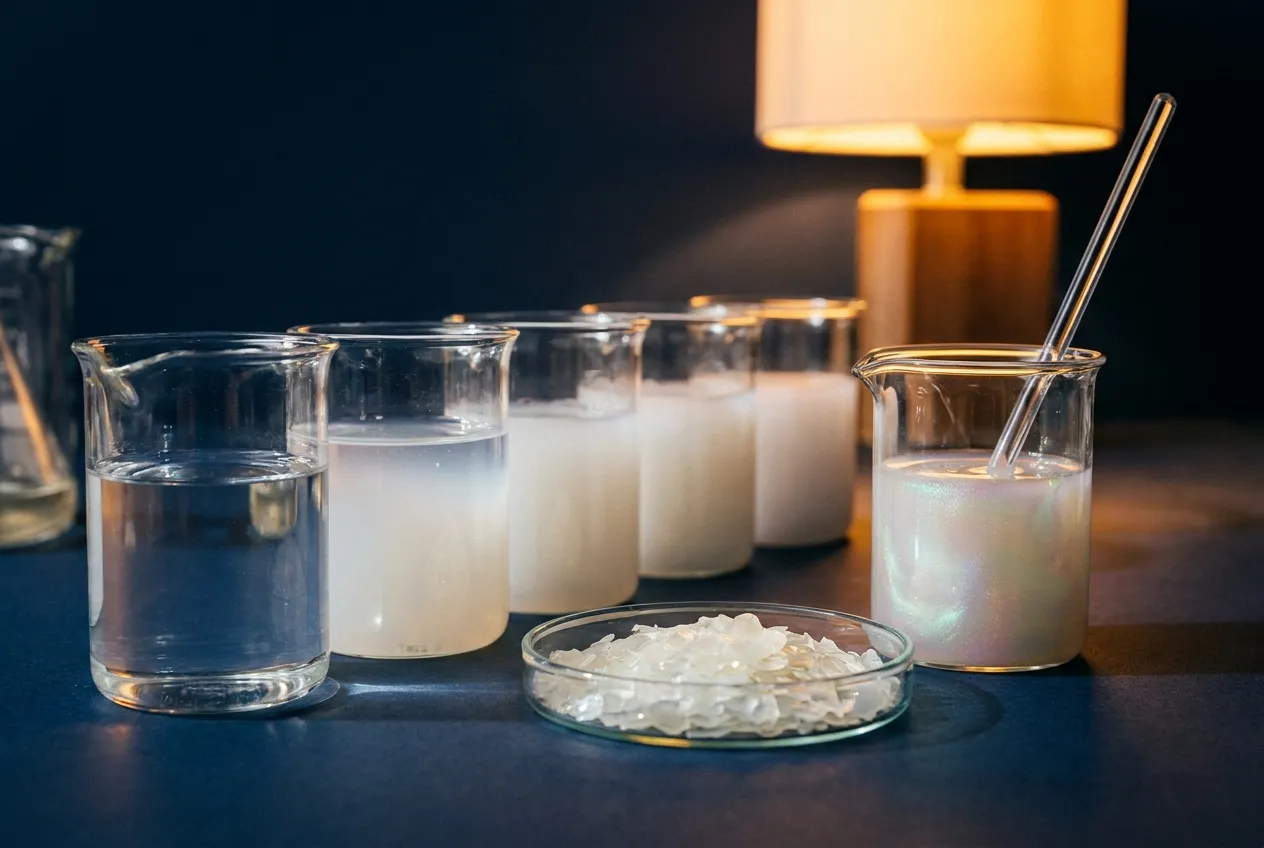
Ask the ingredient databases how to use trimethylsiloxysilicate and you get an INCI name and a safety score. Ask a formulator mid-bench and you get the real questions: how much, dissolved in what, and what will it play nicely with. Those are the answers that decide whether a long-wear formula works.
The short version: trimethylsiloxysilicate is insoluble in water and soluble in volatile silicones, isododecane, and silicone oils, so it lives in the anhydrous or oil phase. It is supplied either as 100% flake resin you dissolve yourself or as a ready-made solution, and it is used at roughly 5 to 30% depending on the product, balanced against flexible silicones so the film stays comfortable.
Solubility: where it lives in the formula
This single fact answers most “how do I use it” questions. Trimethylsiloxysilicate is insoluble in water and soluble in volatile silicones (cyclopentasiloxane, D5), isododecane, and silicone and ester oils. It belongs in the silicone or oil phase of an anhydrous system, or in the oil phase of an emulsion, never the water phase. If a formula will not clear, the resin is almost always in the wrong phase or short of carrier.
Supplied forms: flake versus solution
You can buy the resin neat or pre-dissolved, and the choice affects both the formula and the cost.
| Form | Typical active | Use it when |
|---|---|---|
| 100% flake or powder resin | 100% | you want full control and the lowest cost-per-solid, and can dissolve it in-house |
| Solution in cyclopentasiloxane (D5) | ~50% | a fast-flashing volatile-silicone carrier for long-wear color |
| Solution in isododecane | ~60–75% | a volatile hydrocarbon carrier, often chosen where cyclosiloxanes are being reduced |
| Solution in dimethicone | varies | a non-volatile carrier that stays in the film for slip and feel |
Price the resin by cost per pound of solids, not per pound of solution, and factor the handling time of dissolving flake versus dosing a ready solution.
The carrier decision: D5 versus isododecane
The carrier is not just a diluent; it is a formulation and regulatory choice. Cyclopentasiloxane (D5) is the classic volatile silicone carrier, prized for a fast, clean flash and a silky apply.
But cyclosiloxanes (D4, D5, D6) face tightening restrictions in some markets, so many formulators have moved long-wear systems to isododecane, a volatile hydrocarbon that flashes similarly without the cyclosiloxane regulatory exposure. Dimethicone is the third option when you want the carrier to remain in the film for slip rather than evaporate. Match the carrier to your apply feel, your flash needs, and the regulatory profile of your target market.
Dose and balance
Use levels run roughly 5 to 30% of the formula depending on the product, with the resin’s own film-former contribution in a lipstick often in the low single digits to around 7%.
The number is less important than the balance: too much hard MQ resin and the film feels tight and can crack, so it is offset with flexible silicones, emollients, and plasticizers. Start low, build the wear and transfer resistance you need, and stop before the film turns uncomfortable. Treat any published level as a starting point and confirm on your own panel.
Compatibility
Trimethylsiloxysilicate is broadly compatible with the silicone and oil phase: dimethicone, cyclomethicone, isododecane, ester emollients, and most pigments and pigment dispersions used in color cosmetics. It helps wet and lock pigment into the film.
The limits are the obvious ones: it will not go into the water phase, and very polar systems can cloud or destabilize, so a quick compatibility and clarity check in your actual base is worth the bench time. The mechanism behind the film is covered in how MQ resin makes cosmetics transfer-resistant, and the sun-care angle in water-resistant sunscreen film formers.
Buying trimethylsiloxysilicate in bulk
See the Trimethylsiloxysilicate product page. Tell us the supplied form and the M:Q grade you are matching and request a sample to qualify on your own formula before a bulk order.
Frequently asked questions
Is trimethylsiloxysilicate soluble in water?
No. It is insoluble in water and soluble in volatile silicones (D5), isododecane, and silicone and ester oils, so it is formulated in the silicone or oil phase, never the water phase.
What solvent do you use to dissolve trimethylsiloxysilicate?
A volatile silicone such as cyclopentasiloxane (D5), isododecane, or a silicone oil. It is commonly bought already dissolved at about 50% in D5 or 60 to 75% in isododecane to save the dissolving step.
How much trimethylsiloxysilicate is used in lipstick?
Total use often runs from single digits up to around 30% of the formula, with the resin’s film-former contribution frequently in the low single digits to about 7%, balanced against flexible silicones for comfort. Validate on your own panel.
Should I use the D5 or isododecane solution?
Both flash fast and apply silky. D5 is the classic volatile-silicone carrier; isododecane is a volatile hydrocarbon often chosen where cyclosiloxanes are being reduced. Match the carrier to your feel, flash, and target-market regulations.
What is trimethylsiloxysilicate compatible with?
The silicone and oil phase: dimethicone, cyclomethicone, isododecane, ester emollients, and most color pigments. It is not water-soluble, and very polar systems can cloud, so check clarity in your own base.
Editorial note. This article is general formulation guidance for cosmetic professionals, written for industrial and professional use. It is not safety, medical, or efficacy advice. Dose, solubility, and carrier figures are typical literature and vendor ranges to validate by trial; the Certificate of Analysis governs the material you buy. Confirm ingredient and carrier regulatory status for your target market, and consult the product Safety Data Sheet (SDS). RawSource makes no warranty, express or implied, and assumes no liability for use of this information.
Search 1,300+ industrial chemicals by name or CAS, or send us your spec — we quote by the drum, tote, or container.
Browse the Chemical Index → Request a Quote