
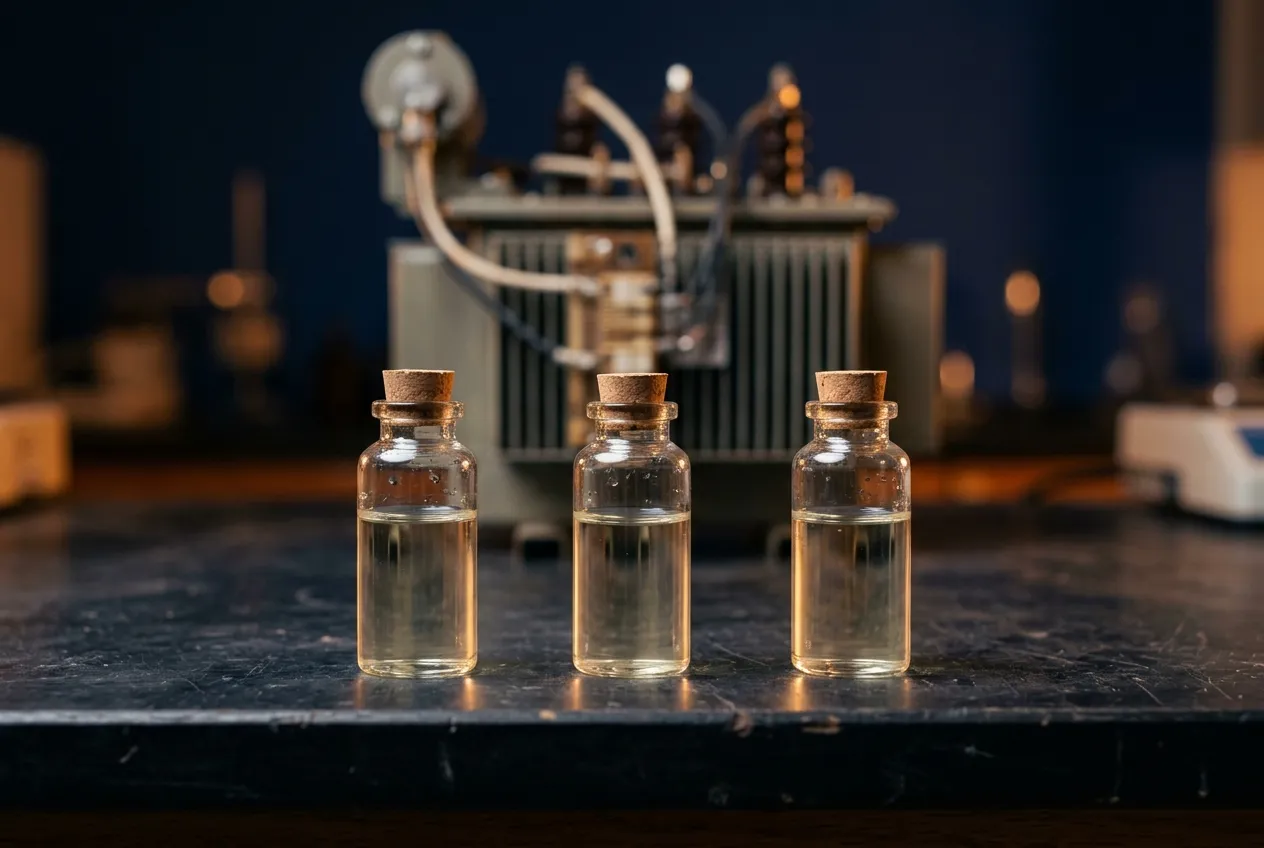
Specifying a transformer fluid is a three-way trade-off, and the marketing for each type pretends its own axis is the only one that matters. Mineral oil is cheap. Silicone is fire-safe. Ester is biodegradable. All three are true, and none of them is the whole answer. The right fluid is the one whose strength matches the constraint that actually governs your installation.
The short version: mineral oil is the low-cost, proven default, but it is flammable, with a fire point around 150 C. Silicone (PDMS) fluid is fire-safe, with a fire point above 340 C, plus high thermal stability and long life, but it is environmentally persistent and costs more.
Natural and synthetic ester fluids are both fire-safe and biodegradable, but they are less thermally and oxidatively stable, absorb moisture more readily, and also cost more. Choose by the dominant constraint: fire safety and longevity point to silicone, biodegradability to ester, and raw cost to mineral.
The three-way comparison
| Factor | Mineral oil | Silicone (PDMS) | Ester (natural / synthetic) |
|---|---|---|---|
| Fire point | ~150 C (flammable) | above 340 C (fire-safe) | ~300+ C (fire-safe) |
| Biodegradability | No | No (persistent) | Yes (readily) |
| Thermal / oxidative stability | Moderate | Very high | Lower (oxidizes more readily) |
| Moisture tolerance | Low | Low | High (hygroscopic) |
| Service life | Moderate | Very long | Moderate |
| Toxicity / halogen | Low tox, non-halogen | Low toxicity, non-halogenated | Low toxicity, non-halogenated |
| Relative cost | Lowest | Higher | Higher |
Silicone fluid here is PDMS (CAS 63148-62-9, PubChem; electrical grade per ASTM D4652); ester fluids include the natural and synthetic ester families. The silicone fluid in this comparison is RawSource’s RS-STO 50 silicone transformer fluid, the low-moisture 50 cSt grade also sold as a silicone heat transfer oil, not a generic 50 cSt silicone oil.
Where silicone wins
Silicone is the choice when fire safety, stability, and service life dominate. Its fire point above 340 C and low heat-release rate make it a less-flammable, fire-resistant dielectric fluid suitable for transformers near people or in confined and high-value locations, and its exceptional thermal and oxidation stability give it a very long, low-maintenance service life. It has low toxicity and is non-halogenated. The full property set and applications are in silicone transformer fluid: fire-safe dielectric cooling.
Where ester wins
Ester fluids win when environmental footprint is the priority. They are readily biodegradable and fire-safe, which is a combination silicone cannot offer, and their high moisture tolerance can extend solid-insulation life in some designs. The trade-offs are lower oxidative stability, which matters in hot, oxygen-exposed service, and a higher tendency to absorb water that has to be managed. For a buyer whose first requirement is biodegradability, ester is usually the answer.
Where mineral oil still wins
Mineral oil remains the default for cost-driven, outdoor, non-fire-critical installations with an established maintenance base. It is the cheapest fluid, it is well understood, and where there is no fire-safety or environmental driver, it is hard to displace on price. Its disqualifier is flammability: where a pool fire is unacceptable, it is simply off the table.
The honest verdict
There is no universally best transformer fluid. Lead with the constraint that governs the installation: choose silicone for fire safety plus the longest, most stable service life; choose an ester when biodegradability is the priority and the thermal duty allows it; choose mineral oil when cost dominates and fire and environmental risk are low. A credible supplier will tell you when your driver points away from silicone.
Buying transformer fluid
See the Silicone Transformer Fluid (RS-STO 50) product page. Tell us your transformer rating, fire and environmental requirements, and standards, and request the specification. The drop-in story for existing PDMS systems is in RS-STO 50 in existing 50 cSt PDMS transformers.
Frequently asked questions
Is silicone or ester transformer fluid better?
Neither universally. Silicone is fire-safe with the highest thermal stability and longest service life but is not biodegradable; ester is both fire-safe and biodegradable but less thermally stable and more hygroscopic. Choose silicone for fire and longevity, ester for biodegradability.
What transformer fluid has the highest fire point?
Silicone (PDMS) fluid, with a fire point above 340 C, is among the highest, well above mineral oil’s roughly 150 C and comparable to or above ester fluids. It is classified as a less-flammable, fire-resistant fluid under IEC 60836.
Which transformer fluid is biodegradable?
Natural and synthetic ester fluids are readily biodegradable. Mineral oil and silicone (PDMS) fluid are not; silicone has low toxicity and is non-halogenated but environmentally persistent.
Why is mineral oil still used if it is flammable?
Cost and an established base. Mineral oil is the cheapest, best-understood fluid, so it remains the default for outdoor, non-fire-critical installations. It is ruled out where fire safety or biodegradability is required.
When should I choose silicone over ester transformer fluid?
When fire safety, thermal and oxidative stability, and long maintenance-free service life are the priorities, especially in hot or high-duty service, and biodegradability is not a governing requirement. For an environmental-footprint-first decision, ester is usually preferred.
Editorial note. This article is general technical and procurement guidance for electrical and industrial professionals and is not engineering or regulatory advice. Comparative fire, environmental, stability, and cost characteristics are typical, generalized properties of each fluid class and vary by specific product and grade; they are not guarantees. Fluid selection and standards compliance must be confirmed for your transformer, installation, and jurisdiction. The Certificate of Analysis governs the material you buy. Always consult the current Safety Data Sheet (SDS) before handling. RawSource makes no warranty, express or implied, and assumes no liability for use of this information.
Search 1,300+ industrial chemicals by name or CAS, or send us your spec — we quote by the drum, tote, or container.
Browse the Chemical Index → Request a Quote