
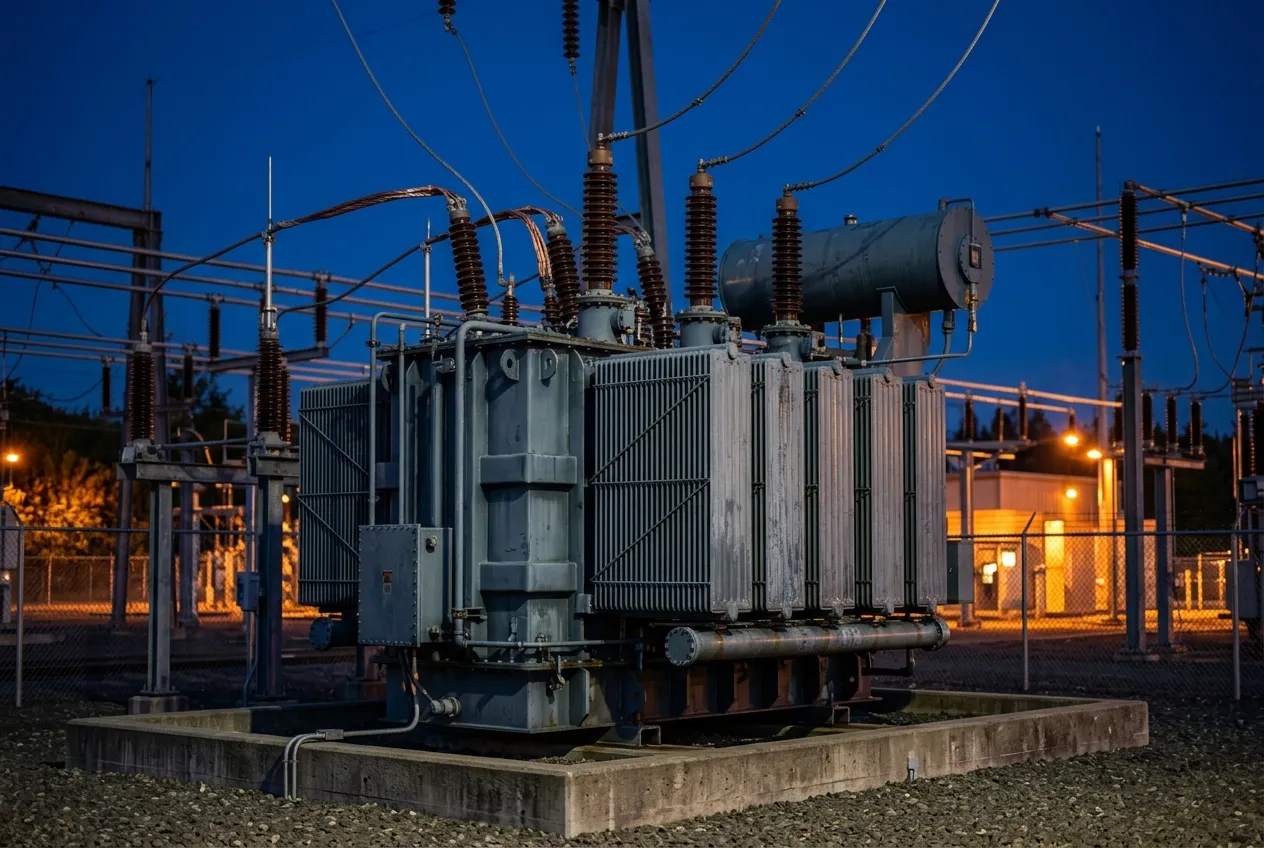
A transformer that fails inside an occupied building, a road or rail tunnel, a mine, or an offshore platform is not just an electrical problem. If it is filled with conventional mineral oil, an arc can ignite a pool fire, and the consequences are measured in lives and shutdowns, not just hardware. Silicone dielectric fluid exists to take that fire risk off the table while still cooling and insulating the transformer.
The short version: silicone transformer fluid is a 50 cSt polydimethylsiloxane (PDMS) dielectric liquid. It is a less-flammable, fire-resistant (K-class) coolant and insulant with a fire point above 340 C, far above mineral oil’s roughly 150 C, plus high thermal and oxidation stability and strong dielectric properties (breakdown voltage 50 kV, volume resistivity on the order of 10^14 ohm-cm). It has low toxicity and is non-halogenated and meets IEC 60836. See the Silicone Transformer Fluid (RS-STO 50) product page.
What silicone transformer fluid is
Silicone transformer fluid is polydimethylsiloxane (PDMS, CAS 63148-62-9, PubChem) at a 50 cSt viscosity, the grade established for electrical use under ASTM D4652 and IEC 60836. It is a crystal-clear liquid that carries no additives, which is part of why it ages so slowly. It is the same purified silicone heat transfer oil used in thermal systems, not a generic 50 cSt silicone oil; transformer cooling is one application of it, and its broader heat-transfer role is covered in silicone heat transfer oil.
| Property | Typical value |
|---|---|
| Chemistry | Polydimethylsiloxane (PDMS), 50 cSt |
| Density at 25 C | 0.96 g/cm3 |
| Viscosity at 25 C | 50 cSt |
| Flash point (open cup) | 300 C |
| Fire point (open cup) | above 340 C |
| Breakdown voltage | 50 kV |
| Volume resistivity at 25 C | ~1 x 10^14 ohm-cm |
| Permittivity at 25 C | 2.5 |
| Dissipation factor at 25 C | 0.0001 |
| Thermal conductivity | 0.151 W/(m.K) |
| Specific heat | 1.51 kJ/(kg.K) |
| Pour point | below minus 50 C |
| Standards | IEC 60836, ASTM D4652 |
Values are typical reference figures; the Certificate of Analysis governs the lot you buy.
The fire-safety case
This is the reason silicone fluid exists in this market. Mineral transformer oil has a fire point around 150 C; silicone fluid’s is above 340 C, and it releases heat far more slowly if ignited. That puts it in the less-flammable, fire-resistant category (often called K-class insulating liquid under IEC 60836), which is what lets a transformer be installed where a flammable-oil unit would be unacceptable or would demand expensive fire barriers and vaults. The fire margin is the headline benefit.
Dielectric and thermal performance
Fire safety is only useful if the fluid still does the transformer’s job, and silicone fluid does. Its breakdown voltage of 50 kV and volume resistivity on the order of 10^14 ohm-cm give it the dielectric strength to insulate, and its thermal conductivity and specific heat give it the heat-transfer capacity to cool. It performs across a wide temperature range, with a pour point below minus 50 C for cold climates, and it is compatible with the solid insulating materials used in transformers.
Stability and service life
Silicone fluid is highly resistant to thermal breakdown and oxidation, and because it contains no additives there is nothing to deplete. In practice that means very long service life and low maintenance, which offsets a higher purchase price than mineral oil over the life of the asset. It is also low-toxicity and non-halogenated, so it avoids the PCB and halogenated-fluid legacy that haunts older fire-resistant coolants.
Where it is used
Silicone transformer fluid is specified where fire risk, location, or environment rule out mineral oil:
- Transformers inside or near occupied buildings, hospitals, and public spaces
- Traction and rail transformers
- Mining, tunnel, and underground installations
- Offshore and marine equipment
- Data-center and critical-infrastructure transformers
- Any site where a less-flammable, fire-resistant dielectric fluid is required
The honest environmental position
Silicone fluid has low toxicity and is non-halogenated, which are real, specific advantages. It is not, however, a “green” or readily biodegradable fluid; PDMS is environmentally persistent and degrades only slowly. Where biodegradability is the priority, natural and synthetic ester fluids lead, at the cost of some thermal stability and a higher tendency to absorb moisture. The honest selection trade-off is laid out in silicone vs ester vs mineral transformer fluid.
Buying silicone transformer fluid
RS-STO 50 is a 50 cSt PDMS fluid meeting IEC 60836 and ASTM D4652, and it serves as a drop-in replacement for other 50 cSt PDMS transformer fluids, as detailed in RS-STO 50 in existing 50 cSt PDMS transformers. Tell us your transformer rating and standard requirements for a quote.
Frequently asked questions
What is silicone transformer fluid?
It is a 50 cSt polydimethylsiloxane (PDMS) dielectric liquid used to cool and insulate transformers. It is a less-flammable, fire-resistant fluid with a fire point above 340 C, high thermal stability, and strong dielectric properties, meeting IEC 60836 and ASTM D4652.
Why use silicone fluid instead of mineral oil in a transformer?
Fire safety. Mineral oil has a fire point around 150 C and can sustain a pool fire; silicone fluid’s fire point is above 340 C with a low heat-release rate, so it is specified where a transformer is near people or in a fire-sensitive location. It also lasts longer and has low toxicity and is non-halogenated.
Is silicone transformer fluid biodegradable?
No. PDMS has low toxicity and is non-halogenated but is environmentally persistent and not readily biodegradable. Where biodegradability is the priority, natural or synthetic ester fluids are the better choice, with some trade-off in thermal stability.
What standards does silicone transformer fluid meet?
Confirm the specification for your application.
What is RawSil HT-50?
RawSil HT-50 is the former product name for RS-STO 50, RawSource’s 50 cSt PDMS silicone transformer and heat-transfer fluid (also designated STO-50). The grade is unchanged: it meets IEC 60836 and ASTM D4652 and is a drop-in replacement for other 50 cSt PDMS dielectric fluids.
Editorial note. This article is general technical and procurement guidance for industrial and electrical professionals and is not engineering, safety, or regulatory advice. Physical, dielectric, and fire-property figures are typical reference values from the product technical data; they are not a guaranteed specification, and the Certificate of Analysis governs the material you buy. Fluid selection, fire classification, and standards compliance (IEC 60836, ASTM D4652) must be confirmed for your transformer, installation, and jurisdiction. The fluid is for industrial and professional use and is not represented as suitable for medical, pharmaceutical, or food use. Always consult the current Safety Data Sheet (SDS) before handling. RawSource makes no warranty, express or implied, and assumes no liability for use of this information.
Search 1,300+ industrial chemicals by name or CAS, or send us your spec — we quote by the drum, tote, or container.
Browse the Chemical Index → Request a Quote