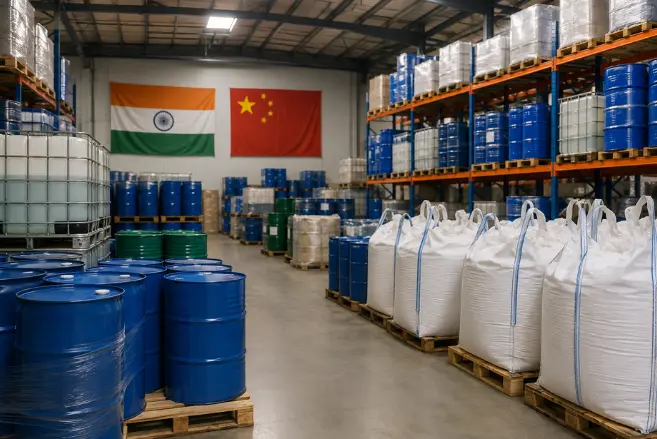
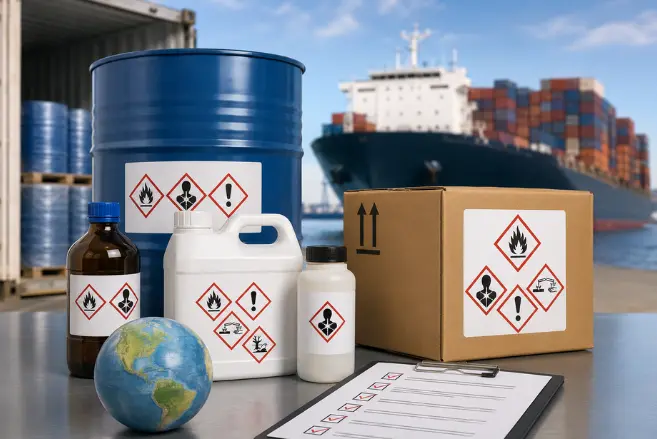
GHS labeling requirements for imported industrial chemicals are defined by the destination country’s specific regulatory implementation, not by the generic UN Globally Harmonized System. The six mandatory label elements (product identifier, signal word, hazard statements, precautionary statements, pictograms, and supplier identification) must be present on every compliant label. A label meeting Chinese GB 30000 export standards does not automatically comply with EU CLP or US HazCom 2012. Non-compliance is discovered at the port, where demurrage begins at $75-$150 per day and re-labeling costs $800-$2,500 per container. As an industrial chemical distributor, Raw Source provides destination-market-format SDS and GHS compliance confirmation on every shipment.
This guide addresses GHS labeling requirements specifically for imported industrial chemicals, covering the six mandatory elements, how implementation differs across the US, EU, India, and China, what procurement teams must verify before goods leave origin, and how non-compliance plays out at the port of entry.
What Is GHS Labeling and Why Does It Vary by Country?
GHS labeling is a standardised system for communicating chemical hazard information on container labels, developed by the United Nations and published as the Globally Harmonized System of Classification and Labelling of Chemicals (the “Purple Book“). It defines six mandatory label elements, a set of standardised pictograms, and a structured classification system for physical, health, and environmental hazards.
The GHS was designed to replace the patchwork of national chemical labeling systems that previously required the same chemical to carry different labels in different markets. It has largely succeeded, over 75 countries have adopted GHS in some form. But “harmonised” does not mean identical. Each adopting country selects which GHS revision to implement, which hazard categories to include, which building blocks to adopt or modify, and what language requirements apply. The result is a system that is more consistent than its predecessor but still requires destination-market-specific label verification for every import shipment.
The 6 Required GHS Label Elements
A GHS-compliant label must include exactly six mandatory elements. Missing any one of them constitutes a non-compliant label under every major GHS implementation.
Element | Description | Common Errors |
Product Identifier | Chemical name, CAS number, or mixture trade name that identifies the substance | Using trade name only without chemical identity; CAS number absent |
Signal Word | Either “Danger” (more severe) or “Warning” (less severe), one per label | Using both signal words; omitting signal word entirely |
Hazard Statements | H-codes describing the nature and degree of hazard (e.g., H314: Causes severe skin burns and eye damage) | Incomplete H-codes for all applicable hazard categories; using outdated H-code versions |
Precautionary Statements | P-codes covering prevention, response, storage, and disposal (e.g., P260, P264, P301+P330+P331) | Omitting P-codes entirely; selecting non-applicable P-codes |
Pictograms | GHS standardised hazard symbols within a red diamond border, applicable symbols for the chemical’s hazard classification | Missing applicable pictograms; using non-GHS symbols |
Supplier Identification | Name, address, and telephone number of the chemical’s manufacturer or importer responsible for placing it on the market | Listing only a trading company without the legally responsible party |
Signal word selection: frequently misapplied on imported chemical labels. “Danger” applies to the most severe hazard categories within each hazard class, for example, Category 1 and 2 acute oral toxicity. “Warning” applies to less severe but still hazardous categories. A chemical with multiple hazard classifications that would individually warrant both “Danger” and “Warning” uses only “Danger”, the more severe signal word always takes precedence. A label bearing both signal words is non-compliant.
Pictogram selection: must reflect the chemical’s actual hazard classification. The nine GHS pictograms cover: flammable (flame), oxidising (flame over circle), acute toxicity-severe (skull and crossbones), health hazard/carcinogen (exclamation mark for lower severity or health hazard symbol for serious effects), corrosive (corrosion), compressed gas (gas cylinder), explosive (exploding bomb), environmental hazard (environment), and respiratory/skin sensitiser (exclamation mark). A corrosive acid arriving without the corrosion pictogram, regardless of why, will not clear a trained customs inspector at a port with hazmat inspection protocols.
Supplier identification: must list the legally responsible party for placing the chemical on the destination market, not just the manufacturer. For imported chemicals, this is typically the importer of record or the authorised representative. A label listing only the Chinese or Indian manufacturer’s name is non-compliant under EU CLP, where the EU-based importer or only representative must be identified.
How Do GHS Labeling Requirements Differ by Import Destination?
Procurement teams sourcing from international origins must verify that their supplier’s label meets the specific requirements of the destination market, not just the origin market or the generic UN GHS standard.
Country / Region | Implementing Standard | Effective Date | Language Requirement | Key Differences from UN GHS |
USA | OSHA HazCom 2012 (29 CFR 1910.1200) | June 2016 (fully phased in) | English | Adopts GHS Rev. 3; some building blocks not adopted |
European Union | 2010 (mixtures) / 2015 (substances fully phased) | All official EU languages of market placement | Based on GHS with EU-specific hazard categories; SVHC labeling additional | |
India | MSIHC Rules 1989 (amended); BIS IS 13252 | Ongoing implementation | English | Partial adoption; harmonisation ongoing |
China | GB 30000 series (adopted 2015, revised 2020) | 2020 revision effective | Mandarin Chinese | Modifications to several hazard categories; own pictogram set in some cases |
Japan | JIS Z 7253:2019 | 2019 | Japanese | Largely aligned with GHS Rev. 7 |
Australia | Safe Work Australia, Model WHS Regulations | Varies by state | English | GHS Rev. 7 adopted 2021 |
US HazCom 2012 adopts GHS Revision 3, not the most recent revision. This creates a version mismatch for suppliers using current UN GHS Rev. 9 or Rev. 10 H-codes and P-codes. Most H-codes and P-codes are backward-compatible, but specific changes in classification criteria between revisions can produce labeling discrepancies that a US customs or OSHA inspection will flag.
EU CLP is the most demanding implementation for imported chemicals. It requires labels in the official language of every EU member state where the chemical is placed on the market. A shipment to Germany requires German-language labels; a shipment sold across three EU markets requires three-language labels. The EU also requires additional labeling for Substances of Very High Concern (SVHCs) under REACH, which must be disclosed on labels even when the SVHC is present below the general concentration threshold in some contexts.
India’s GHS implementation remains the most variable. The Manufacture, Storage and Import of Hazardous Chemicals (MSIHC) Rules 1989 (as amended) require hazard communication for listed chemicals, and BIS IS 13252 adopts GHS principles, but enforcement consistency and the list of chemicals covered continue to evolve. Procurement teams importing into India should require both an English-language GHS-compliant label and an SDS that references IS 13252, and should verify current requirements for their specific chemical category with their customs broker before shipment.
China’s GB 30000 series adopted GHS with modifications, including its own approach to certain hazard category thresholds. Chinese-manufactured chemicals for export carry labels compliant with Chinese domestic standards, these are not automatically compliant with EU CLP or US HazCom 2012. Sourcing managers buying from Chinese origin suppliers should explicitly specify the destination-market label standard in the purchase order, not assume the supplier will default to destination compliance.
What Must Procurement Teams Verify for GHS Compliance Before Goods Leave Origin?
The most expensive GHS compliance failures happen when non-compliance is discovered at the destination port, not before shipment. A pre-departure label verification process eliminates the majority of port-hold risk. These are the checks that procurement and logistics teams must complete before issuing a release to ship.
- Confirm the label standard matches the destination market: Request a label sample or label artwork from the supplier and verify it against the destination country’s specific GHS implementation, not against the UN GHS Purple Book generically
- Verify language compliance: Confirm the label language is the required language(s) of the destination market, English for US/India, member state language(s) for EU, Mandarin for China
- Check signal word accuracy: Verify the signal word (Danger or Warning) matches the chemical’s hazard classification for the destination market’s hazard category scheme
- Confirm all applicable pictograms are present: Cross-reference the chemical’s SDS Section 2 (hazard identification) against the label pictograms, every hazard class with a GHS pictogram must appear on the label
- Verify H-codes are complete and version-appropriate: Confirm H-codes cover all applicable hazard categories under the destination market’s GHS revision, not just the origin market’s standard
- Confirm supplier identification lists the legally responsible party: For EU imports, this must be the EU-based importer or only representative, not the non-EU manufacturer
- For REACH-regulated substances (EU imports): Verify the REACH registration number is current and the label reflects any updated classification resulting from REACH harmonised classification and labelling (C&L)
What Happens When GHS Labels Are Non-Compliant at Port
The consequences of GHS labeling non-compliance at the port of entry are immediate, quantifiable, and often preventable. The cost structure differs by port and jurisdiction, but the pattern is consistent.
Customs hold: the shipment is placed on hold pending label verification or re-labeling. Port storage fees begin accruing immediately. At major container ports, Rotterdam, JNPT, Long Beach, storage fees for a held FCL shipment typically run $75–$200 per day after the free demurrage period expires.
Re-labeling at port: where permitted, the importer may arrange re-labeling at the port warehouse. This requires: sourcing compliant labels (minimum 24–48 hours), arranging a bonded warehouse operator to access the containers, labour for relabeling each drum or container unit, and reinspection. Total cost for a 20-foot container of drums: $800–$2,500 depending on jurisdiction, drum count, and complexity.
Shipment rejection: at ports or for chemical categories where re-labeling at port is not permitted, the shipment is returned to origin at the importer’s cost. Return freight on an FCL chemical shipment from Europe or Asia: $2,000–$6,000 in freight alone, plus re-export documentation and demurrage at origin.
OSHA liability (US): importers who distribute non-compliant GHS-labeled chemicals in the US workplace supply chain face OSHA HazCom citation risk. Willful violations carry civil penalties up to $156,259 per violation as of 2025. This liability attaches to the importer of record, regardless of whether the non-compliance originated with the overseas supplier.
The cost of a pre-shipment label review, typically $0 in procurement team time against a label sample the supplier emails, is not comparable to the cost of a port hold or return shipment. The risk is entirely front-loadable with a structured pre-departure checklist.
How Raw Source Ensures GHS-Compliant Documentation on Every Chemical Shipment: the pre-departure compliance check that prevents port holds is not a theoretical exercise for procurement teams sourcing from overseas suppliers. It is a documentation discipline that must be built into the supply relationship, not left to chance at loading. Raw Source supplies industrial chemical raw materials with a complete documentation package on every shipment that includes SDS in the destination-market format (HazCom 2012 for US, CLP-compliant for EU, MSIHC-aligned for India), GHS label compliance confirmation at origin, CoA, and TDS.
As an industrial chemical distributor operating with Incoterm flexibility (FOB, CIF, CFR, DDP), the documentation package travels with the goods regardless of which Incoterm the buyer selects. Sourcing managers do not need to chase label compliance documentation from an overseas manufacturer after the purchase order is placed. For buyers taking delivery on DDP terms, Raw Source handles import documentation including SDS format alignment for the destination market. For FOB buyers managing their own freight and import, the same documentation package is provided at loading, the label standard requirement must be specified in the purchase order.
The 1 MT minimum applies across all product categories; FCL is the primary operating format. Procurement teams sourcing supply chain solutions for chemical imports who need consistent documentation across multiple chemicals and multiple shipments can discuss consolidated sourcing arrangements.
GHS labeling is one element of a broader documentation compliance framework for chemical imports. Procurement teams who want a structured approach to verifying new suppliers on documentation quality, certification standards, and logistics capability will find the chemical supplier audit checklist useful as a pre-qualification framework that covers labeling compliance alongside CoA verification, ISO tank certification, and port capability confirmation.
Discuss your container-load chemical import requirements and documentation needs with our sourcing team — compliance documentation requirements should be part of every supplier conversation, not a port-of-entry discovery.
GHS Compliance Checklist for Procurement Teams Before Goods Leave Origin
Use this checklist at RFQ stage and again before issuing a release to ship on every new supplier or new chemical:
- Specify the destination market’s GHS implementation standard in the purchase order (e.g., “Label must comply with OSHA HazCom 2012 / 29 CFR 1910.1200”)
- Request a label sample or label artwork at supplier qualification stage, before first order placement
- Verify the six mandatory GHS elements are present: product identifier, signal word, hazard statements (H-codes), precautionary statements (P-codes), pictograms, supplier identification
- Confirm signal word matches the chemical’s actual hazard classification for the destination market
- Confirm all applicable pictograms are present, cross-reference SDS Section 2
- Confirm label language meets destination requirements
- For EU imports: confirm EU-based importer or only representative is named on the label; verify REACH registration status
- For US imports: confirm label is based on GHS Rev. 3 (HazCom 2012 basis) and English-language
- For Indian imports: request IS 13252 reference and confirm English-language label with your customs broker’s current guidance
- Document label confirmation in the purchase file, create an audit trail before goods depart
Frequently Asked Questions
What is the difference between GHS labeling and an SDS?
A GHS label appears on the chemical container and communicates hazard information at the point of handling, covering the six mandatory elements: product identifier, signal word, hazard statements, precautionary statements, pictograms, and supplier identification. An SDS (Safety Data Sheet) is a 16-section document providing comprehensive hazard, handling, storage, and emergency response information for workplace use. Both are required for industrial chemical imports, but the label travels with the container and the SDS is retained in the workplace safety documentation system.
Are GHS labels required for all chemicals imported into the US?
Under OSHA HazCom 2012 (29 CFR 1910.1200), GHS-compliant labels are required on all hazardous chemicals introduced into the US workplace. The determination of whether a chemical is hazardous is made by the chemical manufacturer or importer using GHS classification criteria. Non-hazardous chemicals are not subject to GHS labeling requirements, but standard product identification labeling still applies. Importers bear responsibility for ensuring all incoming hazardous chemical shipments carry compliant labels before distribution into the US supply chain.
Which elements are not required on a GHS label?
The six required elements are: product identifier, signal word, hazard statements, precautionary statements, pictograms, and supplier identification. Elements commonly included as best practice but not required by GHS include: CAS number (though the product identifier must allow chemical identification), batch or lot number, molecular formula, and purity percentage. Shipping UN numbers and transport hazard classifications are separate requirements under IMDG/DOT transport regulations, they appear on transport labels, which are distinct from GHS hazard communication labels.
Do GHS labels need to be in the language of the destination country?
Yes, for all major GHS-implementing jurisdictions. EU CLP requires labels in the official language(s) of the member state(s) where the chemical is placed on the market. OSHA HazCom 2012 requires English-language labels in the US. India's requirements specify English. China's GB 30000 series requires Mandarin Chinese. A supplier producing one-language labels for global export is producing labels that are non-compliant in most of its destination markets. Language non-compliance is among the most common causes of GHS-related customs holds at European ports.
What is the difference between a Danger and Warning signal word on a GHS label?
"Danger" indicates a more severe hazard within a given hazard class, it is assigned to the highest-severity categories (typically Category 1 and 2). "Warning" applies to less severe but still significant hazard categories (typically Category 3 and 4 within a class). A chemical may have multiple hazard classifications, some warranting "Danger" and others "Warning", in that case, only "Danger" appears on the label. A label bearing both signal words simultaneously is non-compliant under every GHS implementation.