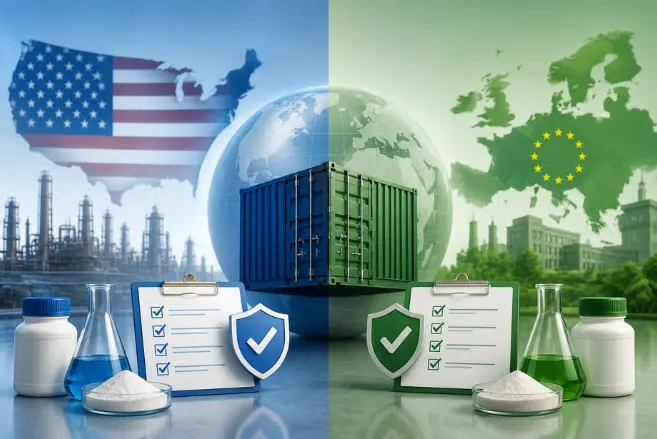
For US importers, TSCA governs what enters the country and REACH governs what your EU suppliers can legally ship, and the two regimes increasingly collide on the same molecule. A substance restricted under REACH but still legal under TSCA can leave you holding container-load inventory that your EU vendor can no longer produce. Procurement teams sourcing bulk chemicals and ingredients across the Atlantic now treat both frameworks as a single sourcing constraint, not two separate compliance silos.
The practical question is no longer “which rule applies.” It is “where do these two regimes disagree, and what does that cost me per container.”
Where TSCA and REACH Actually Diverge
TSCA, administered by the EPA, operates on an inventory model: if a substance sits on the TSCA Inventory, it can be imported, subject to any Significant New Use Rules (SNURs) or Section 6 restrictions. REACH, administered by ECHA, operates on a registration-and-authorization model: no data, no market, and SVHC candidate-list listings can force reformulation across the entire EU supply base.
The divergence matters most on three fronts. PFAS is the clearest example, where ECHA’s proposed universal restriction is years ahead of the EPA’s substance-by-substance approach under Section 6. Phthalates, certain solvents, and several reactive intermediates follow the same pattern, restricted or authorization-listed in the EU while still freely importable into the US.
Dimension | TSCA (US / EPA) | REACH (EU / ECHA) |
Model | Inventory + targeted rules | Registration + authorization |
Burden of proof | Largely on EPA | On the manufacturer/importer |
PFAS approach | Substance-by-substance | Proposed universal restriction |
Trigger for you | Import certification | Supplier’s EU registration status |
Documentation | TSCA import certification | CoA, SDS aligned to REACH dossier |
The asymmetry creates a specific risk: your EU supplier’s ability to manufacture is gated by REACH, while your ability to import is gated by TSCA. When those two timelines diverge, supply continuity breaks before any US rule changes.
The Business Impact on Bulk Sourcing
A REACH SVHC listing or authorization requirement can remove an EU grade from the market within an 18 to 36 month sunset window, even though the same grade remains TSCA-compliant. If you are buying that material in FCL quantities on annual contracts, the exposure is measured in multiple container loads, not kilograms.
Compliance cost is the second impact. TSCA import certification adds modest per-shipment administrative overhead, typically absorbed into customs brokerage. REACH-driven reformulation, by contrast, can materially shift your landed cost when a supplier moves you to a compliant alternative grade, and it resets your qualification clock.
This is also where US-side import obligations stack on top of REACH exposure, a dynamic worth reading alongside the broader picture of US import compliance for industrial chemicals.
The third impact is timing risk on letters of credit and contracts. A force majeure or regulatory-withdrawal clause triggered by a REACH sunset date can leave a signed annual contract unfulfillable mid-term. Procurement teams that wrote those contracts without a regulatory-change clause now carry the reformulation cost themselves.
Sourcing Options When the Regimes Collide
You have three practical paths when a target substance sits on the wrong side of either regime. Each carries a different cost and lead-time profile.
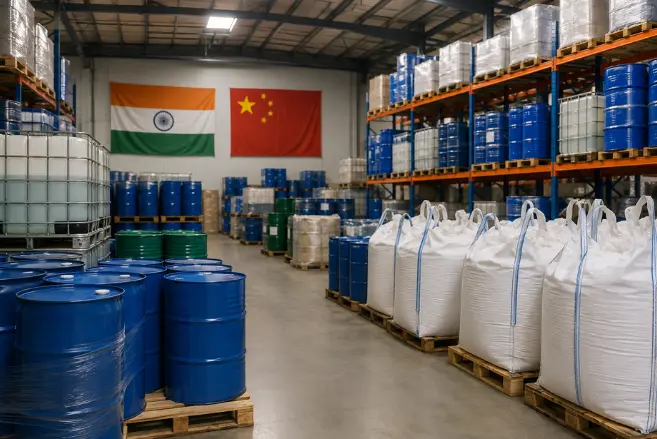
- Dual-source across regions: qualify a TSCA-compliant supplier outside the EU (India, US Gulf, Middle East) in parallel with your EU vendor, so a REACH withdrawal does not strand your supply. Budget 4 to 6 months for full qualification including CoA validation and trial batches.
- Lock pre-restriction inventory: for substances on a known REACH sunset path, negotiate forward container-load cover before the supplier’s registration lapses. This trades working-capital and warehousing cost against a hard supply cliff.
- Migrate to the compliant grade early: absorb the reformulation cost on your schedule rather than under a deadline, qualifying the alternative while your incumbent grade is still available.
Whichever path you take, verify the supplier’s actual REACH registration number and tonnage band before committing, not just a generic compliance statement. A supplier registered for 1 to 10 tonnes per year cannot legally support a multi-container annual program into the EU, and that constraint flows back to their raw-material access.
What Comes Next on the Regulatory Calendar
The EPA continues to expand Section 6 risk evaluations, and the gap with REACH is narrowing on PFAS, formaldehyde releasers, and several chlorinated solvents. Importers should expect more substances to become restricted on both sides within the next 24 to 36 months, which reduces the arbitrage window where a REACH-restricted material stays freely importable into the US.
For procurement, qualification beats waiting. Teams that have already validated a second compliant origin keep their lines running when the next SVHC listing lands. Teams that have not end up qualifying suppliers under deadline pressure, at premium pricing.
How Raw Source Manages Cross-Regime Chemical Sourcing
Running TSCA and REACH exposure at the same time is, at bottom, a sourcing-continuity problem. Raw Source works with procurement teams to keep multi-ton chemical programs supplied even when one regulatory regime tightens faster than the other. The starting point is documentation: every shipment moves with a Certificate of Analysis and an SDS aligned to the relevant regime, so your compliance file is complete before the container leaves port.
For US importers exposed to a REACH withdrawal, the practical value is access to alternative compliant origins without restarting your entire qualification process from zero. Raw Source supplies industrial chemicals in container-load and metric-ton quantities, with a 1 MT minimum, across a catalog that runs from commodity acids such as oxalic acid to solvents, silicones, and specialty intermediates. That breadth lets a procurement team consolidate a dual-sourcing strategy with one supply partner rather than qualifying a separate vendor for each contingency.
Incoterm flexibility matters here too. Whether you need FOB pricing to control your own freight and customs position, or CIF and DDP to push landed-cost and import-compliance responsibility upstream, the structure can match how your team manages regulatory risk. For substances on a known REACH sunset path, forward container-load cover can be discussed against your annual volume, so a sunset date does not become an unplanned production stoppage.
No supplier can make a REACH-restricted molecule legal again, and any vendor claiming otherwise is selling you a problem. What a sourcing partner can do is keep a compliant equivalent flowing in bulk, with the documentation your auditors and customs brokers require. Raw Source’s guidance to importers is to map regulatory exposure across both regimes first, then build sourcing redundancy against the specific substances where TSCA and REACH disagree. To pressure-test your current chemical program against both frameworks, talk to the sourcing team about your annual volumes and target origins.
Discuss Your Cross-Border Chemical Program
Map your TSCA and REACH exposure before your next contract cycle. Request a bulk quote and discuss your container-load requirements and compliant sourcing alternatives with the Raw Source team.
Frequently Asked Questions
Does TSCA compliance mean a chemical is automatically REACH compliant?
No. TSCA and REACH are independent regimes with different listing logic. A substance on the TSCA Inventory and freely importable into the US can still be restricted, authorization-listed, or unregistered under REACH, which affects your EU supplier's ability to manufacture or ship it.
What happens to my supply if a chemical is restricted under REACH but not TSCA?
Your EU supplier may lose the legal ability to produce or export it within the REACH sunset window, typically 18 to 36 months, even though importing it into the US remains legal. The practical effect is a supply cliff, so qualifying a TSCA-compliant alternative origin in advance is the standard mitigation.
Who is responsible for TSCA import certification?
The importer of record certifies TSCA compliance at the port of entry, either a positive certification that the shipment complies or a negative certification where TSCA does not apply. This is usually handled through your customs broker, but legal responsibility sits with the importing entity, not the foreign supplier.
How does REACH affect chemical pricing for US buyers?
REACH compliance and registration costs are built into EU supplier pricing, and a forced migration to a compliant alternative grade can materially shift landed cost. Sourcing the same substance from a TSCA-compliant non-EU origin can avoid REACH-driven cost escalation entirely.
What documentation should I require from an EU chemical supplier?
Require the REACH registration number and registered tonnage band, a current Certificate of Analysis, and an SDS aligned to the REACH dossier. The tonnage band confirms whether the supplier can legally support your annual container-load volume, which a generic compliance statement does not.