
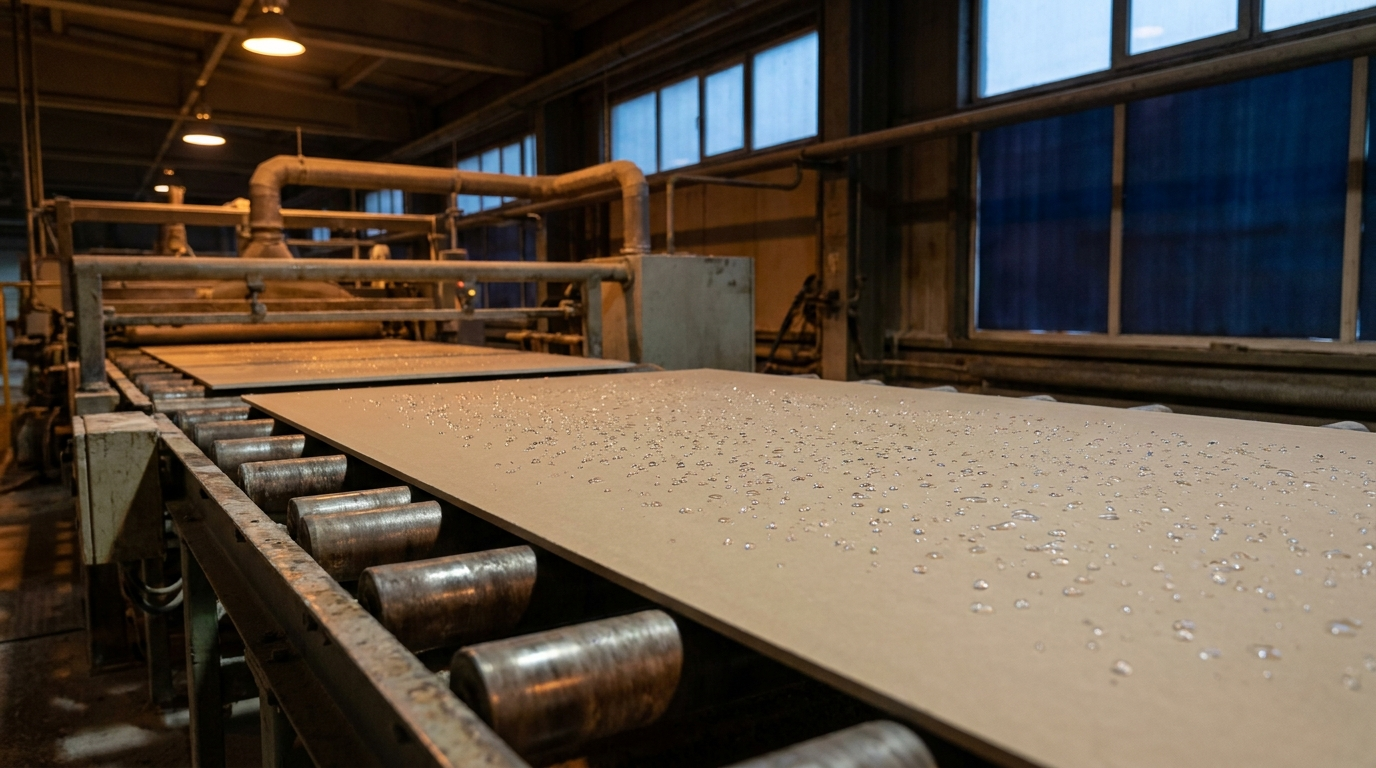
Gypsum board, also called drywall or plasterboard, is the workhorse of interior construction. It is fire-resistant, sound-dampening, and fast to hang. Its weakness is water. Untreated set gypsum (calcium sulfate dihydrate) is riddled with capillary pores, so an ordinary board can absorb 30% to 50% of its weight in water and lose much of its strength when wet. Methyl hydrogen silicone fluid is the additive that closes that gap, and this article covers how it works, how much you dose, and the specs your QC lab should hold it to.
What Methyl Hydrogen Silicone Fluid Actually Is
Methyl hydrogen silicone fluid is poly(methylhydrosiloxane), CAS 63148-57-2. It is a linear polysiloxane whose backbone alternates Si and O, with a methyl group and a reactive Si–H (silicon-hydrogen) bond on each silicon. That Si–H bond is the entire story. It is what lets a thin, inexpensive fluid bond chemically to a gypsum pore wall instead of just sitting on it.
Typical commercial grades run 15 to 45 cSt viscosity at 25°C, density near 1.00 g/mL, and an active hydrogen content of roughly 1.5% to 1.6% by weight on the high-hydrogen grades. Active hydrogen is the number that matters most for waterproofing performance, so put it on the purchase spec.
The Si–H Waterproofing Mechanism
Set gypsum is covered in surface hydroxyl (–OH) groups that love water. The Si–H bonds on the fluid react with those hydroxyls and with ambient moisture, splitting off hydrogen gas and grafting the siloxane chain onto the pore wall. A metal-salt catalyst, usually a zinc, tin, or other organometallic carboxylate, drives this crosslinking at the kiln temperatures already used to dry board, so no separate cure step is needed.
The result is a continuous, methyl-terminated film lining the inside of every capillary. Water now meets a low-surface-energy, hydrophobic surface and beads instead of wicking. You have not plugged the pores; you have made them water-repellent.
Dosing: How Much, and the Trade-off
Dose is set as a percentage of dry stucco (calcined gypsum) weight, and it is small. Most board lines land between 0.3% and 1.0% active fluid, with 0.5% to 0.8% the common sweet spot. Below that band you under-treat the pore network and water absorption climbs; above roughly 1.0% you spend more silicone for diminishing return, and excess unreacted Si–H can keep evolving hydrogen.
The honest trade-off: silicone is one of the more expensive inputs in the slurry, so over-dosing quietly erodes margin without improving the board. Dial in the minimum dose that clears your absorption spec, then hold it.
| Dose (% on stucco) | Typical water absorption | Outcome |
|---|---|---|
| 0% (untreated) | ~30–50% by weight | Standard board; fails wet-area spec |
| 0.3–0.4% | ~10–15% | Partial repellency; may miss ≤5% target |
| 0.5–0.8% | ~5–8% | Working range for water-resistant board |
| 1.0%+ | ~5–7% (plateau) | Diminishing return; cost rises, gain flat |
Absorption figures are formulation-dependent; validate on your own line.
The Spec Targets That Define Pass/Fail
Water-resistant gypsum board in North America is specified under ASTM C1396/C1396M, which consolidated the older C630 water-resistant backing-board standard. Water uptake is measured by ASTM C473: a board specimen is immersed in water for two hours and weighed.
For water-resistant board, the requirement is no more than 5% water absorption averaged across specimens, with no individual specimen exceeding 10%. A board treated with methyl hydrogen silicone fluid at the right dose typically lands in the 5% to 8% range on the core, well below the untreated 30%-plus baseline.
| Property | Standard / method | Water-resistant target |
|---|---|---|
| Water absorption (2 hr immersion) | ASTM C473 | ≤5% avg, ≤10% any specimen |
| Board specification | ASTM C1396/C1396M | Water-resistant core compliant |
| Surface water absorption (Cobb) | Cobb-style, 2 hr | Low uptake, surface beading |
| Fire-rated core (Type X) | ASTM C1396 / ASTM E119 | 5/8 in. assembly fire rating |
If you market the board for tile backing or wet areas, the ASTM C473 number is the one inspectors and spec writers will ask for, so keep it on the technical data sheet.
Why Producers Switch to It
The pull is partly performance and partly process. Methyl hydrogen silicone fluid cures on the heat the dryer already supplies, adds water repellency, mold resistance, and dimensional stability against warping and swelling, and does it at sub-1% loading. It also acts as a defoamer and wetting aid in the slurry, helping control board density.
The methyl groups do not burn readily, so the additive does not work against the gypsum core’s inherent fire performance. You keep the fire and acoustic profile of standard board and gain a water-resistant core for a small per-board cost.
Sourcing and RFQ Guidance
When you request a quote, three numbers separate a usable grade from a generic one: active hydrogen content (target ~1.5%–1.6% for high-hydrogen waterproofing grades), viscosity at 25°C (15–45 cSt), and the recommended catalyst system with its loading ratio. Ask for the certificate of analysis, the storage life (Si–H fluids slowly hydrolyze once exposed to moisture, so shelf life and sealed packaging matter), and confirmation of the CAS as 63148-57-2.
Specify whether you need neat fluid or a pre-emulsified, ready-to-meter version for a continuous board line, since metering a water-based emulsion into slurry is operationally different from handling neat fluid.
If you buy bulk methyl hydrogen silicone fluid for gypsum, plaster, or other waterproofing work and want grade options matched to your absorption spec and line conditions, send your dose target, throughput, and required ASTM C473 result, and we will source against it.
Methodology and sources
Identity and property context for Gypsum (Calcium Sulfate Dihydrate) (CAS 10101-41-4) in this guide is anchored to the compound's PubChem record. Hazard-communication framing follows OSHA's Hazard Communication Standard, 29 CFR 1910.1200. Always defer to the supplier's current SDS and CoA for the specific grade and lot you handle.
Search 1,300+ industrial chemicals by name or CAS, or send us your spec — we quote by the drum, tote, or container.
Browse the Chemical Index → Request a Quote