A procurement team switches to a new hydrochloric acid supplier to save $18/MT. Six months later, their steel pickling line starts producing inconsistent results. The investigation finds iron content in the HCl averaging 12 ppm versus the previous supplier’s consistent 3 ppm. The cost of rework and production time lost over two quarters exceeds the annual savings from the price switch by a factor of four.
Hydrochloric acid is widely treated as a commodity purchase. It is not. The difference between a well-specified HCl procurement and a poorly specified one is the difference between a stable production input and a recurring quality problem with high downstream costs. For bulk chemical suppliers and the procurement teams they serve, HCl requires the same specification discipline as any specialty chemical.
This guide covers everything a procurement team needs to buy hydrochloric acid correctly in container-load quantities: grades, specifications by application, packaging selection, pricing context, transport requirements, and the supplier evaluation criteria that actually predict quality consistency.
What Hydrochloric Acid Is and Why the Production Route Matters
Hydrochloric acid is an aqueous solution of hydrogen chloride gas (HCl) in water. The CAS number is 7647-01-0. It is also commercially known as muriatic acid, particularly in water treatment and construction chemical contexts. In industrial procurement, “HCl” and “hydrochloric acid” are used interchangeably; “muriatic acid” generally implies a technical-grade product suitable for non-critical applications.
Two production routes supply the global market, and they produce meaningfully different products:
Chlor-alkali by-product HCl is co-produced alongside caustic soda (sodium hydroxide) and chlorine in chlor-alkali electrolysis plants. Approximately 70% of global HCl production comes from this route. The key quality implication: by-product HCl can carry trace levels of chlorinated organics (chlorine gas dissolved in water, trace chlorinated hydrocarbon impurities from PVC production off-gases) that make it unsuitable for food-grade, pharmaceutical, and semiconductor applications.
Synthetic HCl is produced by direct synthesis — burning hydrogen in chlorine gas — or by the Mannheim process (reaction of sulfuric acid with sodium chloride). Synthetic HCl has a cleaner impurity profile, higher achievable concentration (up to 37–38%), and is suitable for all grades including food, pharmaceutical, and electronic applications.
The production route distinction matters for specification writing. When writing a purchase specification, require the supplier to state the production route and confirm that the impurity profile meets your application’s requirements. For applications where chlorinated organic impurities are a concern, require synthetic-route HCl and confirm the supplier’s production source.
Grades and Specifications: What to Specify for Each Application
Industrial Grade (Most Procurement Volumes)
Industrial-grade HCl is the primary product for steel pickling, water treatment pH adjustment, chemical synthesis, and ore leaching. The typical specification range:
Parameter | Specification Range | Notes |
HCl concentration | 30–33% w/w | 32–33% commands a small premium |
Iron (Fe) content | Max 5 ppm (general); max 1 ppm (pickling-critical) | Key spec for steel applications |
Free chlorine | Max 5 ppm | Higher levels cause equipment corrosion |
Sulfate (as SO4) | Max 10 ppm | Relevant for sensitive synthesis applications |
Appearance | Clear to pale yellow | Dark yellow/brown indicates contamination |
Arsenic | Max 1 ppm | Required for water treatment applications |
The iron specification is the most procurement-critical parameter for steel and metal pickling applications. Iron content in the HCl feed directly affects the rate of drag-out contamination in pickling baths. Suppliers in Shandong and Gujarat have different baseline iron levels depending on their production equipment and raw material quality. Request 6 months of CoA data before contracting to assess batch-to-batch variance, not just the single-shipment CoA.
Food Grade (E507)
Food-grade HCl must meet the Food Chemicals Codex (FCC) specifications or equivalent national standards (JECFA in international markets, FCC in the US, E507 in the EU). The critical parameters beyond industrial grade:
- Arsenic: Max 0.1 ppm (10x stricter than industrial)
- Lead: Max 0.1 ppm
- Heavy metals (as Pb): Max 1 ppm
- Sulfate: Max 10 ppm
- Appearance: Clear, colorless
Food-grade HCl requires a synthetic production route or chlor-alkali by-product from a plant with dedicated food-grade production certification. The supplier must provide a Certificate of Compliance to the applicable food safety standard on every shipment.
Electronic and Semiconductor Grade
Ultra-high purity HCl (37% concentration, trace metals below 0.1 ppb) is a specialty product with a separate supply chain. Volumes are small relative to industrial grade, pricing is a multiple of industrial grade, and the supplier pool is narrow. This grade falls outside standard commodity chemical procurement and requires a dedicated semiconductor chemical supplier evaluation process.
By-Product vs. Synthetic: Application Decision Guide
Application | By-product HCl Suitable? | Notes |
Steel pickling | Yes, if iron/organics within spec | Confirm chlorinated organic impurity profile |
Water treatment | Yes, for pH adjustment | Check arsenic and heavy metals |
Food processing | No | Requires certified food-grade, synthetic preferred |
Pharmaceutical synthesis | No | cGMP requires synthetic, certified quality |
Oil well stimulation | Yes | Inhibitor packages typically added at point of use |
PVC/chlorinated chemical synthesis | Depends | Evaluate organics profile against process requirements |
Electronic/semiconductor cleaning | No | Requires electronic grade only |
Packaging Options: Selecting Correctly for Bulk HCl
HCl is a corrosive liquid (Class 8 under IMDG, UN 1789). Packaging selection is not merely a logistics cost decision; it is a safety and quality decision.
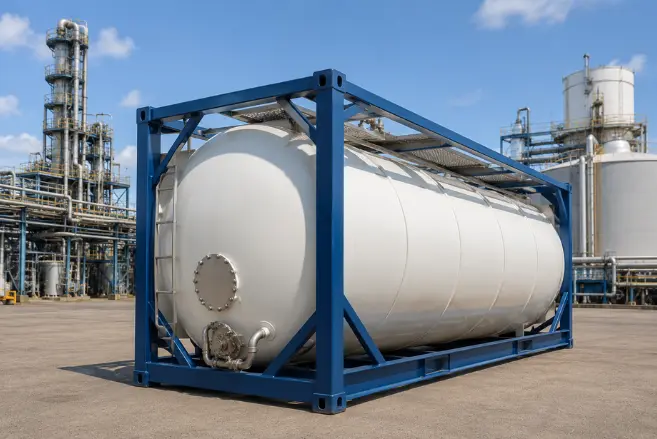
ISO Tanks (18,000–21,000 liter capacity): The preferred option for container-load quantities above 15 MT. ISO tanks for HCl must be rubber-lined (natural or synthetic rubber) or HDPE-lined to resist the corrosive acid. Stainless steel ISO tanks are not suitable for HCl. The per-MT cost of ISO tank shipping is lower than any other packaging format and is the default choice for volumes above 15 MT. Tank cleaning between HCl cargoes requires verification — cross-contamination from previous cargo is a real quality risk that responsible suppliers address with cleaning certificates.
IBCs (Intermediate Bulk Containers, 1,000–1,250 liters): High-density polyethylene (HDPE) IBCs are suitable for HCl up to 35% concentration. IBCs are the right choice for 5–12 MT orders where ISO tank economics do not apply, or where the receiving facility cannot handle ISO tank off-loading. Higher packaging cost per MT versus ISO tanks: typically $15–30/MT additional. IBCs are generally single-use for HCl due to contamination risk.
HDPE Drums (30 kg or 250–265 kg): Suitable for specialty grades, laboratory quantities, or situations where small-lot flexibility is needed. Much higher per-MT packaging cost. For container-load procurement, drums are the least cost-effective option and should only be specified when application-specific reasons require it.
Flexi tanks: Do not use for HCl. Flexi tanks are incompatible with hydrochloric acid. The polyethylene film used in flexi tank construction is not rated for Class 8 corrosive liquids, and flexitank suppliers explicitly exclude acids from their compatibility lists. This is a common and costly error: procurement teams familiar with flexi tanks from other liquid chemical procurement sometimes specify them for HCl shipments, resulting in container damage, cargo loss, and significant liability exposure.
Pricing Context and Market Dynamics
HCl is a regional commodity. The value-to-weight ratio of aqueous HCl is low enough that long-distance shipping fundamentally affects the competitive landscape. This makes HCl one of the few industrial chemicals where domestic or regional supply frequently outcompetes imported supply even for buyers accustomed to India or China sourcing for other chemicals.
Indicative price ranges (industrial grade 30–33%, 2026):
Origin | FOB Price Range (per MT, 30–33% HCl) |
India (Gujarat/Rajasthan) | $60–90/MT |
China (Shandong/Jiangsu) | $45–75/MT |
US domestic | $80–120/MT |
Europe (Germany/Netherlands) | $90–130/MT |
These are indicative ranges. Actual pricing depends on concentration, grade, quantity (single container vs. annual contract), packaging format, and market conditions at the time of inquiry.
Key price drivers: Chlorine supply (which drives by-product HCl supply) is tied to caustic soda demand. When caustic soda demand is strong and chlor-alkali plants run at high utilization, HCl by-product supply increases and prices soften. When caustic soda demand slumps, by-product HCl supply contracts and prices firm. Procurement teams tracking caustic soda market conditions are also effectively tracking HCl supply dynamics. For procurement teams in water treatment chemicals, where HCl is used for pH adjustment and chemical dosing, arsenic and heavy metals specifications are the primary qualification requirements for potable water chemical compliance.
Transport and Regulatory Requirements
HCl is classified as a Class 8 (Corrosive) Dangerous Goods substance under the IMDG Code:
- UN Number: 1789
- Proper Shipping Name: Hydrochloric Acid Solution
- Class: 8 (Corrosive)
- Packing Group: II for concentrations above 25%; III for ≤25%
IMDG packing group classification affects stowage requirements, documentation requirements, and shipping surcharges on certain carriers. Most industrial-grade HCl (30–33%) falls under PG II.
Mandatory pre-shipment documentation:
- Safety Data Sheet (SDS/MSDS) in the language of the destination country
- Certificate of Analysis (CoA)
- IMDG Dangerous Goods Declaration (signed by shipper)
- DG Packing Certificate (for packaged goods)
- Certificate of Origin
For EU-bound shipments, REACH registration confirmation for the HCl substance (CAS 7647-01-0) is required. The substance is pre-registered under REACH by numerous suppliers, but the importer bears responsibility for confirming their supplier’s REACH status.
GHS labeling on all packaging must include the corrosion pictogram (GHS05), the exclamation mark (GHS07 for lower concentration), appropriate signal word, and H/P statements for the concentration being shipped.
Supplier Selection Criteria
Production route and purity profile: Establish at RFQ stage. Get the production route, a typical impurity profile (not just CoA for one batch), and confirmation of whether the product is by-product or synthetic.
CoA consistency: Request 6 consecutive batch CoAs from the supplier’s export records. CoA variance across batches is a better predictor of incoming quality problems than any single-batch specification claim.
ISO 9001 certification: Minimum requirement for any industrial chemical supplier. Check that the certificate covers the manufacturing site relevant to your order, not just a head office or trading entity.
IMDG documentation capability: Can the supplier provide a properly completed DG Packing Certificate and IMDG Declaration, signed by a trained person? Errors in DG documentation are among the most common causes of container holds at origin and destination ports.
ISO tank cleaning records: For ISO tank shipments, request the previous cargo cleaning certificate for the specific tank to be used for your shipment.
References for similar applications: Ask specifically for references from buyers in your application area (steel pickling, water treatment, pharma) who have received consistent supply. Generic chemical customer references are not informative.
Sourcing Bulk Hydrochloric Acid Through Raw Source
Hydrochloric acid procurement involves more application-specific complexity than most commodity hydrochloric acid suppliers in the industrial chemical category anticipate. The grade selection, packaging format, and DG documentation requirements create qualification barriers that make getting the first order right significantly more important than for non-DG chemicals.
Raw Source sources industrial and specialty-grade HCl from established manufacturers in India (Gujarat and Rajasthan) and China (Shandong and Jiangsu). Both origins carry valid ISO 9001 certifications, and Raw Source’s sourcing team reviews CoA consistency data before recommending specific manufacturers for specific applications.
For steel pickling applications, Raw Source specifies iron content at maximum 2 ppm as the standard requirement for pickling-grade HCl sourced through Raw Source’s India network, which exceeds the typical industrial-grade specification and eliminates the most common source of downstream quality failure in pickling applications.
For water treatment applications, Raw Source ensures all HCl supply comes with arsenic analysis and heavy metals confirmation, as required for potable water chemical treatment compliance in most markets.
The DG logistics chain for HCl is managed by Raw Source’s logistics team, which handles IMDG documentation, packing certificates, and vessel booking for Class 8 cargo. ISO tank qualification (including previous cargo verification) is part of the standard pre-shipment checklist for all HCl container orders through Raw Source.
For food-grade HCl requirements (E507 / FCC grade), Raw Source sources exclusively from synthetic-route production with dedicated food-grade certification. Production site, batch traceability, and FCC-compliant CoA are standard documentation for food-grade orders.
Container-load quantities of HCl (15–24 MT per 20-foot container in ISO tank or IBC) are the primary order format through Raw Source. Annual contract pricing is available for buyers with recurring monthly or quarterly volumes. Contact the Raw Source sourcing team to discuss current pricing, available grades, lead times from India and China origins, and documentation requirements for your specific market.
To discuss your HCl procurement requirements, request a bulk quote with your concentration requirement, annual volume, and destination port.
Frequently Asked Questions
What concentration of hydrochloric acid is standard for industrial procurement?
Industrial-grade HCl is most commonly procured at 30–33% w/w concentration. The 32–33% range is preferred for steel pickling and most chemical synthesis applications as it minimizes transport cost per unit of active acid. Higher concentrations (35–37%) are available from synthetic-route producers but command a price premium and require more stringent handling precautions. Water treatment applications typically use 30–32% with fewer purity restrictions.
What is the difference between by-product HCl and synthetic HCl?
By-product HCl is co-produced in chlor-alkali plants alongside caustic soda and chlorine; it represents approximately 70% of global supply and can carry trace chlorinated organic impurities. Synthetic HCl is produced by direct synthesis (burning hydrogen in chlorine) or Mannheim process; it has a cleaner impurity profile and is suitable for all grades including food, pharmaceutical, and electronic applications. By-product HCl is suitable for most industrial applications at appropriate specification limits; synthetic HCl is required for regulated food and pharmaceutical uses.
Can hydrochloric acid be shipped in a flexi tank?
No. Flexi tanks are incompatible with hydrochloric acid. HCl is a Class 8 corrosive liquid under the IMDG Code, and polyethylene flexi tank film is not rated for corrosive acids. Specifying flexi tanks for HCl shipments risks container damage, cargo loss, and significant liability. The correct bulk packaging for HCl is rubber-lined or HDPE-lined ISO tanks, HDPE IBCs, or HDPE drums depending on volume and application.
What packaging is best for bulk HCl shipments?
ISO tanks (18,000–21,000 liters, rubber or HDPE lined) are the most cost-efficient option for container-load volumes above 15 MT. HDPE IBCs (1,000–1,250 liters) are suitable for 5–12 MT orders. HDPE drums are appropriate for specialty grades or small-lot requirements. The choice depends on volume, receiving facility capability, and whether the application requires single-use packaging to prevent cross-contamination.
What is the IMDG classification for hydrochloric acid?
Hydrochloric acid solution is classified as UN 1789, Class 8 (Corrosive), Packing Group II for concentrations above 25% w/w, and Packing Group III for concentrations at or below 25% w/w. Industrial-grade HCl at 30–33% falls under PG II. This classification requires a properly completed Dangerous Goods Declaration, DG Packing Certificate, and Class 8 placards on the outer packaging or container.
What impurities should I specify when buying industrial-grade HCl?
The key impurities to specify for industrial applications are: iron (Fe) content (max 5 ppm for general industrial, max 1–2 ppm for steel pickling), free chlorine (max 5 ppm), sulfate (max 10 ppm), and arsenic (max 1 ppm for water treatment applications). For applications sensitive to organic impurities, request a chlorinated organics profile from the supplier. Request 6 consecutive batch CoAs rather than a single sample CoA to assess consistency, which is more predictive of supply quality than any single-batch specification.