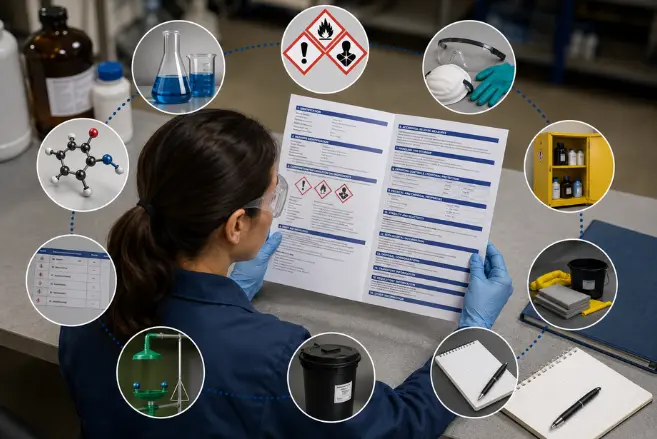
A chemical Technical Data Sheet (TDS) is a supplier-issued document specifying a chemical’s composition, purity, physical properties, packaging formats, and shelf life. It is the primary specification document for container-load procurement, the basis against which every CoA must be checked at delivery. A well-structured TDS from a qualified bulk chemical supplier reveals grade consistency, production discipline, and regulatory readiness before any purchase commitment is made.
Most procurement teams treat the TDS as a formality. Experienced sourcing managers know it is a diagnostic tool. A TDS with missing CAS numbers, single-floor purity claims, or absent test method citations signals supplier risk at FCL scale before a single MT changes hands.
This guide walks through every section of a chemical TDS, what each section must contain, and the red flags that should prompt supplier disqualification before you commit to container-load volumes.
What Does a Technical Data Sheet Tell You About a Chemical Supplier?
A TDS is not an SDS and not a CoA. Each document serves a different function in chemical procurement.
The TDS defines the specification, what the chemical should be, at what purity, in what form, under what storage conditions. It is a forward-looking commitment from the supplier. The SDS (Safety Data Sheet) covers hazard identification, handling precautions, and emergency response. The CoA (Certificate of Analysis) is batch-specific: it confirms that the actual production batch meets the TDS specification, with test results.
All three documents are required for industrial chemical procurement. But the TDS is the one that determines whether a supplier is worth qualifying in the first place.
Document | Purpose | Issued When | Controls |
TDS | Product specification | At inquiry / catalog stage | What to expect |
SDS | Hazard and safety information | At supply / regulatory requirement | How to handle |
CoA | Batch test results | At shipment | What you received |
A TDS that is vague on purity ranges, missing test method references, or dated more than three years ago signals a supplier who either cannot maintain specification consistency or does not invest in documentation quality. Both are procurement risks at container-load scale.
What Are the 8 Core Sections of a Chemical TDS?
Not all TDS documents follow the same format. Some are one page; others run to ten. Regardless of layout, a compliant, useful TDS must address eight core areas. Evaluate each one systematically before advancing a supplier to RFQ stage.
Product Identification
This section should state the chemical’s full IUPAC name, commercial name(s), CAS number, UN number (if hazardous goods), and the grade designation. Missing or ambiguous CAS numbers are an immediate red flag, they can indicate a mislabeled product, an off-spec blend, or a supplier trying to obscure origin. For a standard industrial chemical, the CAS number should match the registered identity exactly. Verify CAS numbers against authoritative chemical databases like PubChem or the CAS Registry, both freely accessible for identity confirmation.
Chemical Composition and Purity
This is the most procurement-critical section. It should state purity as a range (e.g., 98.5–99.5% NaOH), not a single threshold (e.g., “min 98%”). A stated minimum without a maximum range indicates the supplier cannot control upper-end purity consistently, relevant for applications where over-concentration causes process problems. The section must also list key impurities with quantified limits: iron content in ppm, heavy metal thresholds, chloride or sulfate limits depending on application.
Physical and Chemical Properties
This section covers appearance (color, physical state), odor, pH (at a stated concentration and temperature), density or specific gravity, boiling and melting points, flash point (for flammable materials), solubility, and viscosity where relevant. These parameters allow receiving teams to do a basic sensory and instrumental check against specification at goods receipt, before the full CoA is processed.
Quality Specifications and Test Methods
Every purity claim must cite the analytical test method used. “Assay by titration per ASTM E478” is useful. “Assay: 98.5% min” without a method reference is not. Test methods are what make specifications reproducible and verifiable. If the supplier’s TDS does not cite ASTM, ISO, IP, or an equivalent method standard, you cannot validate their CoA results against an independent reference.
Packaging and Storage Requirements
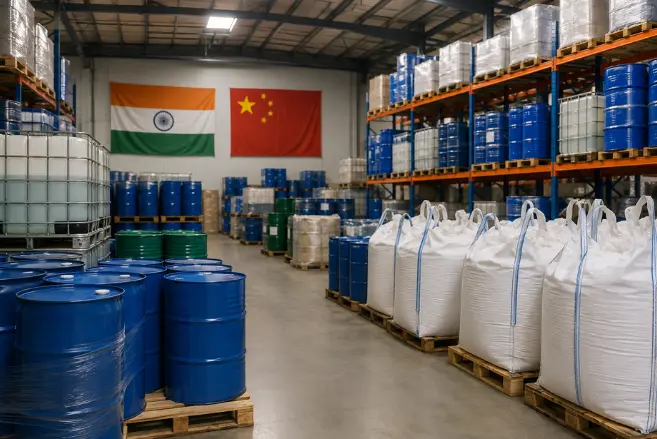
This section specifies the available packaging formats (25 kg bags, 200 L drums, 1,000 L IBCs, ISO tanks, flexi-tanks, bulk road tanker) and storage requirements (temperature range, humidity limits, incompatible materials, ventilation). For container-load procurement, packaging compatibility with your site’s receiving infrastructure matters as much as chemical purity. A supplier offering only 25 kg bags when your process requires IBC delivery adds handling cost and contamination risk.
Shelf Life and Stability
Shelf life should be stated in months from date of manufacture, with the specified storage conditions clearly referenced. Common shelf life ranges: inorganic salts 36–60 months under dry conditions; organic solvents 24 months in sealed containers away from heat and UV; reactive chemicals (strong oxidizers, hygroscopic materials) as low as 12 months. A TDS that omits shelf life entirely, or states an unrealistically long figure without storage condition qualifiers, is unreliable.
Regulatory and Compliance Status
For chemicals imported into regulated markets, this section should confirm REACH registration status (EU), BIS certification (India), FSSAI grade classification (food applications), FDA compliance (US food/pharma), or other applicable regulatory references. A blank regulatory section is acceptable only for genuinely unregulated industrial intermediates. For any chemical touching food, pharma, water treatment, or export markets, missing regulatory data is a disqualifier.
Manufacturer and Supplier Information
The TDS should clearly identify the manufacturing entity (not just the trading entity), including legal name, country of manufacture, contact details, and revision date. A TDS bearing only a trading company’s logo, with no manufacturer identification, creates traceability risk. If a quality dispute arises at delivery, you need to trace the CoA back to the production facility, not just the broker.
How to Evaluate Chemical TDS Purity and Grade Specifications
Grade designations, technical-grade, reagent-grade, food-grade, pharma-grade, industrial-grade, are not regulated terms. Different suppliers use them inconsistently. The only reliable basis for grade evaluation is the quantified specification: assay percentage and impurity profile.
For industrial applications, the key questions are:
What is the assay floor: A purity floor of 98% NaOH (technical-grade caustic soda) covers most chemical synthesis, textile, and water treatment applications. The same floor is insufficient for food-grade applications, which require stricter heavy metal limits regardless of the stated grade name.
What are the impurity thresholds: Impurities that matter depend on your end-use. For TiO2 production, iron and manganese content in sulfuric acid are critical process contaminants. For textile mercerization with caustic soda, sodium chloride (NaCl) content affects fiber quality. For electronic-grade chemicals, trace metal impurities are measured in ppb. The TDS must quantify the impurities relevant to your application, not just provide a generic purity figure.
Are ranges given, or only minimums: As noted above, a range (98.5–99.5%) indicates tighter process control than a minimum only (98% min). When comparing TDS documents across three suppliers for the same chemical, rank them by specificity of impurity data and tightness of purity range, not by headline assay percentage.
Does the grade match the regulatory requirement: If you are sourcing for a food application requiring FDA GRAS status or FSSAI compliance, “food-grade” in the TDS grade field is necessary but not sufficient. The impurity profile must meet the specific regulatory standard, and the CoA must confirm it batch by batch.
What Red Flags in a Chemical TDS Should Disqualify a Supplier?
A supplier’s TDS quality is a direct proxy for their production and quality management standards. These are the warning signs that should prompt either a supplier clarification request or disqualification before advancing to sample or FCL order stage.
- Missing CAS number, or multiple CAS numbers without explanation (possible product identity ambiguity)
- Purity stated as a single floor (“min 98%”) with no upper limit and no impurity profile
- No test method cited for any analytical parameter, assay, impurity, or physical property
- Shelf life absent, or stated without reference to specific storage conditions
- Regulatory compliance section blank for chemicals that clearly require it
- TDS dated more than three years ago with no revision history or version control
- Packaging section lists only small formats (1 L bottles, 5 kg packs) for a product being offered at FCL volume
- Manufacturer identification absent, TDS bears only a trader’s name and logo
- Physical property data copied verbatim from PubChem without application-specific qualification (a sign of a TDS generated without actual production data)
Any single flag is worth a clarification request. Multiple flags together indicate a supplier who cannot support container-load procurement at a quality standard that protects your production process and your regulatory compliance.
Comparing TDS Documents Across Multiple Suppliers
When evaluating three or more suppliers for the same chemical, a structured comparison against the TDS prevents the common procurement error of selecting on price while overlooking specification risk.
Build a comparison table covering: assay range, key impurities with limits, test methods cited, shelf life, packaging options, regulatory compliance status, and TDS revision date. Score each supplier on specificity, not on the absolute numbers, but on how precisely they define what they are committing to.
A supplier offering 99.0–99.5% assay with iron max 5 ppm cited by ASTM E202 is preferable to a supplier offering “min 99%” with no impurity data, even if the stated assay minimum is equivalent. The first supplier is showing you their process capability. The second is giving you a minimum guarantee that leaves you with no recourse if the delivered material is technically within spec but operationally unsuitable.
How Raw Source Supplies Chemicals with Verified TDS Documentation: every procurement team eventually encounters the gap between the TDS a supplier presents at inquiry and the CoA that arrives with the shipment. Raw Source exists in part to close that gap for container-load buyers. As a bulk chemical supplier, Raw Source provides TDS documentation at inquiry stage, before purchase commitment, along with CoA from a recent production batch, so sourcing managers can verify specification alignment before placing an order.
The practical consequence of requesting TDS upfront is that specification mismatches surface before the purchase order is placed, not after an FCL shipment has cleared customs. A supplier who cannot provide a current TDS with assay range, impurity limits, and test method citations is signalling a documentation gap that will reappear at every subsequent shipment. That signal is worth taking seriously at RFQ stage rather than discovering at goods receipt.
Every Raw Source shipment operates on Incoterm flexibility: FOB, CIF, CFR, and DDP options allow buyers to select the terms that fit their import logistics and risk preference. The 1 MT minimum applies across all product categories, with FCL as the primary operating format. Multi-grade sourcing is available where applicable, technical-grade, food-grade, and industrial-grade products carry separate TDS documents reflecting the distinct specification commitments for each grade.
For procurement teams sourcing acids, solvents, surfactants, or specialty chemicals, the documentation package on every Raw Source shipment includes the current TDS, batch CoA, and SDS, not provided on request, but as standard. The sourcing manager receives everything needed to complete incoming quality verification without chasing the supplier post-delivery.
The grade-specific TDS structure matters in practice. A food-grade caustic soda TDS carries different impurity limits (iron max 10 ppm, heavy metals below food regulatory thresholds) than a technical-grade TDS (iron tolerance often 50 ppm or higher). A solvent TDS for pharmaceutical intermediate synthesis specifies GC purity and residual impurities at a precision level that an industrial-grade solvent TDS does not include. When buyers receive a single generic TDS covering all grades, the document is not fit for purpose for specification-sensitive applications. Raw Source issues grade-specific TDS documentation as standard, not on request.
Procurement teams evaluating a new chemical supplier for the first time should treat the TDS review as the first stage of supplier qualification, ahead of commercial negotiation. The chemical supplier audit checklist published by Raw Source provides a structured 50-question framework covering documentation, certification, logistics capability, and quality management, directly applicable to verifying a supplier’s TDS quality as part of a broader qualification process.
Request a bulk quote for your chemical raw material — TDS available on inquiry.
TDS vs. CoA: Which Document Controls Your Procurement
The TDS is the specification commitment. The CoA is the batch verification. Both are necessary; neither substitutes for the other.
At order stage, the TDS governs. Your purchase order should reference the TDS version number and incorporate its specification parameters as contractual requirements. Any deviation between the TDS and the delivered CoA, whether in assay, impurity level, or physical form, is a non-conformance that triggers your supplier dispute process.
At delivery stage, the CoA governs. Every FCL shipment should arrive with a batch-specific CoA covering, at minimum, the parameters specified in the TDS. Check the CoA assay against the TDS range, not just the TDS minimum. Confirm that impurity values fall within specified limits. Verify that the test methods on the CoA match the methods referenced in the TDS.
Reject a shipment when the CoA deviates from TDS parameters outside the specification range, when the CoA is missing required impurity data, or when the CoA references a different test method than the TDS without prior written agreement. These are not administrative discrepancies, they are quality failures that affect your production process and your own customers’ specifications.
Frequently Asked Questions
What is a technical data sheet for chemicals?
A technical data sheet (TDS) is a supplier-issued document specifying a chemical's composition, purity, physical properties, packaging formats, shelf life, and regulatory status. It defines what the buyer can expect in every shipment and serves as the specification baseline for procurement qualification and incoming quality control. The TDS is reviewed before ordering; the CoA (Certificate of Analysis) is reviewed at delivery to confirm the batch met the TDS specification.
What is the difference between a TDS and an SDS?
A TDS (Technical Data Sheet) specifies product quality and performance characteristics, purity, grade, physical properties, packaging, and shelf life. An SDS (Safety Data Sheet) covers hazard identification, handling precautions, and emergency response under GHS/HazCom requirements. Both are required documents for industrial chemical procurement, but they serve distinct functions: the TDS governs specification, the SDS governs safety.
What is the difference between a TDS and a CoA?
A TDS states the specification the supplier commits to in advance. A CoA (Certificate of Analysis) is a batch-specific document issued at shipment, confirming that actual test results meet those specifications. The CoA must be checked against the TDS at each delivery. A supplier cannot substitute a TDS for a CoA, the TDS tells you what the product should be; the CoA tells you what this particular batch actually is.
What should I check in a chemical TDS before placing a bulk order?
Verify the CAS number and grade designation, purity assay range with the specific test method cited, key impurity limits relevant to your application, packaging options and compatibility with your receiving infrastructure, shelf life and storage conditions, and regulatory status for your end-use market. Missing or vague entries in any of these areas are grounds for supplier clarification before committing to container-load quantities.
Are TDS documents legally binding?
A TDS is a technical specification document, not a contract. Legal enforceability depends entirely on how the TDS is incorporated into your purchase order, supply agreement, or quality specification annex. Procurement teams should reference the TDS version number explicitly in contract documentation and require that CoA parameters match TDS ranges. This makes TDS deviations enforceable as contract non-conformances.