

By RawSource Sourcing Desk, Commercial & Sourcing Desk, RawSource — author profile
A silicone-carried formulation passes every performance spec, then a customer’s compliance team flags one ingredient against the EU restricted-substance list, and the purchase order stalls in legal review. The chemistry worked. The regulatory status did not. That gap, between a material that performs and a material that clears its environmental obligations, is where silicone sourcing decisions now live.
“Silicone” is not one substance, and treating it as one is the first mistake a buyer makes here. The environmental questions split cleanly along molecular weight: high-polymer fluids and rubbers on one side, small volatile rings on the other. The data below separates them so a procurement team can see exactly where the risk sits.
Which silicones carry the real environmental risk?
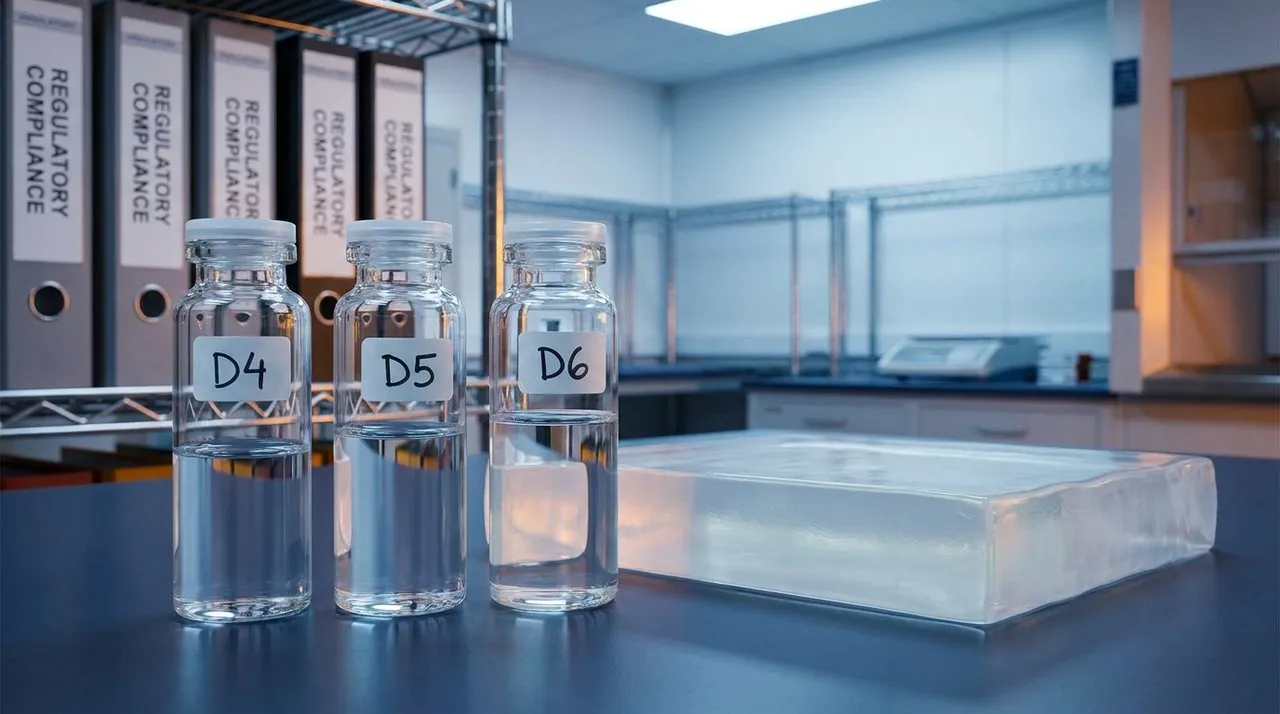
The risk concentrates in the volatile cyclic methylsiloxanes, not in the high-molecular-weight materials most plants buy by the drum. Three cyclics drive the regulatory file: octamethylcyclotetrasiloxane (D4, CAS 556-67-2, formula C8H24O4Si4), decamethylcyclopentasiloxane (D5, CAS 541-02-6, C10H30O5Si5), and dodecamethylcyclohexasiloxane (D6, CAS 540-97-6, C12H36O6Si6).
These small rings are the building blocks of nearly every silicone product. The workhorse of the category, polydimethylsiloxane (PDMS, sold as dimethicone, CAS 9006-65-9), is a long-chain polymer assembled from the same siloxane units. Silicone rubber and silicone resins are crosslinked networks of those chains. The polymers are heavy and non-volatile; the cyclic rings are light and volatile, and the cyclics are what every environmental assessment now targets.
That distinction matters at the loading dock. A buyer purchasing a 60,000 cSt PDMS fluid for a coating line faces a different regulatory question than a personal-care formulator buying a D5 cyclic as a volatile carrier. The grade, not the word “silicone,” sets the obligation.
Why are D4, D5, and D6 persistent and bioaccumulative?
They persist because they barely dissolve in water and resist the degradation pathways that break down most organics. The physical data tells the story directly. Each cyclic shows water solubility in the parts-per-billion range and a meaningful vapor pressure, so the dominant environmental release route is evaporation to air, while the fraction that reaches water or sediment lingers.
| Property | D4 (556-67-2) | D5 (541-02-6) | D6 (540-97-6) |
|---|---|---|---|
| Boiling point | 175 °C | 210 °C | 245 °C |
| Water solubility | 0.056 mg/L (23 °C) | 0.017 mg/L (25 °C) | 0.0051 mg/L (23 °C) |
| Vapor pressure | 1.05 mmHg | 0.2 mmHg | 0.0169 mmHg |
| Density | 0.956 (sp. gr.) | 0.959 g/cm³ | 0.967 g/cm³ |
| ECHA classification | PBT and vPvB | vPvB | vPvB |
Source: PubChem experimental properties (CIDs 11169, 10913, 10911); ECHA Candidate List classifications.
In air, the cyclics react with hydroxyl radicals and break down over days to weeks. The regulatory worry is the aquatic compartment: low solubility plus high affinity for fats means the cyclics that do reach water partition into sediment and concentrate up the food chain.
The same low solubility that keeps them out of the water column gives them a high octanol-water partition coefficient (log Kow), the laboratory proxy for bioaccumulation potential. Monitoring data showing the cyclics in sediment and aquatic biota underpins ECHA’s vPvB conclusion, which translated that behavior into the formal hazard classes that triggered the restrictions covered below.
What happens to silicone fluids when they reach wastewater or soil?
PDMS does not stay intact in the environment, but its breakdown route runs through soil, not water. Because the polymer is effectively insoluble and strongly surface-active, the bulk of any PDMS reaching a treatment plant partitions onto the biosolids instead of passing into the effluent.
When that sludge is land-applied or the polymer otherwise enters soil, clay minerals catalyze hydrolysis of the siloxane backbone. The chain is cut progressively into smaller fragments and finally into dimethylsilanediol, a water-soluble small molecule. Microbes and atmospheric oxidation then mineralize the silanediol to inorganic silica and carbon dioxide. The endpoint is the same silica the silicon started as.
This is the practical separation a procurement team should hold onto: the high-polymer fluids and elastomers degrade through a documented soil pathway, while the small cyclics carry the persistence and bioaccumulation profile. Treating both as one “silicone footprint” overstates the risk on the polymers and understates it on the cyclics.
The partition behavior is quantitative. PDMS and the cyclics share extremely low water solubility and a strong tendency to bind organic matter, so a treatment plant captures most of the silicone load in its biosolids instead of discharging it to the effluent. That moves the question onto sludge management: where the biosolids go, the silicone goes. Land application routes the polymer to the soil pathway that mineralizes it; landfill and incineration are the other endpoints.
How are silicones regulated for environmental reasons?
Regulation focuses almost entirely on the three cyclics, and the EU sets the pace. Under REACH, D4, D5 and D6 sit on the Candidate List of substances of very high concern (SVHC), with D4 classified as PBT and vPvB and D5 and D6 as vPvB. That listing is the legal hook for the downstream restrictions and for supply-chain notification duties.
Candidate List status also triggers REACH Article 33 supplier-communication duties and SCIP database notification once a substance exceeds 0.1% by weight in an article, so the obligation reaches importers and downstream users, not only the formulators adding the cyclic directly.
The binding limit is REACH Annex XVII, entry 70. It first restricted D4 and D5 in wash-off cosmetic products to below 0.1% by weight each, applicable from 31 January 2020. A 2024 amendment extended the same entry to add D6 and to cover leave-on cosmetics and other consumer and professional uses, with transitional deadlines phasing in over the following years. Buyers can track the current scope on ECHA’s restricted-substances list and the Candidate List table.
The picture outside Europe is firming up, not settling. In the United States, EPA designated D4 a high-priority substance under the amended Toxic Substances Control Act (TSCA) and is running a formal risk evaluation; the status is tracked on EPA’s TSCA risk-evaluation page. Environment and Climate Change Canada lists D4 as toxic under the Canadian Environmental Protection Act, citing its environmental persistence. A buyer selling into all three markets should assume the EU limits set the de facto specification.
| Region | Instrument | Substances | Status |
|---|---|---|---|
| EU | REACH Candidate List (SVHC) | D4, D5, D6 | Listed; D4 PBT/vPvB, D5/D6 vPvB |
| EU | REACH Annex XVII, entry 70 | D4, D5 (wash-off); extended to D6 and leave-on by a 2024 amendment | In force, phased deadlines |
| US | TSCA risk evaluation | D4 | High-priority; evaluation underway |
| Canada | CEPA | D4 | Listed as toxic |
What is the manufacturing footprint of making silicones?
The largest environmental load is front-loaded into the first step, before any siloxane exists. Silicones begin as silicon metal, produced by carbothermic reduction of quartz (SiO2) with carbon in a submerged electric-arc furnace operating above 1,800 °C. That furnace step is electricity-intensive, so the carbon intensity of the resulting silicon tracks the carbon intensity of the grid feeding it.
Silicon metal is then converted in the Müller-Rochow direct process: it reacts with methyl chloride over a copper catalyst to yield methylchlorosilanes, chiefly dimethyldichlorosilane. Hydrolysis of that intermediate produces the siloxane mixture, including the D4, D5, and D6 cyclics, plus hydrogen chloride that is recovered and looped back to make more methyl chloride. The cyclics are then polymerized or rearranged into the fluids, gums and resins sold downstream.
For a sourcing team, two footprint levers follow from that chemistry. The energy figure is dominated by the silicon-metal furnace and its power source, which is a supplier-origin question worth asking. The chlorine chemistry runs as a closed loop in well-run plants, so HCl recovery and solvent management are reasonable points to probe in a supplier audit. The relevant industry context sits in the plastics and polymers hub and the coatings and construction hub, where silicone fluids, rubbers and resins carry the bulk of demand.
What should procurement teams require before sourcing silicones?
Treat the residual cyclic content as a specification line, not an assumption. The single most useful action is to make the certificate of analysis carry the numbers that the regulators care about, so a compliance review never stalls a shipment after the fact.
Require residual D4, D5 and D6 reported by gas chromatography on every CoA, with a stated ceiling appropriate to the end use, instead of a generic “trace” notation.
For leave-on cosmetic, consumer, or professional end uses sold into the EU, specify residual cyclics below the current Annex XVII limit and confirm the SDS reflects REACH status.
For high-polymer fluids and rubbers, request the grade stripped of low-molecular-weight cyclics where the application allows, and confirm the viscosity grade matches the spec.
Add a clause requiring written notice of any change in REACH restriction scope affecting the grade, given the phased EU deadlines.
Build the regulatory check into qualification, not first delivery; the documentation cost is far lower than a held shipment.
A grounding in the underlying chemistry helps these conversations, and the silicone-fluid primer in What Is Silicone Oil? covers the viscosity and grade vocabulary an RFQ needs. For the broader import-side obligations, the REACH compliance guide for chemical importers maps the notification and documentation duties, and the sustainable sourcing guide sets the footprint questions in a wider procurement frame.
The RawSource Sourcing Desk works with procurement teams to benchmark siloxane grades, line up CoA and SDS documentation, and flag restricted-substance status before an RFQ closes; the dimethicone and D4 product pages list the grade detail to start a quote.
FAQ
Are silicones biodegradable? High-molecular-weight PDMS is not readily biodegradable in standard OECD water tests, but it breaks down in soil: clay-catalyzed hydrolysis cleaves it to dimethylsilanediol, which microbes mineralize to silica and carbon dioxide. The volatile cyclics degrade in air through reaction with hydroxyl radicals.
Why are D4, D5, and D6 restricted if silicones are considered safe to handle? The restriction addresses environmental fate, not acute handling hazard. ECHA classifies D4 as PBT and vPvB and D5 and D6 as vPvB, because these cyclics resist breakdown in water and sediment and concentrate in aquatic organisms.
Does the REACH restriction apply to all silicone fluids and rubber? No. Annex XVII entry 70 sets residual-concentration limits for specified cosmetic and consumer uses, not a blanket ban. The practical question for an industrial buyer is the residual cyclic level on the CoA, not the polymer class.
How does a buyer confirm a grade meets current cyclic-siloxane limits? Request a CoA reporting residual D4, D5 and D6 by gas chromatography, plus a current SDS showing REACH status, and specify the residual ceiling in the RFQ instead of assuming it.
Methodology: physical-property values (boiling point, water solubility, vapor pressure, density) are quoted from PubChem experimental-property records for CIDs 11169 (D4), 10913 (D5), and 10911 (D6). Hazard classifications and restriction scope reference ECHA’s Candidate List and REACH Annex XVII. Regulatory status is current as of mid-2026; confirm the live entry before contracting.
Frequently asked questions
Are silicones biodegradable?
Why are D4, D5, and D6 being restricted if silicones are considered safe to handle?
Does the REACH restriction on D4, D5, and D6 apply to industrial silicone fluids and rubber?
How can a buyer confirm a silicone grade meets current cyclic-siloxane limits?
Sources & methodology
Figures are RawSource sourcing data unless attributed to a named source. Regulatory citations are current as of publication. Chemical identities verified by CAS number against the RawSource catalog.
Search 1,300+ industrial chemicals by name or CAS, or send us your spec — we quote by the drum, tote, or container.
Browse the Chemical Index → Request a Quote