
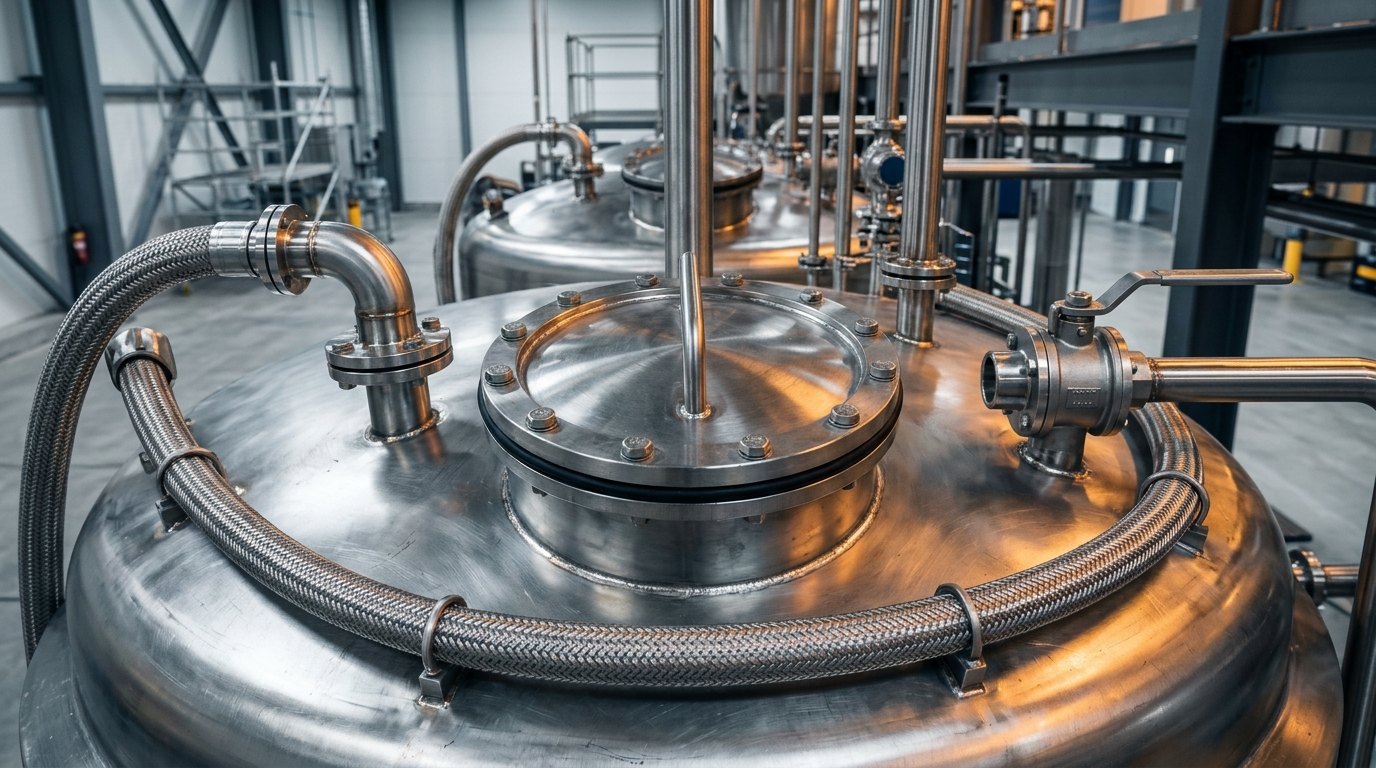
The CoA for a lot of RS-D2000, a polyetheramine diamine, sits inside its moisture line of 0.25 max wt%. The first half of the 200 kg drum sprays clean. The last fraction comes off the gun with pinholes. That fraction is drawn after weeks with the bung hand-tight in a humid plant, and the isocyanate side gets the blame.
Check the amine first. The drum shipped nitrogen blanketed and met specification. Somewhere between the first draw and the last, it stopped being the material you qualified.
How do polyetheramines pick up water and carbon dioxide in storage?
Polyetheramines are amine-terminated polyethers, and both halves of the molecule work against a loosely closed container. The polyether backbone takes up water, most readily in the low-molecular-weight and ethylene oxide-rich grades. The amine ends react with carbon dioxide from air to form carbamate salts. Every storage condition on these grades aims at the same thing: keeping air off the liquid between draws.
The water side is a property of the grades themselves. RS-T403, a polyoxypropylene triamine of 440 g/mol nominal, is completely miscible with a range of solvents, water among them.
In a formulation, that property is an advantage. In a part-empty drum, it means nothing at the liquid surface stops humid air from dissolving in. RS-M1000 has an ethylene oxide-rich backbone, with a PO/EO mole ratio of 3/19, which makes it relatively hydrophilic.
The carbon dioxide side is the chemistry behind amine blush on a curing epoxy surface. A primary amine and carbon dioxide give a carbamate. In the drum, that shows up as haze, a crust on the bung threads or a skin at the surface. Each amine group tied up as a salt is one fewer amine group available for cure.
Both effects move the material away from the numbers you dose on. RS-D230 carries an amine hydrogen equivalent weight (AHEW) of 60 g/eq, and a dose calculation of that kind assumes the weight you pour is the amine you specified. Absorbed water is dead weight in that calculation.
In a polyurea or polyurethane system it does worse. Water reacts with isocyanate to form a urea and release carbon dioxide gas, which consumes isocyanate and leaves bubbles in the part. The isocyanate chemistry is covered on the polyurethane polyols and isocyanate page. RS-D2000 is a key ingredient in polyurea and RIM formulations, so its moisture line protects the spray gun as much as the stoichiometry.
The action follows directly. Write the grade’s moisture maximum into your receiving check, and run the same test again on any container that has been open long enough to worry you.
Storage conditions, grade by grade
The conditions differ less from grade to grade than buyers expect, and they reward the same close reading as a chemical technical data sheet. Three of the six grades covered here, all from the polyetheramine family, share the same temperature window and closure instructions. The table sets each grade’s conditions against its moisture specification and its pack.
| Grade | Storage conditions | Temperature | Moisture, sales spec | Packaging |
|---|---|---|---|---|
| RS-D230 | Tightly closed, cool, dry, well ventilated | 2 to 40 °C | 0.30 max wt% | 195 kg drums, 950 kg or 942 kg IBC totes, ISO tank |
| RS-D2000 | Tightly closed, dry, well ventilated | 2 to 40 °C | 0.25 max wt% | 200 kg drums (nitrogen blanketed), 1,000 kg IBC totes |
| RS-SD2001 | Tightly closed, cool, dry, well ventilated; protected from moisture and contamination | 2 to 40 °C | 0.20 max % | 200 kg net drums (nitrogen blanketed) |
| RS-T403 | Tightly closed, cool, well ventilated; away from strong acids | – | 0.25 max wt% | 200 kg drums |
| RS-T5000 | Original container, tightly closed until use; dry, cool, well ventilated, out of direct sunlight | – | 0.25 max wt% | 200 kg drums, 1,000 kg IBC totes |
| RS-M1000 | – | – | – | 200 kg drums, 1,000 kg IBC totes, bulk ISO tank |
– not specified; ask the desk.
Every liquid grade carries the same instruction for an opened container: reseal it carefully and keep it upright to prevent leakage. That instruction carries most of the weight in this piece. A tightly closed drum is the container as delivered. A carefully resealed drum is the same container on day two, after an operator has drawn from it.
RS-T403 and RS-T5000 are to be kept cool, and neither has a specified temperature range. Set a window for RS-T403 and RS-T5000 in your own storage specification and record it.
RS-T403 is kept away from strong acids, and RS-T5000 away from incompatible materials in general. Apply the acid rule to the whole family: every grade here is an amine.
The nitrogen blanket is spent at the first draw
RS-D2000 ships in 200 kg drums (nitrogen blanketed), and so does RS-SD2001, the N,N’-diisopropyl secondary diamine. The blanket protects the drum only until the bung comes out. Once air replaces the nitrogen, the drum is an ordinary closed container with a moist, carbon dioxide-bearing atmosphere above a liquid that takes up water.
Here is the position. Re-inerting the headspace after each draw matters most for RS-SD2001, because its moisture line, 0.20 max %, is the tightest of these grades and leaves the least room for water picked up between draws. Its relatively low reactivity suits work that needs a slower cure and a longer working time, with primary amine held to 5 max %.
The reason is the moisture line, not the cure speed. Even a hindered secondary amine reacts with isocyanate much faster than water does, so a slower cure alone would not make the rule stricter for RS-SD2001 than for RS-D2000.
After each partial draw from a blanketed grade, purge the headspace with dry nitrogen before you reseal. If your plant cannot do that, decant the remainder into smaller containers filled close to the top.
There is a genuine trade-off in pack size. RS-D230 comes in 195 kg drums or in 950 kg or 942 kg IBC totes. The tote saves handling and drum disposal. It also sees many more openings before it is empty, and its headspace grows with every draw.
For a line that consumes a container quickly, the tote wins. For a line that draws from one container over several weeks, the drum keeps less material exposed for less time. Set that choice on your draw rate, not on unit price alone.
The temperature window has a floor as well as a ceiling
RS-D230, RS-D2000 and RS-SD2001 have a recommended storage temperature of 2 to 40 °C. Buyers tend to read only the ceiling. The floor matters as much in a winter receiving bay. RS-D230’s viscosity is specified at 15 max mPa·s at 25 °C, and an amine that has sat near the floor pumps and meters slower than that figure suggests.
RS-T5000 is already a viscous liquid, and its storage conditions add protection from direct sunlight, which rules out the south wall of a yard in summer.
Write the 2 to 40 °C window into your storage area requirements for the three grades that carry it. Log temperature where the drums actually sit, not at the thermostat. A cold drum should come back into the window and be mixed before it reaches the metering pump.
RS-M1000 has to be melted before it meters
The monoamine behaves differently from the other five. RS-M1000 is a white waxy solid at room temperature, so no pump draws it as delivered. Its uses include ore flotation, corrosion inhibition and the emulsification of epoxy resins, and each needs it liquid and dosed by weight or volume.
Melting adds an exposure step the liquid grades avoid. The bung is often loosened for a heating cycle, and a warm, hydrophilic liquid with a PO/EO ratio of 3/19 takes up water faster than a cold solid. Melt the whole container, mix it, then draw. A part-melted drum can feed unevenly from the liquid zone near the heated wall.
While the drum warms, vent it to a nitrogen line rather than to open air. RS-M1000 has no specified maximum heating temperature, so set one in your own procedure before you fit a heating jacket.
Acids, labels and the receiving check
Two storage conditions turn into dispensing rules. The first is the acid rule: an acid neutralizes the amine groups you bought the material for. Keep acid catalysts and acidic additives off any pump, hose or transfer drum used for polyetheramines.
The second is labeling: RS-T5000 is never stored in an unlabeled container, and RS-D230, RS-D2000 and RS-SD2001 are kept in properly labeled containers. Every decant carries its grade and lot.
RS-D230 and RS-D2000 share CAS 9046-10-0. The EPA Substance Registry Services record for that CAS (retrieved 2026-10-23) names the substance “Polypropylene glycol bis(aminopropyl) ether” and lists it on the TSCA Inventory, the list EPA keeps under TSCA section 8(b), 15 U.S.C. 2607(b). A container labeled by CAS alone does not tell your operators which grade is inside.
The receiving check needs one parameter, set by you:
- On arrival, compare the CoA moisture result with the grade’s sales line: 0.30 max wt% for RS-D230, 0.25 max wt% for RS-D2000, RS-T403 and RS-T5000, and 0.20 max % for RS-SD2001.
- Record the margin between the CoA result and that line. A thin margin means fewer openings before the drum drifts out.
- Before drawing the last fraction from any container that has been open across a humid spell, retest moisture by Karl Fischer titration, in a working medium buffered for amines, against the same line. If it fails, quarantine the remainder rather than blending it down.
- Inspect the bung threads and liquid surface at each draw. A crust on the threads or a haze at the surface most often means carbamate from air, a sign that the reseal is not holding.
The triamine grades and the diamines share this procedure. Only the moisture line and the pack change from grade to grade.
Choosing between drums and a tote, or deciding whether to buy nitrogen for re-inerting, comes down to one figure on your own records. That figure is the moisture margin between the CoA result and the grade’s maximum, set against how many times the container will be opened before it is empty.
Methodology: each grade value is what the technical data sheet for that RS code states, in its units, typical where marked typical; the lot COA governs. Storage conditions are each grade’s handling and storage instructions. CAS identity and TSCA Inventory status are from EPA Substance Registry Services (retrieved October 2026) and TSCA section 8(b), 15 U.S.C. 2607(b).
Frequently asked questions
Can a part-used IBC tote of polyetheramine stay in service until it is empty?
Does RS-SD2001 need different handling from the primary diamines?
What does keeping polyetheramines away from strong acids mean for a shared chemical store?
Is the 2 to 40 °C window a transport condition as well?
Sources & methodology
Figures are RawSource sourcing data unless attributed to a named source. Regulatory citations are current as of publication. Chemical identities verified by CAS number against the RawSource catalog.
Search 1,300+ industrial chemicals by name or CAS, or send us your spec — we quote by the drum, tote, or container.
Browse the Chemical Index → Request a Quote