
Type “TPO” into a search bar and you get two completely unrelated products fighting over the same three letters. A facilities manager means a roofing membrane. A coatings or 3D-resin formulator means a photoinitiator — a small-molecule additive that makes a UV ink or coating cure under a lamp. They are not grades of one material, and not interchangeable. If you came here for the additive that cures acrylate systems, you are in the right place; if you came for the roof, the table below points you elsewhere in one line.
The short version: TPO photoinitiator is diphenyl(2,4,6-trimethylbenzoyl)phosphine oxide, CAS 75980-60-8, molecular formula C₂₂H₂₁O₂P. It is a Type I (cleavage-type) acylphosphine oxide photoinitiator: absorb a UV or near-UV photon and the molecule splits into two free radicals that kick off the free-radical polymerization of acrylate and unsaturated-polyester resins. Two traits make it a workhorse. It absorbs out into the violet/near-UV (roughly 380-420 nm), so it cures under the 395 and 405 nm LED lamps most modern lines use, and it photobleaches, losing its own color and absorbance as it reacts so light keeps reaching deeper. That combination makes it useful in both water-clear and pigmented or white systems: UV/LED coatings, inks, adhesives, and 3D-printing (DLP/SLA) resins. None of this has anything to do with TPO thermoplastic-polyolefin roofing membrane.
Is TPO photoinitiator the same as TPO roofing?
No. They share an acronym and nothing else. The fastest way to tell which “TPO” a datasheet or RFQ means is the form factor and the unit of sale: the photoinitiator ships as a powder or granule (its phosphinate analogue as a liquid) and is bought by the kilogram; the roofing product ships as rolls of sheet and is bought by the square. Here is the clean split.
| TPO photoinitiator | TPO roofing membrane | |
|---|---|---|
| What it is | A single small-molecule chemical additive | A polymer compound formed into a sheet |
| Full name | Diphenyl(2,4,6-trimethylbenzoyl)phosphine oxide | Thermoplastic polyolefin (a polypropylene / ethylene-propylene rubber blend) |
| CAS | 75980-60-8 | Not a single CAS (a formulated polymer blend) |
| Job | Starts UV/LED free-radical cure in inks, coatings, resins | Waterproofs flat and low-slope commercial roofs |
| Form / unit | Powder or granule (liquid for the phosphinate analogue); sold per kg | Single-ply sheet membrane; sold by the roll / square |
If your interest is the membrane, RawSource does not supply roofing sheet and the rest of this guide will not help you. Everything below is about the photoinitiator.
What TPO photoinitiator actually is
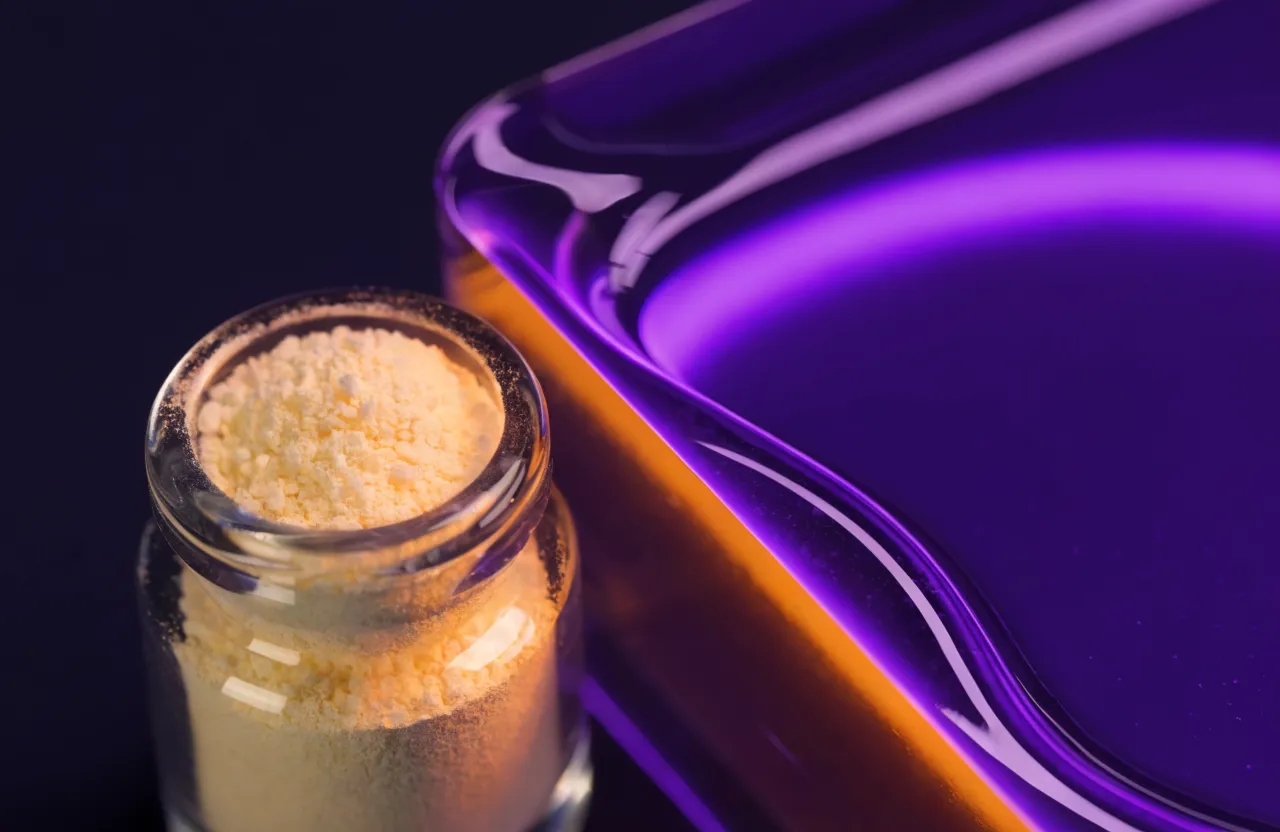
TPO belongs to the acylphosphine oxide family of photoinitiators, and specifically it is a monoacylphosphine oxide (one acyl group on the phosphorus). Its close relative BAPO carries two acyl groups and is a bisacylphosphine oxide (more on that split below). The identity that matters for sourcing and for a Certificate of Analysis (CoA): name diphenyl(2,4,6-trimethylbenzoyl)phosphine oxide, CAS 75980-60-8, formula C₂₂H₂₁O₂P, typically a pale-yellow crystalline powder.
The liquid phosphinate analogue, ethyl (2,4,6-trimethylbenzoyl)phenylphosphinate, is a different molecule with its own CAS, so confirm which one a datasheet or RFQ means.
How TPO works
A free-radical UV system cures because a photoinitiator absorbs light, generates radicals, and those radicals add across the carbon-carbon double bonds of acrylate monomers and oligomers to build a crosslinked network. TPO is a Type I initiator, which means it does the radical generation by direct cleavage: when the molecule absorbs a photon, the bond between the phosphorus and the carbonyl carbon breaks (a Norrish Type I cleavage), producing a phosphinoyl radical and a benzoyl radical. Both fragments are reactive and can start chains, so one absorbed photon does real work. (For the broader split between cleavage initiators and the hydrogen-abstraction kind, see Type I vs Type II photoinitiators.)
Two behaviors set TPO apart from the common hydroxyketone initiators. First, where it absorbs. Hydroxyketones absorb mostly in the shorter UV and go effectively blind above about 380 nm. TPO’s absorption runs longer, with useful capture extending into the violet/near-UV out to roughly 420 nm.
Second, photobleaching. The phosphine-oxide chromophore is consumed as it reacts, and its photoproducts absorb at shorter wavelengths, so a TPO-loaded film starts off able to capture long-UV light and then turns more transparent to it as cure proceeds. The practical payoff is that light keeps penetrating to lower layers instead of being soaked up at the top, which is exactly what you need for thick films and for cure through pigment. It is also why a properly cured TPO film tends to yellow less than you might expect from a pale-yellow powder: much of the color bleaches out during cure.
Why TPO suits 395-405 nm LED
This is the single biggest reason TPO has become a default on modern lines. UV-LED lamps are narrowband (they emit in a tight cluster at 365, 385, 395, or 405 nm rather than the broadband output of a mercury arc), and a photoinitiator only generates radicals at wavelengths it actually absorbs. A 365 nm hydroxyketone package run under a 405 nm LED will under-cure no matter how long you expose it, because the initiator captures almost nothing at that wavelength. TPO’s absorption tail reaches into the 385-420 nm band where those LEDs live, so it converts their output into radicals efficiently.
The honest trade-off: TPO is excellent at depth and at the LED wavelengths, but it is not the fastest initiator for the very top surface of a film exposed to air. That top skin is where atmospheric oxygen scavenges radicals and can leave a soft, tacky layer, the oxygen-inhibition problem covered in why UV resin stays tacky. A common approach is to pair TPO for through-cure with a fast surface-cure hydroxyketone such as 2-hydroxy-2-methylpropiophenone at the top of the package, so you cover both ends of the film. Many production clear-coat and ink formulations run exactly this blend rather than a single initiator.
Where TPO photoinitiator is used
Because it cures through depth and through color, TPO shows up across the free-radical UV/LED world.
| Application | What TPO does there |
|---|---|
| UV/LED industrial and wood coatings | Through-cure of clear topcoats and primers; low post-cure yellowing |
| Pigmented and white coatings | Photobleaching drives cure under pigment that competes for every photon |
| Inkjet, screen, and offset UV inks | Cures inks under narrowband LED heads where short-UV initiators fail |
| 3D-printing resins (DLP / SLA / LCD) | Matches 385-405 nm print engines; cures each layer through its depth |
| UV/LED adhesives and laminating resins | Cures bondlines, including through lightly tinted or filled systems |
White and high-opacity systems are the clearest case for an acylphosphine oxide. In a white coating the titanium dioxide scatters and absorbs UV before it reaches the resin below, so a non-bleaching initiator simply runs out of light; TPO (and, for the heaviest builds, BAPO) keeps working as it clears.
TPO vs BAPO, in one paragraph
The quick rule: TPO (monoacylphosphine oxide) is the efficient general-purpose long-UV/LED initiator for clear and moderately pigmented films; BAPO (bisacylphosphine oxide) carries two acyl groups, generates more radicals per molecule, and pushes cure even deeper through heavy pigment and thick builds, at higher cost and with a deeper initial yellow that it then photobleaches. Reach for TPO first; step up to BAPO when a white or thick system still under-cures at depth. We will publish a dedicated TPO-vs-BAPO comparison; until then, the through-cure and pigment behavior of both is covered in the oxygen-inhibition guide.
Handling and regulatory status
TPO is an industrial raw material and must be handled to its current Safety Data Sheet. Two sourced points matter for buyers. Under the EU CLP Regulation, TPO carries a harmonised (Annex VI) classification that was strengthened to reproductive toxicant Category 1B, hazard statement H360 (“may damage fertility … suspected of damaging the unborn child”), applicable from 1 September 2025 under Commission Delegated Regulation (EU) 2024/197; it is also classified as a skin sensitizer (Skin Sens. 1, H317) and as hazardous to the aquatic environment (Aquatic Chronic, H411) (ECHA substance information). Separately, the EU prohibited TPO in cosmetic products from the same date.
These classifications apply to the substance as such; confirm the current regulatory status, restrictions, and classification for your specific application and jurisdiction, and review the SDS for the grade you buy before handling, storage, or disposal. This page describes industrial coating, ink, adhesive, and resin use only.
Buying TPO photoinitiator
See the TPO photoinitiator product page.
Tell us your lamp type and peak wavelength (mercury, or 365 / 385 / 395 / 405 nm LED), your film build and whether it is clear or pigmented, and your cure-speed, through-cure, and yellowing targets, and request a sample to qualify cure on your own line.
Frequently asked questions
Is TPO photoinitiator the same as TPO roofing membrane?
No. The photoinitiator TPO is diphenyl(2,4,6-trimethylbenzoyl)phosphine oxide (CAS 75980-60-8), a small-molecule chemical additive that starts UV/LED cure in coatings, inks, and resins. TPO roofing membrane is thermoplastic polyolefin, a polypropylene/ethylene-propylene rubber blend formed into single-ply sheet for waterproofing roofs. They share an acronym and nothing else, and are not interchangeable.
What is TPO photoinitiator used for?
It is a Type I free-radical photoinitiator used to cure UV- and LED-curable acrylate and unsaturated-polyester systems: industrial and wood coatings, pigmented and white coatings, UV inks (inkjet, screen, offset), UV/LED adhesives, and 3D-printing (DLP/SLA/LCD) resins. Its strength is through-cure and cure under pigment, thanks to photobleaching, and its absorption at the 385-405 nm wavelengths used by LED lamps.
What is the CAS number for TPO photoinitiator?
CAS 75980-60-8, for diphenyl(2,4,6-trimethylbenzoyl)phosphine oxide, molecular formula C₂₂H₂₁O₂P. The liquid analogue, ethyl (2,4,6-trimethylbenzoyl)phenylphosphinate, is a different molecule with its own CAS, so confirm which one a datasheet means.
TPO vs BAPO: which photoinitiator should I use?
Start with TPO (a monoacylphosphine oxide) for clear and moderately pigmented UV/LED coatings, inks, and resins; it is efficient at long-UV/LED wavelengths and cures through depth. Step up to BAPO (a bisacylphosphine oxide) when a white or thick-film system still under-cures at depth; it generates more radicals per molecule and pushes cure deeper, at higher cost and with a deeper initial color that photobleaches.
Why does TPO cure under 395 nm and 405 nm LED when other photoinitiators don’t?
Because TPO’s absorption extends into the violet/near-UV out to roughly 420 nm, where common hydroxyketone initiators absorb almost nothing. UV-LED lamps emit in a narrow band (365, 385, 395, or 405 nm), and an initiator only makes radicals at wavelengths it absorbs, so TPO captures LED output that short-UV initiators miss. It also photobleaches, clearing as it reacts so light keeps reaching deeper layers.
Does TPO leave a tacky surface after curing?
TPO cures through depth well, but the very top surface of any free-radical film exposed to air can stay slightly tacky because atmospheric oxygen scavenges surface radicals (oxygen inhibition), independent of which initiator you use. The usual fixes are to pair TPO with a fast surface-cure hydroxyketone such as 2-hydroxy-2-methylpropiophenone, raise dose or inert the cure zone, or cure under film, covered in our guide to why UV resin stays tacky.
Editorial note. This article is general technical guidance for coatings, ink, adhesive, and 3D-resin formulation professionals. Cure speed, through-cure, surface tack, and yellowing depend on your specific resin and oligomer, photoinitiator package, lamp type and wavelength, film thickness, pigmentation, line speed, and curing atmosphere, and must be validated on your own system; the Certificate of Analysis (CoA) governs the grade you buy. TPO is an industrial chemical and carries a harmonised CLP hazard classification (reproductive toxicant, skin sensitizer, aquatic toxicity) as cited above; review the current Safety Data Sheet (SDS), use appropriate PPE, and confirm regulatory status for your application and jurisdiction before handling. Products are sold for industrial and professional use only. Nothing here is a medical, health, or efficacy claim. RawSource makes no warranty, express or implied, and assumes no liability for use of this information.
Search 1,300+ industrial chemicals by name or CAS, or send us your spec — we quote by the drum, tote, or container.
Browse the Chemical Index → Request a Quote