
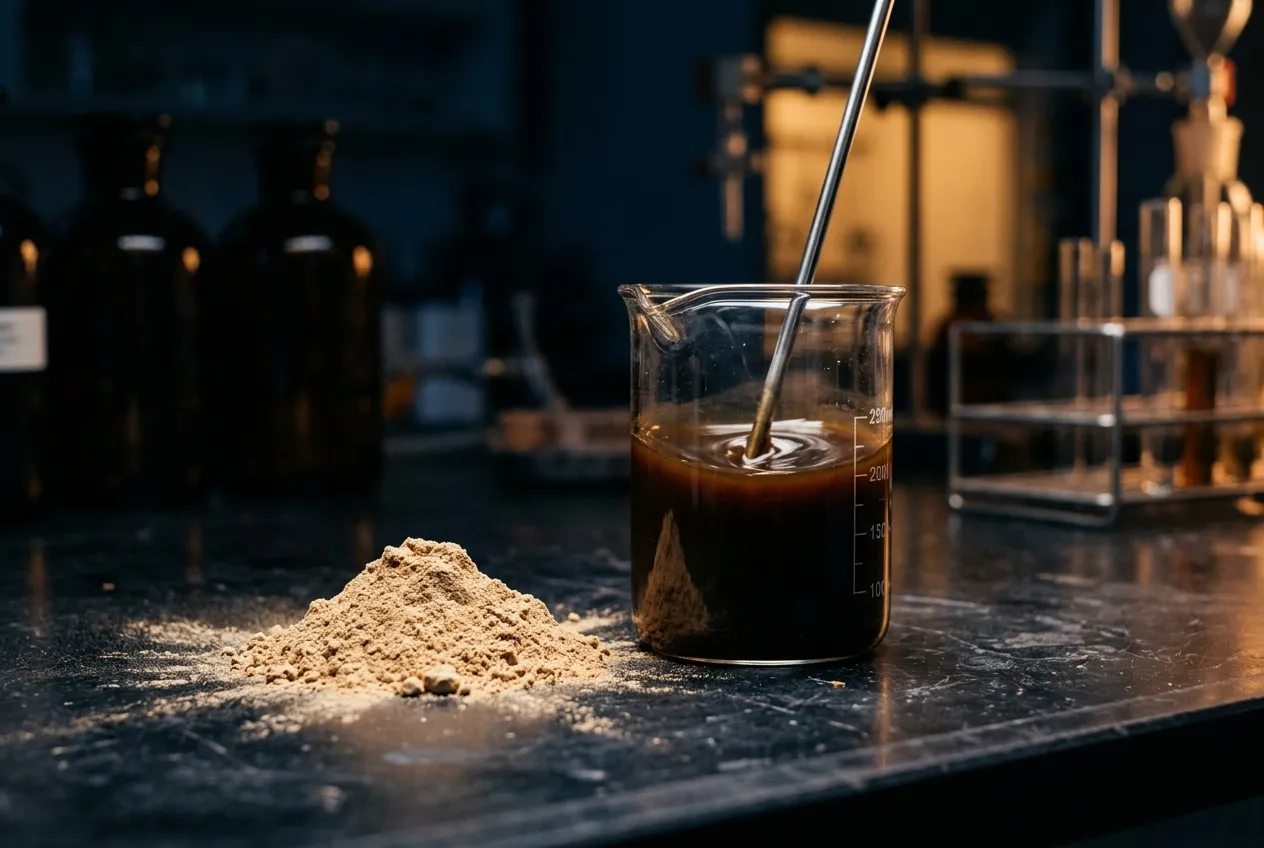
Wherever a fine insoluble solid has to stay suspended in water, the same problem shows up: the particles clump, the suspension thickens or sediments, and the product separates, settles in the drum, or plugs the spray nozzle. A dye that flocculates streaks the cloth; a pesticide that settles loses its dose; a carbon-black or ceramic slurry that agglomerates is unusable. Lignosulfonate is the cheap, wood-derived anionic dispersant that keeps those solids apart and suspended.
The short version: lignosulfonate is a natural anionic surface-active agent that wets and disperses insoluble solids into water. It adsorbs onto particle surfaces, gives them a like charge, and keeps them deflocculated and suspended, which stabilizes dye and pigment dispersions, agrochemical (pesticide) formulations, carbon black, leather-tanning agents, and ceramic slurries. The same dispersing action that reduces water in concrete is at work here, applied to suspensions instead of cement.
The problem: solids that won’t stay apart
Fine particles in water attract each other and flocculate, so the suspension thickens, settles, or cakes. Lignosulfonate (CAS 8061-51-6, PubChem) solves this the way a dispersant does: its molecules adsorb onto the particle surfaces and impart a negative charge, so the particles repel each other instead of clumping. The result is a finer, more uniform, more stable dispersion that flows, sprays, and stays suspended, and a lower viscosity at the same solids loading.
Where it disperses
| Application | The dispersing job |
|---|---|
| Dyes and pigments | Keeps dye and pigment particles fine and deflocculated for even, streak-free color |
| Agrochemicals (pesticides) | Disperses and suspends wettable powders and suspension concentrates so the active stays in suspension |
| Carbon black | Wets and disperses carbon black into water-based systems |
| Leather tanning | Disperses tanning agents for even penetration |
| Ceramic slurries | Lowers slurry viscosity and improves fluidity at high solids |
For pesticide formulations, lignosulfonate is used as a formulation dispersant; such inert ingredients are addressed under the EPA inert-ingredient framework, which the formulator confirms for the specific product.
Why it disperses well
Lignosulfonate is a polymeric, anionic, surface-active molecule, which is exactly the combination a dispersant needs: the surface activity lets it wet and adsorb onto the particle, the anionic charge provides the electrostatic repulsion that keeps particles apart, and the polymeric size adds a degree of steric separation. It works across a useful pH range and is inexpensive, which is why it is a workhorse dispersant where a high-performance synthetic is not required.
Calcium versus sodium, and grade
For dispersant use, sodium lignosulfonate is often preferred for its higher solubility and because the sodium ion is usually more compatible than calcium in formulations; calcium lignosulfonate is also used and is the common concrete grade. More purified, lower-sugar, lower-ash grades give cleaner dispersions where color or residue matters. Match the cation and purity to the formulation, and validate dispersion and stability on the actual system. The binder side of the chemistry is in lignosulfonate as a pelletizing and briquetting binder.
Buying lignosulfonate as a dispersant
See the Sodium Lignosulfonate product page. Tell us your solids, formulation, and stability target, and request a sample to test dispersion on your own system. Its concrete use is in lignosulfonate concrete water reducer.
Frequently asked questions
What is lignosulfonate used for as a dispersant?
It wets and disperses insoluble solids in water, keeping them deflocculated and suspended. It is used in dyes and pigments, agrochemical (pesticide) formulations, carbon black, leather-tanning agents, and ceramic slurries, where it stabilizes the suspension and lowers viscosity.
How does lignosulfonate disperse solids?
It adsorbs onto particle surfaces and gives them a negative charge, so the particles repel each other instead of clumping. As a polymeric surfactant it also adds some steric separation, producing a finer, more stable, lower-viscosity dispersion.
Sodium or calcium lignosulfonate for dispersing?
Sodium lignosulfonate is often preferred as a dispersant for its higher solubility and compatibility; calcium lignosulfonate is also used. Purified, lower-sugar grades give cleaner dispersions where color or residue matters. Match the grade to the formulation.
Can lignosulfonate disperse pesticides and dyes?
Yes. It disperses and suspends agrochemical wettable powders and suspension concentrates and keeps dye and pigment particles fine and deflocculated for even color. Confirm formulation suitability and any regulatory status for your specific product.
Is lignosulfonate a good dispersant for ceramics?
Yes. It lowers ceramic slurry viscosity and improves fluidity at high solids loading, which improves casting and processing. The grade and dose are matched to the body and confirmed by trial.
Editorial note. This article is general technical guidance for formulation and industrial professionals. Dispersant performance guidance is general and must be validated on your own formulation; the Certificate of Analysis governs the grade you buy, and regulatory suitability (for example as a pesticide-formulation inert) must be confirmed for your specific product and jurisdiction. Lignosulfonate is a wood-derived material not classified as hazardous or flammable per its SDS; it can irritate skin and eyes, so use appropriate PPE. Always consult the current Safety Data Sheet (SDS) before handling. RawSource makes no warranty, express or implied, and assumes no liability for use of this information.
Search 1,300+ industrial chemicals by name or CAS, or send us your spec — we quote by the drum, tote, or container.
Browse the Chemical Index → Request a Quote