
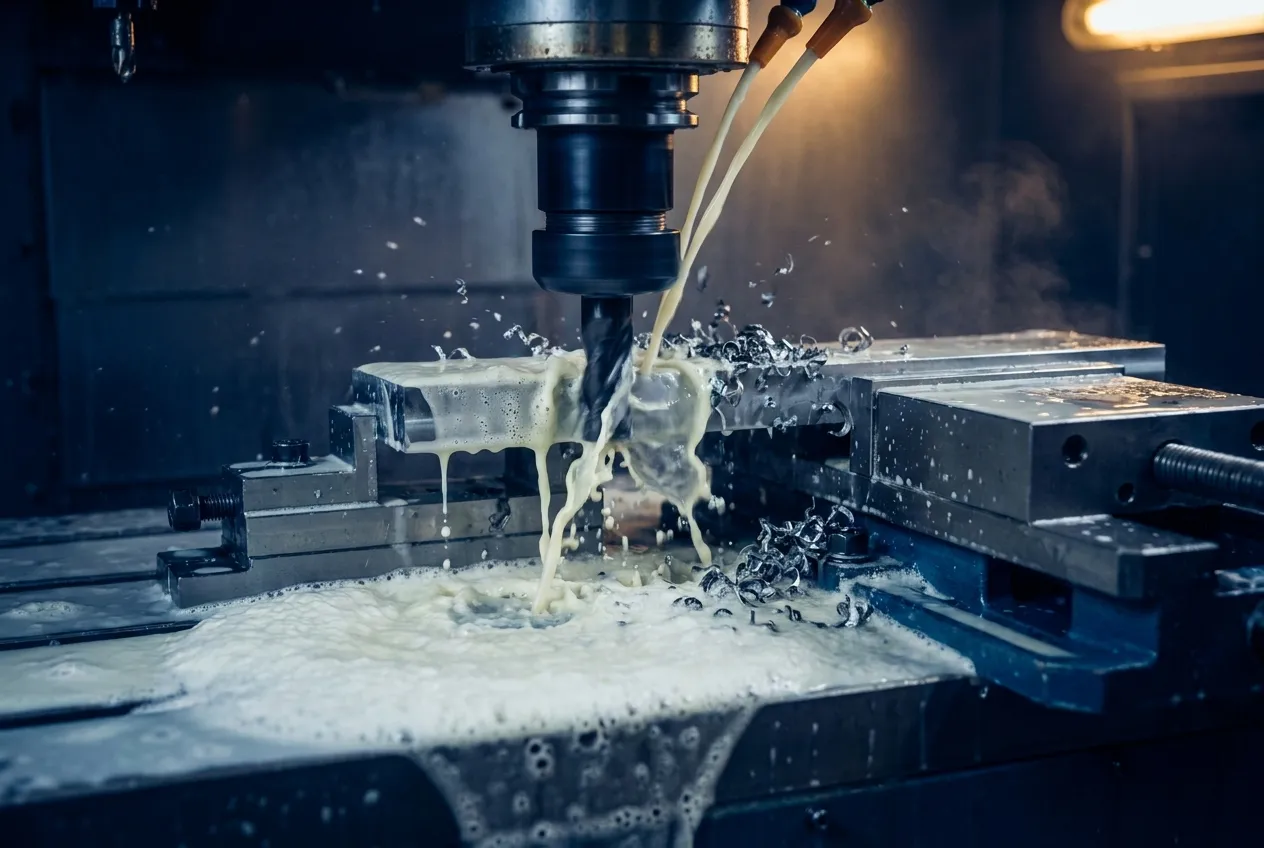
The sump is throwing foam over the lip and onto the floor, the through-spindle pressure is pushing a head of suds across the work, and parts are coming out streaked. Somebody dumps in more defoamer, and an hour later it is worse.
The short version: machine coolant foams when pumps whip air into a fluid already loaded with surfactant and tramp oil. Most of the fix is mechanical: get the concentration right, raise the sump level, seal the air leaks, and skim the oil. A defoamer is the last step, not the first. Silicone works at a very low dose, but it is the wrong choice if you paint or plate the parts downstream.
Why is my machine coolant foaming?
| Cause | What is happening | The tell |
|---|---|---|
| Over-concentration | a too-rich mix carries more surfactant than the water can hold | refractometer reads high; white foam |
| Soft / low-hardness make-up water | below ~70 ppm CaCO₃ the low mineral content stabilizes bubbles; the ideal make-up window is ~80-125 ppm | foam worse after a water change to softened or RO water |
| Tramp oil | way-lube and hydraulic leaks feed bacteria and stabilize foam | brown or greasy foam, bad smell |
| Pump air entrainment | high-pressure or through-spindle delivery and suction-side air leaks whip in air | foam builds with the spindle running |
| Low sump level / short dwell | fluid recirculates before entrained air can escape | foam at high duty cycle |
| Bacterial degradation | microbes break down additives and raise foam | rancid smell, brown foam, falling pH |
| Lost or over-added defoamer | defoamer carries out, or excess emulsifier re-stabilizes foam | foam returns fast after dosing |
White foam or brown foam?
A quick read: white, airy foam usually means air entrainment or an over-rich mix. Brown or greasy foam usually means tramp oil or a bacterial problem. White points you at concentration and air; brown points you at oil skimming and sump hygiene.
Fix it engineering-first
Reach for the cheap levers before the drum of defoamer.
- Check concentration with a refractometer and correct it; over-rich is a leading cause. Most shops run grinding at roughly 3-5%, general machining at 6-10%, with the supplier TDS as the real target. Remember the refractometer factor: a semi-synthetic with a factor near 1.78 reading 4 Brix is actually around 7% in the sump, so multiply the Brix reading by the fluid’s factor instead of reading it straight.
- Raise the sump level and improve return-line dwell so entrained air can break out. A rough target is a sump that turns over no faster than about once a minute; tight, fast-cycling sumps never give bubbles time to release.
- Lower pump pressure where you can, and seal suction-side air leaks.
- Skim tramp oil, which stabilizes foam and feeds bacteria.
- Check make-up water hardness. Below ~70 ppm CaCO₃ foams; above ~200 ppm scums emulsifiers onto sumps and filters. The usable window is roughly 80-125 ppm, so blend hard tap with RO rather than running straight softened water.
Then, if foam persists, add a tank-side defoamer. Start around 0.1 to 0.5 percent and dial it in. Do not standing-dose: over-adding carries out of the system, and the emulsifiers in it can re-stabilize the foam you are trying to kill.
One honest caveat on bench data: the old ASTM foam-tendency methods for these fluids (D3601 and D3519) were withdrawn in 2013 because neither reliably predicted in-use foaming. So validate a defoamer on your own sump under real spindle pressure rather than trusting a lab foam number on a data sheet.
The silicone fisheye trap (the honest caveat)
For most machine shops a silicone (PDMS) defoamer is the right answer: it kills foam at a very low dose and is compatible across soluble-oil, semi-synthetic, and synthetic fluids. There is one important exception. If your parts are painted, powder-coated, plated, or e-coated downstream, silicone carryover causes fisheyes and adhesion failure on those parts.
For a paint-line or plating-adjacent shop, use a non-silicone defoamer (polymer, EO-PO, or fatty-alcohol) or a fisheye-tolerant silicone-polyether instead. The same defect described in why paint gets fisheyes shows up on machined parts when silicone rides through. The hydrophobic silica that makes silicone defoamer work is part of why dosing discipline matters.
Choosing and buying coolant defoamer
A single-machine shop buys a pail and doses by hand. A multi-machine shop dosing continuously buys by the drum or tote and should price it by active content, not by the pail. Silicone antifoam emulsions are typically sold at 10-30% active silicone, so a 10% product dosed at the same volume as a 30% one is doing a third of the work; normalize the quote to active percent before you compare suppliers. The grade choice comes down to one question: does anything you make get coated or plated later? If not, silicone is usually the most cost-effective. If so, go non-silicone. Trial a sample on your own sump before you commit.
Frequently asked questions
Why is there white foam in my coolant reservoir?
White, airy foam usually means air entrainment or an over-rich mix. Check the concentration with a refractometer, raise the sump level, and look for suction-side air leaks before you add anything.
Why is my coolant foam brown?
Brown or greasy foam usually means tramp oil and often bacteria. Skim the oil, check the smell and pH, and clean up the sump. A defoamer will mask it but will not fix the underlying contamination.
How much defoamer do I add to coolant?
Start around 0.1 to 0.5 percent tank-side and work up only until foam is controlled. Over-adding makes foam worse, because the defoamer carries out and its emulsifiers re-stabilize foam. Dial the dose to your fluid; treat published figures as a starting point.
Will coolant defoamer hurt my parts or finish?
A non-silicone defoamer will not. A silicone defoamer can, if your parts are painted, plated, or coated downstream, because silicone carryover causes fisheyes and adhesion failure. Match the chemistry to what happens to the part after machining.
Can I just keep adding more defoamer?
No. Past the effective dose, more defoamer makes foam worse, not better. Fix concentration, sump level, air leaks, and tramp oil first, then dose the minimum that holds foam.
See the Silicone Antifoam Emulsion (10-50% active) product page.
Editorial note. This article is general guidance for machine shops and fluid managers, written for industrial and professional use. Dose figures are typical literature ranges and starting points to validate by trial on your own fluid, not guaranteed specifications or performance promises. Confirm suitability and consult the product Safety Data Sheet (SDS) before use. RawSource makes no warranty, express or implied, and assumes no liability for use of this information.
Search 1,300+ industrial chemicals by name or CAS, or send us your spec — we quote by the drum, tote, or container.
Browse the Chemical Index → Request a Quote