
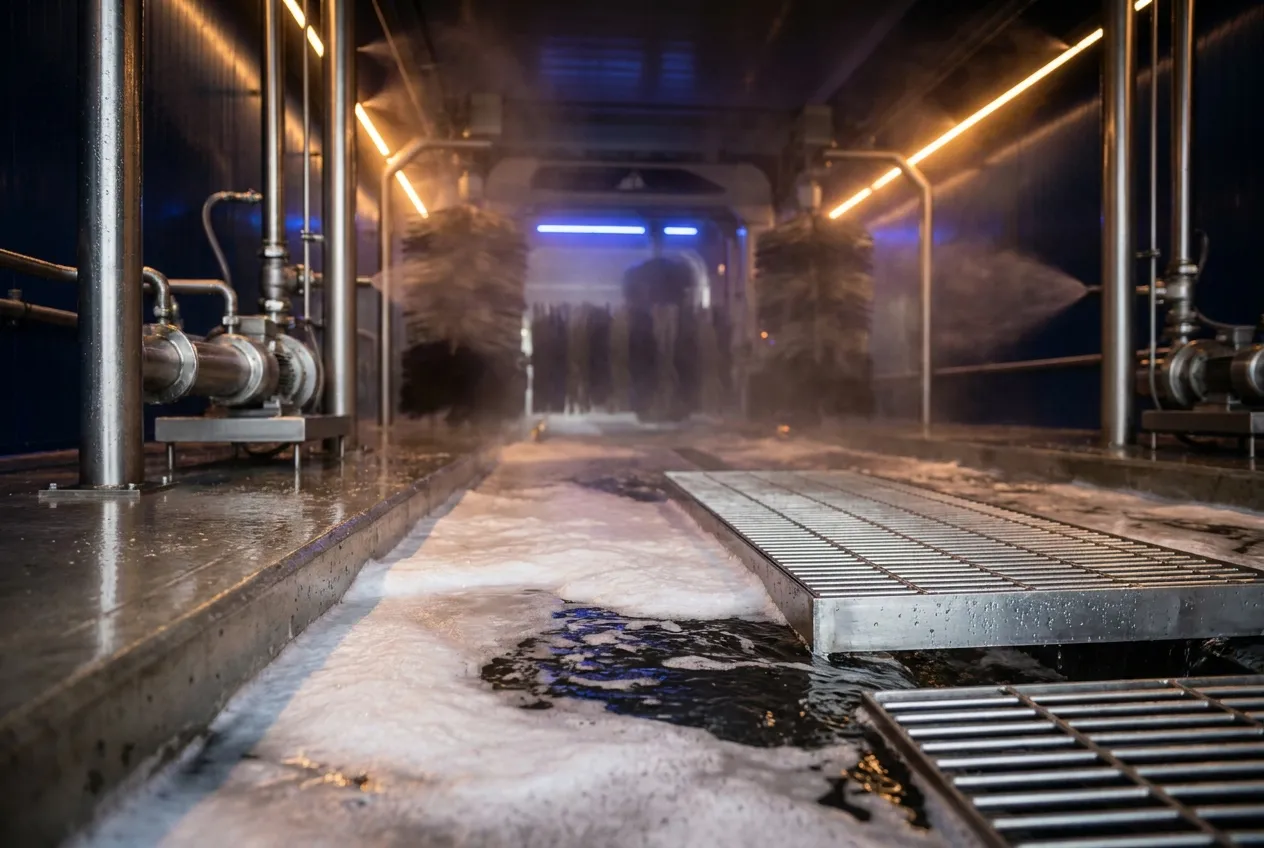
A tunnel runs eighty cars through on a Saturday morning, and by mid-afternoon the reclaim pit is wearing a foot of foam that creeps toward the floor grates. The crew skims it. It comes back. Someone starts asking whether it is time to pump and refill the pit again, eating a half day of downtime and a water-and-sewer bill nobody budgeted for.
The short version: car wash reclaim foam is almost always surfactant carryover. High-foaming triple-foam, presoak, and wheel chemistry ride the rinse water into the pit, where the reclaim pumps recirculate and re-agitate it into stable foam. A silicone defoamer knocks it down in minutes. Switching the upstream chemistry to an oil-free, reclaim-compatible product is what keeps it from coming back.
This is not the foam you put on the car on purpose. Foam-cannon soap and snow foam are built to cling and show; they are a different product with the opposite goal. The foam in the pit is the leftover surfactant from those products, whipped back up in the water you are trying to reuse.
Why does a car wash reclaim pit foam over?
Foam needs two things: a surfactant to lower the water’s surface tension, and agitation to whip in air. A reclaim system supplies both. Triple-foam, conditioners, and presoak are engineered to foam aggressively on the vehicle. That surfactant does not disappear at the rinse arch. It follows the water down the trench and into the reclaim tank, and your recirculation pumps entrain air into it every time they cycle.
| Cause | What is happening | The tell |
|---|---|---|
| Triple-foam / conditioner carryover | Foaming polymer and surfactant ride the rinse into the pit | Foam is worst after a run of foam-heavy packages |
| Presoak, tire and wheel cleaner | High-surfactant, sometimes high-pH chemistry carries over | Foam with a grey or oily cast |
| Recirculation agitation | Reclaim pumps entrain air into surfactant-loaded water | Foam builds through the day and peaks at high throughput |
| Oil and soil saturation | Loaded water cannot hold more, so surfactant stays at the surface | Greasy film, stubborn stable foam |
| Cool reclaim water (below ~120°F) | Oils and wax do not separate; bubble films persist | Worse in winter and on the first wash of the day |
One thing that looks like foam but is not: a steady stream of small bubbles from a pump suction line is usually an air leak, not surfactant foam. No defoamer fixes that. Tighten the plumbing.
What reclaim foam actually costs you
The foam itself is cosmetic. The cost is everything downstream of it. Foam overflows onto the equipment-room floor, carries back to the wash and re-deposits on cars as spotting, and fools level floats and sensors into misreading the tank. Pumps cavitate when they pull foam instead of water. A loaded, warm, foaming pit grows odor and biology.
The expensive failure is the one operators reach for first: dumping and refilling the pit early. That is fresh-water draw, sewer discharge, and downtime, often weeks before the pit actually needed it. Stop the foam and you stretch the dump interval, and that is where the money is.
How to knock reclaim foam down fast
A silicone defoamer is the fast tool. Polydimethylsiloxane (PDMS, CAS 63148-62-9) is water-insoluble and carries a very low surface tension; paired with hydrophobic silica, the droplets enter the foam film, spread across it, and rupture the bubble wall in seconds. It is delivered as a water-dispersible emulsion and works at parts-per-million.
Two rules decide whether it works cheaply or burns money:
- Dose where the water moves. Add it at the pit or the recirculation return where the water is agitated, not into a quiet corner where it just sits.
- Knock it down, then stop. Start low, a few ppm of active silicone, and add until the foam breaks. Effective control for surfactant foam usually lands in the low tens of ppm. Over-dosing wastes product, and the emulsifiers carried with it can actually re-stabilize foam.
Treat those numbers as a starting point to dial in against your own water, not a spec. The honest framing matters here: a defoamer is the knock-it-down-now tool, not the cure. If you are dosing the pit every single day, the chemistry feeding it is the real problem. For the underlying mechanism, see how a defoamer improves efficiency in recirculating water systems.
How to stop reclaim foam coming back
This is the part the product-listing sites skip. Defoamer buys you the afternoon; chemistry and housekeeping buy you the season.
| Lever | Why it ends the foam |
|---|---|
| Switch to oil-free / reclaim-compatible triple-foam and presoak | Formulated not to carry foam into reuse water; the single biggest fix |
| Recover and skim oils | Oil load stabilizes foam; pulling it out lets bubbles drain |
| Keep settling and separation working | Solids and oils that stay suspended keep the water primed to foam |
| Hold reclaim water warm enough | Above roughly 120°F, oils and wax separate instead of holding films |
| Right-size the pit, respect settling time | Short-cycling the water through an undersized pit re-agitates surfactant |
Do these and the pattern changes: instead of dosing defoamer constantly, you reach for it only when a busy day spikes the load. Operators on the forums put it plainly: you do not want to be running defoamer all the time, because it means you are treating a symptom.
When a silicone defoamer is the wrong call
Silicone is the strongest knockdown chemistry, which is exactly why it needs discipline.
- If your reclaim overflows to the sewer or an on-site bioreactor, heavy standing-dose silicone can carry over into that system. Spot-dose to break foam; do not run a continuous feed into water headed for biological treatment. The trade-offs of silicone versus organic chemistry are laid out in silicone vs. organic defoamers.
- If the “foam” is an air leak, it is a plumbing repair, not a chemical one.
- If you formulate car-wash products rather than operate a wash, the strongest silicone is not always the right grade. Recoat, clarity, and reclaim-compatibility needs can point to a silicone-polyether or a non-silicone defoamer in the finished product. The point is to match the grade to the system, not to default to silicone.
Buying defoamer for a car wash reclaim system
There are two buyers behind this problem, and they buy differently.
Operators want a drum or pail of emulsion at the pit. Silicone antifoam emulsions are sold by active concentration, from 10% through 50%. A higher-active concentrate is dilutable: you buy the concentrate, cut it to working strength on site, and pay less freight and water per pound of active silicone. For most reclaim pits a mid-active emulsion dosed at the recirculation point is the practical choice.
Car-wash chemical blenders and private-label brands are the larger, repeating buyer. They purchase bulk antifoam as a raw material to formulate reclaim-safe triple-foam and presoak. That is a tote or IBC conversation, and it is where carrying the full chemistry range matters: silicone antifoam emulsion for fast knockdown, plus silicone-polyether, polyether (EO/PO), and oil and fatty-acid non-silicone defoamers when the finished product needs them. Reclaim is, at bottom, an industrial water treatment problem, and the right answer depends on the water.
If you operate a wash, the fastest path is to trial a sample on your own reclaim water before you commit to a drum. A validated dose on your water tells you more than any spec sheet.
Frequently asked questions
How much defoamer do I add to a reclaim pit?
Start low, a few ppm of active silicone added where the water is agitated, and work up until the foam breaks, typically into the low tens of ppm for surfactant foam. Then stop. Standing-dosing wastes product and can re-stabilize foam. Dial the dose in against your own water; published ranges are a starting point, not a spec.
Will defoamer hurt my reclaim system or the cars?
Used correctly as a spot-dose to break foam, it should not. The risk comes from over-dosing or running a continuous feed, especially if your reclaim water discharges to a sewer or biological treatment, where silicone can carry over. Use it to knock foam down, not as a permanent additive, and confirm your local discharge requirements.
Why does the foam come back after I skim it?
Skimming removes the foam, not the surfactant that makes it. As long as high-foaming chemistry keeps carrying into the pit and the pumps keep recirculating, the foam rebuilds. The durable fix is oil-free, reclaim-compatible chemistry upstream.
Is this the same as foam-cannon or snow-foam soap?
No — it is the opposite. Foam cannon and snow foam are built to foam on the car on purpose. Reclaim foam is the leftover surfactant from those products, whipped back up in the water you are trying to reuse.
Can I just buy a more concentrated defoamer and dilute it?
Yes. Silicone antifoam emulsions come in 10% to 50% active grades, and the higher-active concentrates are dilutable. Buying the concentrate and cutting it to working strength on site lowers your freight and water cost per pound of active silicone.
Editorial note. This article is general guidance for commercial car-wash operators and formulators, written for industrial and professional use. Dosing figures are typical literature ranges and starting points to validate by trial on your own water, not guaranteed specifications or performance promises. Before changing reclaim chemistry or discharging treated water, consult the product Safety Data Sheet (SDS) and confirm your local sewer-discharge and water-reuse requirements. RawSource makes no warranty, express or implied, and assumes no liability for use of this information.
Search 1,300+ industrial chemicals by name or CAS, or send us your spec — we quote by the drum, tote, or container.
Browse the Chemical Index → Request a Quote