
Sodium lignosulfonate (CAS 8061-51-6) is a water-soluble anionic polymer recovered from the sulfite pulping of wood. It works primarily as a dispersant and concrete water reducer: the sulfonated lignin backbone adsorbs onto particle surfaces and keeps them from flocculating. Industry buys it for concrete admixtures, dye and pigment dispersions, agrochemical formulations, dust suppression on haul roads, and lead-acid battery plate expanders.
What is sodium lignosulfonate?
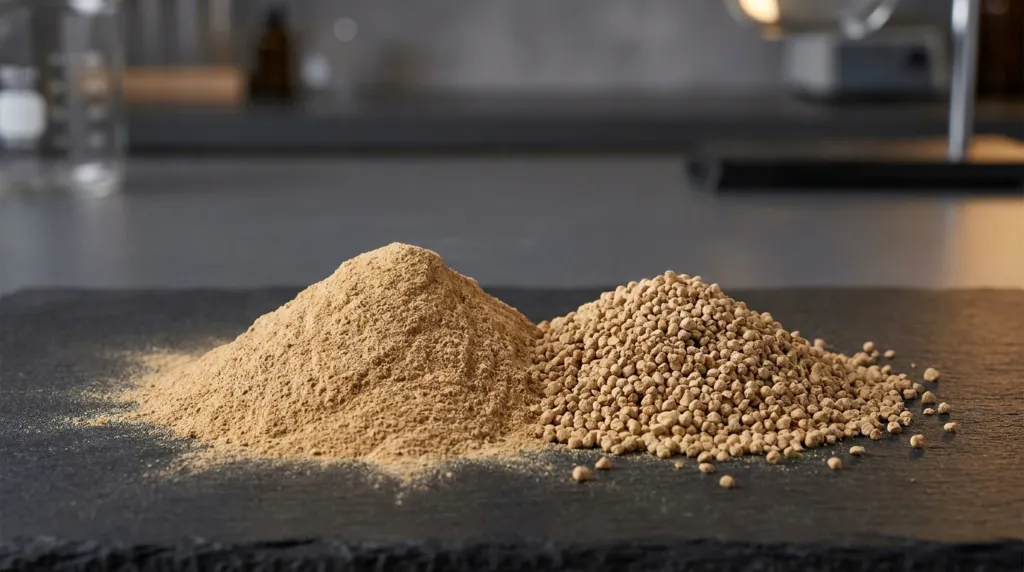
Lignosulfonates are the sodium, calcium, magnesium, or ammonium salts of lignosulfonic acid, a byproduct of the sulfite process used to separate cellulose fibers from the lignin that binds wood together. During cooking, sulfite ions attach to the lignin and sulfonate it; neutralizing with a sodium base gives the sodium salt. The result is a brown, free-flowing powder (also sold as granules or a 40-50% liquid) that dissolves readily in water.
It is a UVCB substance: a material of unknown or variable composition. There is no single molecular formula or molecular weight. The polymer is polydisperse, with chain weights running from roughly a thousand to several tens of thousands of g/mol depending on the wood source and how the liquor was processed. That variability is why grade selection and a trial run matter more here than a single spec line. Because it comes from wood-pulping byproducts, the material is derived from a renewable feedstock and is biodegradable, though it breaks down slowly.
Key properties & specifications
The table below lists typical values for a technical-grade sodium lignosulfonate powder. Treat these as representative ranges, not guarantees: actual figures vary by grade, and a current Certificate of Analysis governs any shipment.
| Property | Typical value / note |
|---|---|
| CAS number | 8061-51-6 |
| Synonyms | Sodium lignosulphonate, lignosulfonic acid sodium salt, sodium ligninsulfonate, SLS (context-dependent) |
| Appearance | Brown to dark-brown free-flowing powder or granules (also supplied as liquid) |
| Ionic charge | Anionic |
| Molecular weight | No fixed value — polydisperse polymer, roughly 1,000 to tens of thousands g/mol |
| Water solubility | Readily soluble; high-solids solutions are routine |
| pH (1% solution) | ~4 to 9 depending on grade |
| Bulk density | ~0.5 to 0.7 g/cm³ (powder) |
| Moisture | Typically ≤7% in dried powder grades |
| Grades | Concrete/admixture, dispersant, agricultural, dust-control, low-sugar/refined grades; powder vs. liquid |
One practical note on grade selection: reducing sugars left over from pulping can interfere with cement set, so concrete-admixture work usually calls for a low-sugar or fermented grade, while a general dispersant application can tolerate a standard grade. Confirm the reducing-sugar spec on the TDS before you commit to a concrete trial.
How sodium lignosulfonate works
The mechanism is adsorption plus charge repulsion. The lignosulfonate molecule carries anionic sulfonate groups along a branched, hydrophobic backbone. The backbone anchors to a particle surface — a cement grain, a pigment, a clay fine — while the sulfonate groups stay in the water and give the particle a negative surface charge. Like-charged particles push each other apart instead of clumping.
In a cement paste, that deflocculation releases water trapped inside particle clusters, so the same workability needs less mixing water. In a pigment slurry, the same effect keeps solids suspended and stops settling. The trade-off worth naming: lignosulfonates are mid-range performers. They are inexpensive and forgiving, but they will not hit the very high water reduction of a polycarboxylate superplasticizer, and overdosing in concrete can retard set or entrain air. They are a workhorse, not a high-range admixture.
Applications & dosage
The dose figures below are starting points. Lignosulfonates are batch-variable, so confirm performance with a trial on your own materials before locking in a loading.
Concrete water reducer / plasticizer
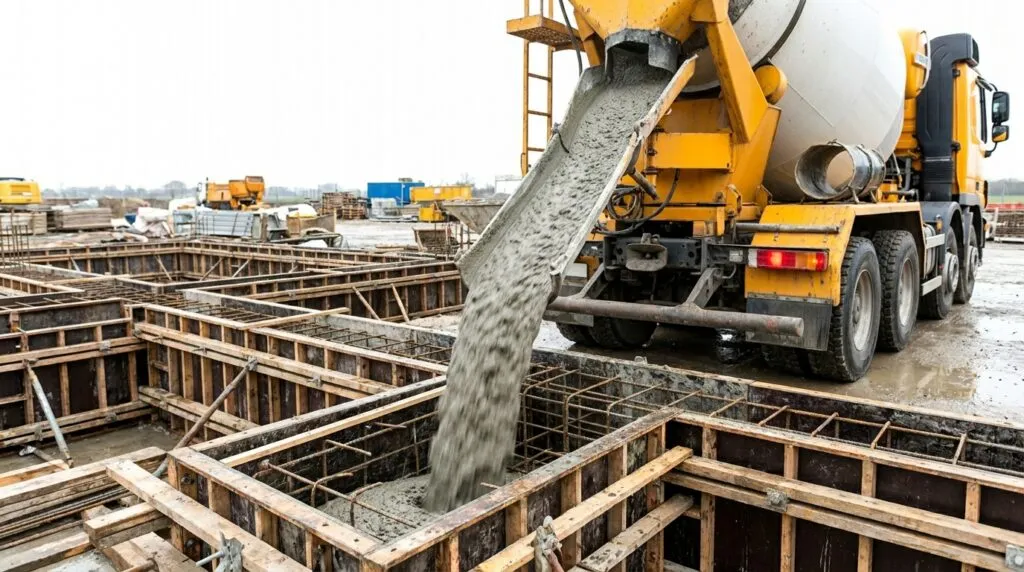
As a plain water reducer, sodium lignosulfonate behaves as an ASTM C494 Type A (water-reducing) admixture; it reaches Type D (water-reducing and retarding) only when blended with retarding components, so frame any Type D claim around the finished formulation, not the raw powder. Typical loading is 0.2-0.6% by weight of cement. Calcium lignosulfonate is the more common counter-ion for concrete; sodium is chosen where the mix chemistry favors it or where a low-calcium admixture is needed.
Dispersant for dyes, pigments, carbon black & agrochemicals
Used to disperse and stabilize solids in dye baths, pigment pastes, carbon black, and wettable-powder pesticide and agrochemical formulations. Typical loading is 0.1-1% of the formulation, dialed to the solids load and fineness. The high water solubility of the sodium salt is an advantage in spray-dried and water-based products.
Dust suppression on unpaved roads

Applied as a dilute spray, lignosulfonate binds fine particles together and to coarser aggregate, cutting fugitive dust on haul roads and unpaved surfaces. It is hygroscopic, so it also helps hold moisture in the surface. Application is typically a dilute aqueous solution at a rate set by surface area and traffic; reapplication is needed after heavy rain because it is water-soluble.
Lead-acid battery negative-plate expander
This is a sodium-specific use. Lignosulfonate is a component of the expander mix in the negative plate of lead-acid batteries, where it helps preserve the active surface area of the lead through charge-discharge cycling. Calcium lignosulfonate is not used here.
Other uses
Sodium lignosulfonate also serves as a pellet binder in animal feed, a deflocculant in ceramic bodies and slips, an additive in oil-well drilling fluids, and a carrier and chelating agent for micronutrients in agriculture.
Sodium vs. calcium lignosulfonate
Both salts share the same lignosulfonate chemistry and both act as plasticizers and dispersants. The counter-ion drives the choice. Calcium is the cheaper, default concrete water reducer because it is compatible with Portland cement chemistry. Sodium is preferred where calcium would be a problem — some dye and agrochemical dispersions, oilfield brines, battery expanders — or where higher solubility and a low-calcium product are needed. For the concrete-focused breakdown, see our calcium lignosulfonate page.
| Attribute | Sodium lignosulfonate | Calcium lignosulfonate |
|---|---|---|
| CAS | 8061-51-6 | 8061-52-7 |
| Counter-ion | Sodium | Calcium |
| pH (1%) | ~4 to 9 | ~3 to 6 |
| Primary use | Dispersant; specialty water reducer; battery expander | Concrete water reducer / plasticizer (the workhorse) |
| Concrete dose (by wt. cement) | 0.2-0.6% | 0.1-0.3% |
| Lead-acid batteries | Yes (negative-plate expander) | No |
| Chosen when | Calcium incompatible; high solubility / low-calcium needed | Lowest cost; Portland-cement compatible |
Packaging, bulk supply & lead time
RawSource is a sourcing partner: we supply sodium lignosulfonate in bulk to specification rather than producing it. Common formats are 25 kg bags, 500 kg and 1 MT (1,000 kg) bulk bags, and liquid in totes, shipped by the pallet, tote, or full truckload. Lead time depends on grade, volume, and current sourcing; container-load quantities and recurring supply programs are available. Tell us the application, the grade or spec you need, and the annual volume, and we will quote against it.
Quality & documentation
Technical Data Sheets, Safety Data Sheets, and a batch Certificate of Analysis are available on request. Because lignosulfonate is a variable, batch-dependent material, we recommend requesting the CoA for the specific lot and running a trial on your own formulation before scaling a new grade into production.
Methodology and sources
Identity and property context for Sodium Lignosulfonate (Sodium Ligninsulfonate) (CAS 8061-51-6) in this guide is anchored to the compound's PubChem record. Hazard-communication framing follows OSHA's Hazard Communication Standard, 29 CFR 1910.1200. Always defer to the supplier's current SDS and CoA for the specific grade and lot you handle.
Frequently asked questions
What is sodium lignosulfonate used for?
Its main uses are as a dispersant (dyes, pigments, carbon black, agrochemicals), a concrete water reducer, a dust suppressant on unpaved roads, an animal-feed pellet binder, a ceramic deflocculant, and the negative-plate expander in lead-acid batteries.
What is the difference between sodium and calcium lignosulfonate?
They share the same lignin-sulfonate chemistry but carry different counter-ions. Calcium is the standard, low-cost concrete water reducer. Sodium is used where calcium would be incompatible, where higher solubility is needed, or in battery expanders. See the comparison table above.
Is sodium lignosulfonate soluble in water?
Yes. It is highly water-soluble and dissolves readily to make high-solids solutions, which is part of why it is favored in water-based dispersions and spray-dried products.
What is the typical dosage in concrete?
As a water-reducing admixture, a typical starting range is 0.2-0.6% by weight of cement. Calcium lignosulfonate is more commonly used for concrete at 0.1-0.3%. Confirm with a trial mix, since the material is batch-variable.
Is sodium lignosulfonate biodegradable?
It is derived from renewable wood-pulping byproducts and is biodegradable, though it degrades slowly in the environment.
What is the pH of sodium lignosulfonate?
A 1% solution typically runs from about pH 4 to 9 depending on grade. Calcium lignosulfonate tends to be more acidic, around pH 3 to 6.
Search 1,300+ industrial chemicals by name or CAS, or send us your spec — we quote by the drum, tote, or container.
Browse the Chemical Index → Request a Quote