
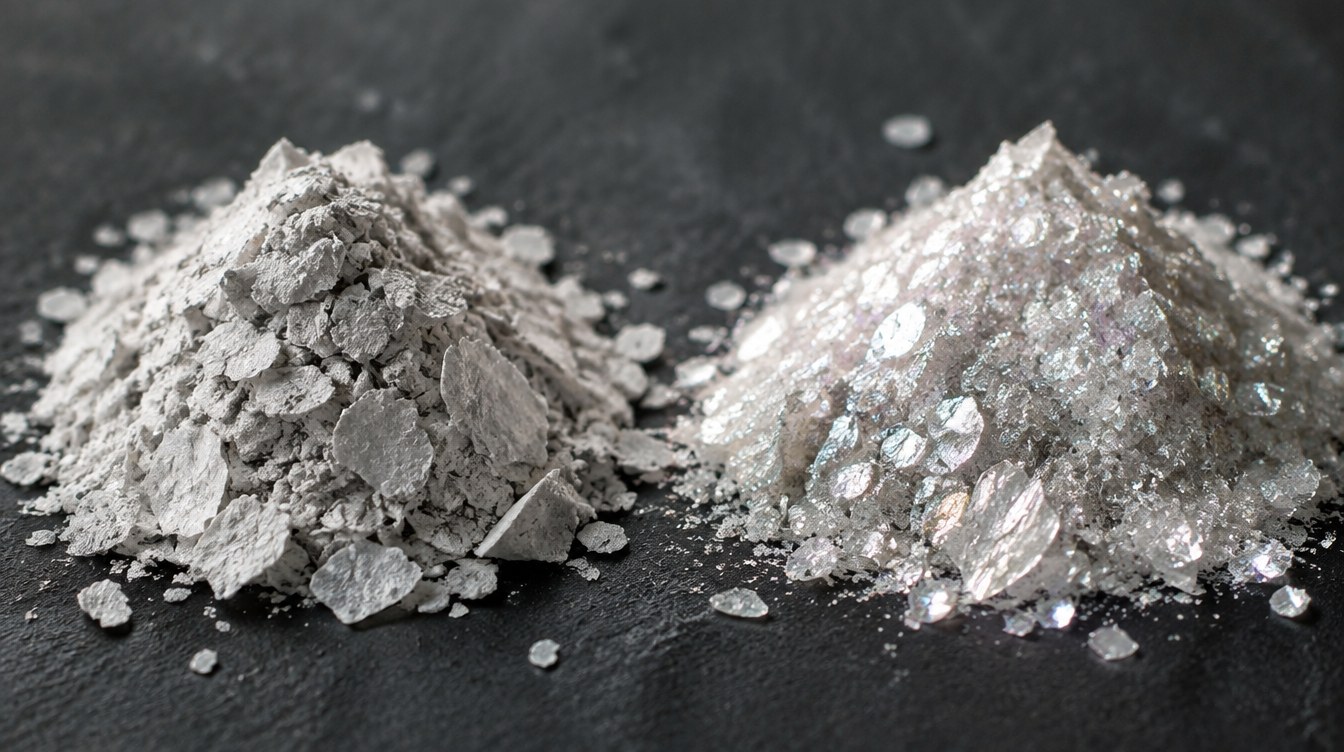
Your formulator approves a pearl eyeshadow on a lab sample. Purchasing re-quotes the mica on price, and the new purchase order reads “Mica, CAS 12001-26-2.” The first production lot presses cleanly, matches every line on its Certificate of Analysis (CoA), and comes off the line flat and slightly grey. Nobody shipped the wrong chemical. That registry number also covers mica sold as joint-compound filler and drilling-mud additive, and the supplier filled the order exactly as you wrote it.
That failure sits inside a wider mistake: treating synthetic FD&C and D&C colors and mica as two shades of the same purchase. They are different buys. A dye, its lake and a mica platelet put color in front of the eye by three different mechanisms, and each mechanism has its own way of going wrong on a production line. Specify the mechanism first and the shade second, and most of these rejections never happen.
Dyes and lakes absorb, mica reflects
A synthetic dye is a soluble organic molecule. It dissolves in the phase it is added to and absorbs part of the visible spectrum, which is why it gives clean, transparent color in water-based systems. It also goes wherever that phase goes, so in a layered product, an emulsion or a coated tablet it can migrate and bleed into neighboring layers.
A lake is the same dye fixed onto an insoluble substrate, usually alumina. It still colors by absorption, but it now behaves as a dispersed pigment particle that stays where you put it, within the lake’s stable pH range. Outside that range the substrate can dissolve and free the dye to bleed.
That is why lipstick, pressed powder and tablet coatings call for FD&C and D&C lakes and not the parent dyes. The two forms are not substitutes on a line, even when the color name on the drum is identical.
Mica does something else. It is a platy aluminosilicate mineral that absorbs little visible light. Its value is geometry: flat, smooth platelets reflect light like small mirrors, which reads as luster and slip. Coat those platelets with a thin layer of titanium dioxide or iron oxide and the reflections interfere, producing pearl and interference colors that shift with coating thickness and viewing angle. On its own, mica is a substrate and an effect, not a hue.
| Synthetic dye | Lake (dye on alumina) | Mica | |
|---|---|---|---|
| How it colors | absorbs light while dissolved | absorbs light as a dispersed particle | reflects and interferes at platelet surfaces |
| In water | dissolves | does not dissolve | insoluble (NIOSH, 2024) |
| Heat | organic, decomposes far below mineral temperatures | follows the parent dye | melting point 1500 °C (PubChem); loses structural water well below that |
| Bleed between phases | travels with its phase | stays put inside its stable pH range | stays put |
| The grade question | which dye, which solvent system | dye content on the substrate, particle size | platelet size, coating, whiteness, impurity profile |
| Typical job | transparent color in water-based systems | saturated, bleed-free color in anhydrous and pressed systems | luster, pearl, slip, substrate for effect pigments |
The practical rule falls out of the table. If the brief says hue, buy an absorber: a dye for water-based systems, a lake where bleed is unacceptable. If the brief says luster or pearl, buy a platelet. If it says both, buy both, and specify each against its own job instead of asking one to cover for the other.
What does the mica CAS number identify?
The PubChem record for mica (CID 131842327) gives a formula of Al6F2H2K2O22Si6 and a molecular weight of 800.60 g/mol. Read the formula and you see an idealized potassium aluminum silicate carrying fluoride and hydroxyl, close to the muscovite type. That is a reference composition, not a measurement of anything you will receive. Natural mica is a family of minerals with substitution in its structure, and the record’s synonym list names muscovite alongside other mica species and a run of trade grades.
The density entry makes the same point. PubChem, citing NIOSH, lists mica’s density as 2.6 to 3.2 with no unit: a specific gravity, relative to water. That spread is not a manufacturing tolerance; it is the difference between mica minerals, with the darker, iron-rich micas toward the heavy end.
For a buyer it has two consequences. A grade change can shift how much volume a fixed weight of mica fills in a pressed powder or a paint film. And a dark, iron-bearing mica will never give the clean white base a pearl pigment needs.
Now look at what the same registry number is sold for. The catalog record for CAS 12001-26-2 lists mica as a functional filler in drywall joint compound, an additive in oil-well drilling muds, an extender and reinforcing filler in paints, a filler in roofing products and rubber compounds, and sheet mica for heat-resistant electrical insulation. Each of those is a legitimate grade. None of them is built for the whiteness and platelet integrity a color cosmetic or a decorative coating depends on.
Here is a position worth testing against your own files: a mica CoA that reports molecular weight is a warning sign. A mineral lot has no molecular weight you can measure, so that line was copied from a database record. If the document leads with registry data and leaves out particle size and impurity results, it was written for the filler trade, whatever the product name says.
Writing a mica spec that a filler grade cannot pass
The CAS number belongs on the order, but as one line of the identity block, not the whole specification. These are the fields that separate an effect grade from a filler grade:
-
End-use grade stated in words: the cosmetic or decorative-coating grade your regulatory lead approved, not “mica powder.”
-
Particle size distribution, as the range from the supplier’s Technical Data Sheet (TDS), tested on the lot. Fine platelets read as satin; coarse platelets read as sparkle.
-
Surface treatment or coating: uncoated, titanium dioxide coated or iron oxide coated, named, because the coating sets the pearl or interference color.
-
Whiteness or color against a retained physical standard, judged in your own drawdown or pressed pan.
-
Impurity results, heavy metals included, reported against the limits your regulatory lead sets for each market.
-
Microbial results for cosmetic grades, where your quality system calls for them.
-
Lot traceability back to the source deposit or synthesis batch, so a second lot can be matched to the first.
Approve the first lot against the retained standard, not against the CoA alone. A CoA tells you the lot met the numbers the supplier chose to report. The standard tells you whether it looks like the sample your formulator approved, which is the only test the finished product will face.
Before you reject a flat lot, rule out your own process. PubChem’s 1500 °C melting point is not a color-stability limit: natural mica starts losing structural water well below it, though still above the temperature of a cosmetic hot-pour or a coating bake, so heat seldom explains lost luster. Shear does.
A high-shear mill or homogenizer running after the pearl pigment goes in breaks platelets, and broken platelets scatter light instead of reflecting it. Add effect grades late, at low shear, and run a retained lot through the same process before you blame the new one.
Where does a lake still beat mica?
Mica cannot give you a saturated red or a deep blue on its own. Interference colors depend on viewing angle and wash out against a light background, so a lipstick shade or a coated tablet that must read the same from every angle needs an absorbing colorant. That is the lake’s job, and in a pressed or anhydrous product it does it without bleeding into the next layer.
The reverse also holds. A lake will never give you luster, however much you load. Push lake loading up to compensate for missing sparkle and you get a darker, muddier shade at a higher cost per batch. Most finished color products therefore use both: a lake or dye for hue, mica for luster and slip, and a coated mica where the brief calls for pearl.
The procurement job is to keep the two on separate line items with separate specifications. Bundle them under one “colorants” line and a price-driven substitution on one can quietly change the other, which is how a cheaper mica ends up blamed on a lake that never changed.
Two families, two document sets
Under US rules the two families sit on opposite sides of batch certification by the Food and Drug Administration (eCFR, current as of September 30, 2026): each FD&C or D&C lake “shall be considered to be a straight color” (21 CFR 82.51 and 82.1051), 21 CFR 82.5 sets the conditions for certifying a straight color batch, and the certificate for a certified batch shows the lot number assigned to it (21 CFR 80.31). Mica batches “are exempt from the certification” (21 CFR 73.2496(d), eCFR, September 30, 2026).
That split is your document check, so do not let one CoA template cover both. A color additive that is not exempt must carry in its labeling “the lot number assigned by the Color Certification Branch” (21 CFR 70.25(d), eCFR, September 30, 2026). Make that number a release field on the lake line, and treat a lake lot that arrives without it as unusable, however good its chemistry looks. A mica lot has no certification lot number to check; release it against your own specification.
The eyeshadow in the opening needs one more check. No listing or certification authorizes a color additive in an article intended for the area of the eye unless it “specifically provides for such use” (21 CFR 70.5(a), eCFR, September 30, 2026). Mica’s listing does, covering cosmetics “applied to the area of the eye” (21 CFR 73.2496(b), eCFR, September 30, 2026). Confirm that each lake’s own listing provides for eye-area use before it goes on an eye-product order. Outside the US, ask your regulatory lead which documents each market requires.
For handling, check the current Safety Data Sheet (SDS) for each grade before the first bag is opened. The safety and hazards section of the PubChem mica record is a starting point for your safety lead, not a substitute for the supplier’s SDS on the lot you receive. Fine powders from either family belong under dust control at the weigh station.
Methodology: mica identity and physical data come from the PubChem compound record (CID 131842327), which cites NIOSH (2024) for density and solubility; the application list comes from the catalog record for CAS 12001-26-2; US certification and eye-area rules are quoted from Title 21 of the eCFR, current as of September 30, 2026. Colorant mechanisms are general pigment chemistry; confirm regulatory status for your products against the current listing text in each market.
Frequently asked questions
Can a mica pearl pigment replace an FD&C lake to hit the same shade?
Is a CoA that matches CAS 12001-26-2 enough to release a cosmetic mica lot?
Why does mica density appear as a range and not a single value?
A new mica lot reads flat in my product. Is the supplier at fault?
Sources & methodology
Figures are RawSource sourcing data unless attributed to a named source. Regulatory citations are current as of publication. Chemical identities verified by CAS number against the RawSource catalog.
Search 1,300+ industrial chemicals by name or CAS, or send us your spec — we quote by the drum, tote, or container.
Browse the Chemical Index → Request a Quote