

By RawSource Sourcing Desk, Commercial & Sourcing Desk, RawSource (about)
A 10 kg bag of fumed silica arrives labeled 200 m2/g, the exact grade your lab qualified. The sealant line still drops below target viscosity at the same 2% loading, and the batch goes on hold. The label was not wrong. The specification you read off it was incomplete, because two powders at the same nominal surface area can disperse and thicken differently depending on how they came out of the flame and what happened to their surface afterward.
Buying fumed silica well starts with understanding the process that makes it. The production route fixes the particle structure and purity, plus the surface chemistry, and those three things drive every performance number you care about downstream. This guide walks the pyrogenic process step by step, then translates it into the specifications and CoA fields that belong in a request for quote.
What is fumed silica, and how is it made?
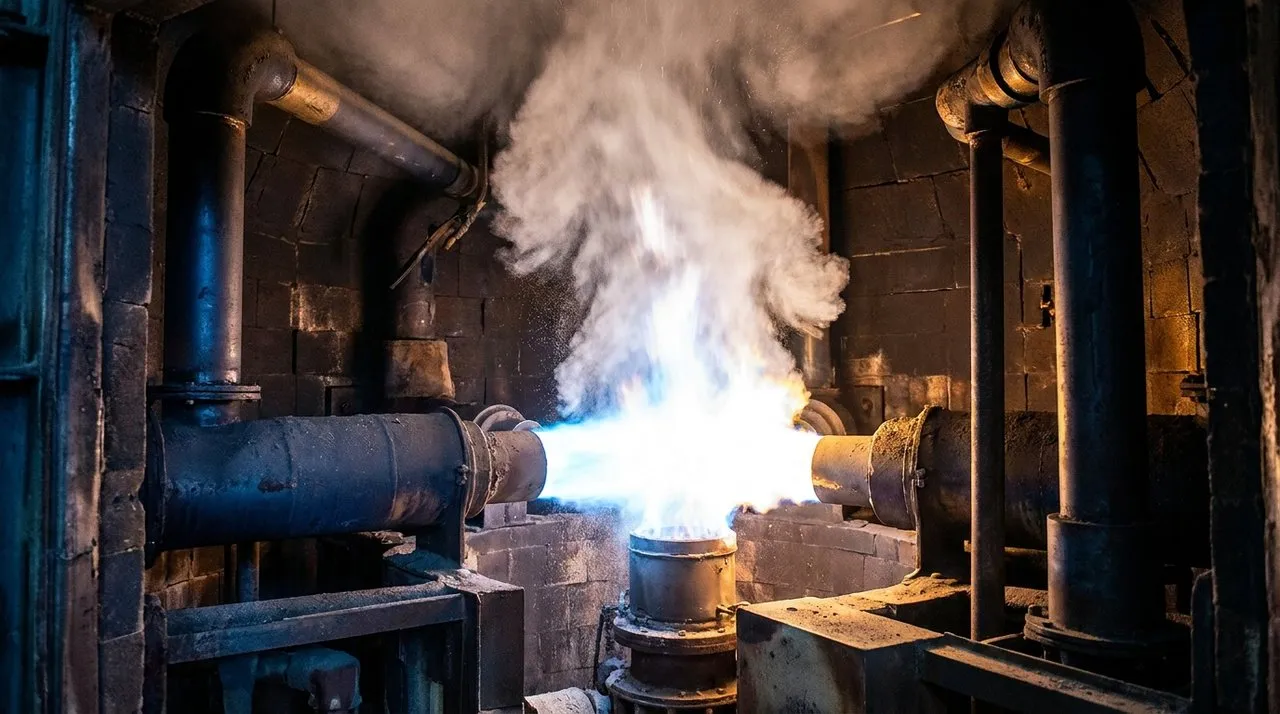
Fumed silica is synthetic amorphous silica produced by flame hydrolysis of silicon tetrachloride. Silicon tetrachloride (SiCl4) vapor is fed into a burner with hydrogen and air, and combusts. Water formed in the flame hydrolyzes the SiCl4 to silicon dioxide, and the overall reaction is:
SiCl4 + 2 H2 + O2 -> SiO2 + 4 HCl
The feedstock sets the purity. Silicon tetrachloride is a distilled liquid, supplied either as a dedicated product or recovered from other silicon chemistries, and distillation strips the metal impurities that plague mined-mineral routes. A clean vapor going into the flame is why the powder coming out is so pure.
The flame runs at roughly 1,000-1,800 degrees C. At that temperature the silica forms as molten spherical nuclei that collide and fuse while still hot. The result is not a simple powder of separate spheres. Primary particles of about 5-50 nm sinter together into branched, chain-like aggregates of roughly 0.1-0.5 micron, and those aggregates cluster loosely into larger agglomerates that break apart again under shear.
This three-level structure is the whole point. Primary particles fix the surface area, the fused aggregates carry the reinforcing and thickening power, and the loose agglomerates are what disperse back apart when you mill. The branched aggregates form a temporary network in the liquid that collapses when you stir and rebuilds when you stop, which is the thixotropy buyers pay for at loadings of only a few percent.
The downstream steps matter as much as the burner:
- Separation. The white powder is pulled out of the cooled gas stream in cyclones and filters. As collected, it is extremely low in bulk density, often on the order of 40-60 g/L tapped for untreated grades, which is why a 10 kg bag is so bulky.
- Deacidification. Residual hydrogen chloride clings to the fresh surface and is driven off by heating in humid air. The recovered HCl is reused, and finished hydrophilic grades typically read a chloride content well under 250 ppm.
- Optional surface treatment. Hydrophobic grades go through a further reaction that caps the surface silanol groups with silanes or siloxanes (covered below).
Two facts about the output anchor everything else. Purity is high because the feedstock is a distilled vapor: finished fumed silica is commonly >99.8% SiO2. And the silica is amorphous, not crystalline, which changes how it is regulated and handled. PubChem records silicon dioxide as insoluble in water, with a density near 2.2 g/cm3 and a melting point around 1,710 degrees C (PubChem CID 24261). Flame hydrolysis as an industrial route was commercialized in the 1940s and has been the standard pyrogenic process ever since.
Why does the flame route produce a different material than precipitated silica?
Because one route is dry and pyrogenic while the other is wet and chemical, and the two histories leave the particles with different surfaces, porosity, and purity. Precipitated silica is made by neutralizing a sodium silicate (waterglass) solution with acid, then filtering, washing, and drying the precipitate. That wet route leaves internal porosity and residual salts, and it gives a denser, more porous particle. The flame route gives non-porous primary particles and higher purity, with a lower density of surface silanol groups.
For a buyer, the practical consequence is that the two are not interchangeable on a per-kilogram basis. The table below summarizes the differences that show up in a spec sheet.
| Property | Fumed (pyrogenic) silica | Precipitated silica |
|---|---|---|
| Production route | Flame hydrolysis of SiCl4 (dry) | Acid neutralization of sodium silicate (wet) |
| Main byproduct | HCl (recovered) | Sodium sulfate / wash salts |
| Particle structure | Non-porous, branched aggregates | Porous, more compact |
| Typical BET surface area | ~50-400 m2/g | ~30-200 m2/g |
| SiO2 purity | >99.8% | Lower; residual salts |
| Tapped density | Low (~40-60 g/L untreated) | Higher |
| Primary role | Thixotropy, reinforcement, clarity | Bulk filler, carrier, anti-caking |
| Relative cost | Higher | Lower |
The price gap between the two routes is structural, not a margin choice. The flame process consumes purified silicon tetrachloride and hydrogen, plus the energy to run a high-temperature burner, then spends further plant capacity recovering hydrogen chloride and deacidifying the powder. The wet route runs near ambient temperature on cheaper sodium silicate.
That cost difference follows the material to your dock. A switch from a fumed to a precipitated grade can cut raw-material spend sharply where the application tolerates it, while a switch in the other direction buys purity and structure the wet route cannot match at any price. Price the two on delivered cost per functional unit, not per kilogram: a fumed grade that thickens at 2% can undercut a precipitated grade that needs 6% to reach the same viscosity.
If your application is reinforcement of silicone rubber, sag control in an adhesive, or anti-settling in a clear coating, the structure and purity of the fumed grade earn the premium. If you are carrying a liquid onto a powder or anti-caking a dry blend, precipitated silica usually does the job for less. The trade-off is laid out in more detail in the fumed silica versus precipitated silica comparison.
What do surface area and particle size tell you when buying?
BET surface area is the single number that best predicts how a fumed silica will behave, so specify it first. Surface area scales inversely with primary particle size: smaller particles from a hotter, faster flame give higher surface area, more silanol groups per gram, and stronger network building. That is why grade families are sold by their nominal BET value, measured by nitrogen adsorption (the BET method).
| Nominal BET surface area | Dispersion and thickening | Typical role |
|---|---|---|
| ~90-150 m2/g | Easier to wet out, moderate build | Lower-viscosity coatings, easy-mix systems |
| ~150-250 m2/g | Strong thixotropy, the workhorse range | Adhesives, sealants, paints, gel coats |
| ~300-400 m2/g | High reinforcement, harder to disperse | Silicone elastomer (HTV/RTV) reinforcement |
Two cautions sit behind that table. First, higher surface area thickens more per gram but demands more shear energy to deagglomerate; under-dispersed high-surface-area silica leaves grit and gives you less viscosity than a properly dispersed lower grade.
Second, nominal BET is a target with a tolerance, often plus or minus 15-25 m2/g around the stated value, so the CoA value, not the grade name, is what you check against your formulation window. The earlier viscosity miss usually traces to one of two causes: a CoA BET sitting at the low edge of tolerance, or incomplete dispersion on a line tuned for an easier grade. Both are catchable on incoming inspection if you read the measured number instead of trusting the nameplate.
Particle size on a fumed silica is reported as the primary particle size (nanometers) and is mostly informational; you cannot sieve or filter aggregates back to primaries. What you control on the floor is dispersion energy and order of addition, not the inherent particle size.
When do you need hydrophobic (treated) fumed silica?
You need a hydrophobic grade when the system is non-polar, moisture-sensitive, or prone to water pickup that destroys the silica network. Untreated (hydrophilic) fumed silica is covered in silanol (Si-OH) groups that love water and polar solvents. Those groups are what let it disperse in waterborne coatings and build structure there. In a non-polar resin, in a solvent-free sealant, or in a cosmetic emulsion, the same silanols can absorb moisture and clump, losing thickening efficiency.
Hydrophobic grades fix this by reacting the surface silanols with a treating agent after the flame step. Common chemistries include dimethyldichlorosilane, hexamethyldisilazane, and longer-chain organosilanes. The treatment caps the polar sites, lowers moisture uptake, and improves dispersion in non-polar media. One widely used surface modifier is a trimethoxycaprylylsilane-treated fumed silica (CAS 92797-60-9); a related dimethyl-silylate hydrophobic grade (silica dimethyl silylate, CAS 68611-44-9) is common in personal-care and sealant work.
A short decision rule helps at the RFQ stage:
- (a) Polar or waterborne system, no moisture worry: a hydrophilic grade is usually correct and cheaper.
- (b) Non-polar resin, solvent-free sealant, or moisture-sensitive package: specify a hydrophobic grade and the treatment chemistry.
- (c) Clear or optical system: confirm the grade is designed for transparency, because treatment and dispersion both affect haze.
Hydrophobic treatment also lowers the silanol count, which slightly reduces the surface area read by BET and changes the thickening response, so re-qualify loading when you switch from a hydrophilic to a hydrophobic grade. Application notes for the rheology-control side live in the guide on fumed silica in paints, coatings, and adhesives, and the reinforcement side is covered for rigid systems in fumed silica in PVC.
How is fumed silica regulated and handled?
Fumed silica is amorphous, so it is regulated apart from respirable crystalline silica, and that distinction belongs in your incoming-goods paperwork. Crystalline silica (quartz, cristobalite) is the form tied to silicosis and the tight occupational limits. OSHA sets a respirable-crystalline-silica permissible exposure limit of 50 micrograms/m3 as an 8-hour time-weighted average, with a 25 micrograms/m3 action level.
Fumed silica, made and kept amorphous, does not fall under that crystalline limit; NIOSH lists amorphous silica with separate, much higher exposure guidance (NIOSH Pocket Guide, amorphous silica). Confirm the SDS states amorphous, crystalline-free, and carries a fumed-silica CAS (112945-52-5) rather than a crystalline-quartz number. The distinction is worth checking on every supplier, because a generic “silica” SDS that cites a quartz CAS will pull your site into respirable-crystalline-silica recordkeeping that the amorphous powder does not require.
For food, pharma, and personal-care buyers, silicon dioxide is an established additive. The U.S. FDA permits silicon dioxide as an anticaking and stabilizing agent in food up to 2% by weight under 21 CFR 172.480. If you are buying into one of those channels, request the grade’s food, USP/NF, or pharmacopeial documentation explicitly, because industrial and food grades are made on the same flame but qualified to different standards.
Handling is a dust-control question, not a toxicity-class question. The powder is light and airborne, so use local exhaust, dust masks rated for fine particulate, and grounding on transfer lines. Treat spills as a slip and inhalation nuisance and clean with vacuum rather than dry sweeping.
What should be on the CoA and in the RFQ?
Specify the performance levers, not just the product name, so two suppliers quote the same material. A fumed silica RFQ that prevents the viscosity surprise at the top of this guide should pin the following:
- BET surface area, with tolerance (for example, 200 m2/g, plus or minus 25). This is the primary lever.
- Surface treatment: hydrophilic, or hydrophobic with the named chemistry.
- Tapped (or pour) density, which drives bag count and storage volume, and the freight you pay on a low-density solid.
- Loss on ignition and moisture, which track silanol and adsorbed water and affect dispersion.
- pH of aqueous dispersion (untreated hydrophilic grades commonly read about 3.6-4.5 in a 4% dispersion).
- Purity and chlorides (>99.8% SiO2; residual chloride typically under 250 ppm on hydrophilic grades).
- Grade qualification: industrial, food (21 CFR 172.480), or pharmacopeial, with the matching documentation.
Require the CoA to report the actual measured BET, not just the grade nameplate, and check it against your formulation window on every lot. On a material sold by surface area, lot-to-lot BET drift inside tolerance is the most common quiet cause of viscosity and reinforcement shifts.
Two structural specs also affect total landed cost. Because tapped density is low, freight and warehouse cube can rival the per-kilogram difference between grades, so model density into the TCO before you switch suppliers on price alone. And because fumed silica picks up moisture, confirm packaging (moisture-barrier liners, pallet wrap) and shelf life in the same RFQ.
How RawSource helps
If you are matching a grade to a formulation, the RawSource fumed silica listing sets out the grade and treatment options, and the amorphous silica page covers the broader synthetic-silica family; send a target BET surface area and treatment level, plus the grade qualification, with a request for quote so the response matches your spec window instead of a nameplate. For application context by end market, the Coatings & Construction and Plastics & Polymers hubs map where each grade tends to land.
Methodology: surface-area, density, pH, and purity ranges in this guide are typical commercial values for pyrogenic silica grades and should be confirmed against the supplier CoA for the specific lot. Regulatory figures cite OSHA, FDA (21 CFR 172.480), NIOSH, and PubChem as of June 2026.
Frequently asked questions
Is fumed silica the same as silica fume?
Is fumed silica a respirable crystalline silica hazard?
How much fumed silica is needed to thicken a system?
What is the difference between hydrophilic and hydrophobic fumed silica?
Fumed silica versus precipitated silica: which should you buy?
Sources & methodology
Regulatory citations are current as of publication. Chemical identities verified by CAS number against the RawSource catalog.
Search 1,300+ industrial chemicals by name or CAS, or send us your spec — we quote by the drum, tote, or container.
Browse the Chemical Index → Request a Quote