
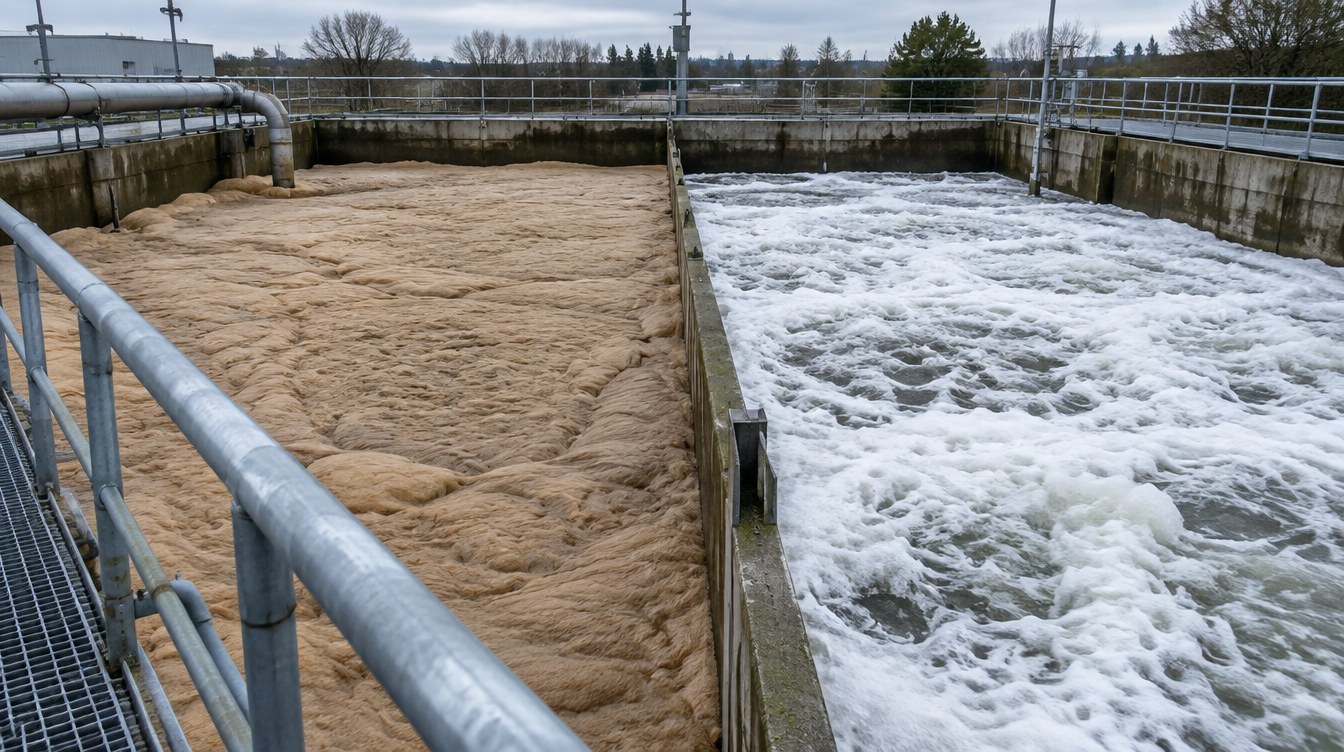
The request from the wastewater plant reads like last month’s: foam across the aeration basin, sludge riding over the weir, order more defoamer and raise the dose. Before that order goes out, ask what color the foam is and how long it stands. A defoamer collapses foam held up by surfactants and keeps it down. Foam built by filamentous bacteria collapses too, then comes back, because the organisms holding it up keep growing until the plant changes how it runs.
How does a defoamer improve efficiency in wastewater treatment?
A defoamer breaks the liquid films that hold bubbles together, so foam stops carrying sludge over weirs, burying level sensors and filling digester gas space. That protects capacity and operator time. It controls surfactant foam, confirmed in a plant trial. On biological (filamentous) foam it is a stopgap: the foam returns until sludge age, grease load and scum recycling are corrected.
The efficiency case is real but narrower than a sales sheet suggests. Foam that spills over a basin wall takes mixed liquor solids with it, so the plant loses the biomass doing the treatment. Foam in a digester takes working volume and can reach the gas piping. Foam on walkways and weirs takes staff time to hose down. The oxygen-transfer argument cuts both ways, and the section on aeration below explains why.
Foam is gas held in thin liquid films. Surfactants, proteins and the water-repellent surfaces of some bacteria line those films and slow their draining. A silicone defoamer is an insoluble oil, polydimethylsiloxane with the repeat unit (C2H6OSi)n, often carrying hydrophobic silica particles. A droplet enters a film, spreads or bridges across it, and the film thins and breaks. Silicone antifoam emulsion disperses that oil in water so a small dose spreads through a large basin.
Where does foam form in a treatment plant, and which dose point answers it?
Foam control for water treatment is a dose-point decision as much as a product decision. Each unit foams for its own reason, and product fed at the wrong point either misses the foam or leaves the plant with the effluent.
| Where it foams | What builds the foam | What you see | Dose point | What the defoamer does |
|---|---|---|---|---|
| Aeration basin, surfactant foam | Detergents and process surfactants in the influent; a new basin starting up; a slug from one industrial discharger | White, billowy, watery foam | Continuous feed into the basin inflow or the return sludge line, so the active is mixed in before foam forms | Fixes it while you trace the source |
| Aeration basin, biological foam | Filamentous bacteria with water-repellent cell surfaces, favored by grease and a long sludge age | Brown, thick, greasy foam that floats sludge and resists collapse | Spray onto the foam, for access and to keep it off the weirs | Stopgap only; the foam returns until the cause is corrected |
| Anaerobic digester | Biogas rising through feed rich in surface-active material; overloading; poor mixing; filaments arriving in the waste sludge | Dense foam rising into the gas space | Into the feed or recirculation line, plus a spray through a cover port, where one exists, when foam rises | Protects gas space and piping while loading and mixing are checked; silicone dosed here can carry siloxanes into the biogas, which leave silica deposits in engines and boilers that burn it |
| Secondary clarifier | Foam carried over from the aeration basin | Foam and scum mats on the surface and at the weirs | Upstream, at the aeration basin; skim the scum out of the plant | Controls the carryover; clarifier scum is usually biological foam, so treat its cause upstream |
| Effluent drop or outfall | Air entrained where effluent falls; residual surfactants | White foam at the drop | Last resort, because product dosed here leaves with the discharge | Check the discharge permit first |
One clarifier symptom is not foam at all. Clumps of sludge rising from the blanket with fine gas bubbles in them can be lifted by nitrogen gas from denitrification in a blanket held too long. A defoamer does nothing for that; pulling sludge out of the clarifier faster does.
The inflow and digester feed points are antifoam duty: the product is in the water before foam forms. The spray is defoamer duty, collapsing a head that already stands. The difference between antifoam and defoamer comes down to that dose point more than to the chemistry in the drum, and continuous feed ahead of the foam avoids the cycle of build-up and knockdown.
Why does biological foam come back after the defoamer goes in?
Filamentous foam is a population problem, not a surface problem. Organisms such as Microthrix parvicella and the nocardioform actinomycetes, the group that includes Gordonia, have water-repellent cell surfaces. They attach to rising air bubbles, concentrate in the foam and hold it stable. Knock the foam down and the organisms are still in the mixed liquor, so the foam rebuilds as soon as aeration lifts them again.
Grease in the influent, a long sludge age and scum that goes back into the process all favor them. A plant that returns skimmed foam to the headworks reseeds the basin with the organisms it is trying to lose, and foam pumped to the digester can foam the digester instead.
The fixes are operational: waste more sludge to shorten sludge age, as far as nitrification allows (cold months need a longer sludge age just when this foam is worst), cut grease at its source and at the primary clarifier, haul skimmed foam out of the plant, and check a foam sample under the microscope before and after each change.
Dose a defoamer through that period to keep weirs clear and walkways usable, and plan to stop once the filaments fall back. Choose that stopgap with care. A defoamer carried on vegetable oil or fatty esters adds the long-chain fatty material that Microthrix parvicella grows on. In a basin where filaments dominate, a silicone grade is the cleaner stopgap on that count, because the silicone itself is not food for the organisms; ask which emulsifier the emulsion carries, since fatty-acid esters there can feed them too.
Does a defoamer cut oxygen transfer in the aeration basin?
It can, and this is where a foam program quietly costs energy. Diffusers release fine bubbles because small bubbles carry more surface per volume of air, and oxygen crosses into the mixed liquor through that surface. A defoamer works by thinning bubble films and letting bubbles merge. Overdosed into the basin, it can do the same to diffuser bubbles: fine bubbles coalesce into coarser ones, the gas surface shrinks, and transfer falls. The blowers then run harder to hold the dissolved oxygen setpoint.
So measure before you assume. Log blower airflow or power against dissolved oxygen before a dose change and again after it. Lower the dose in steps until foam starts to come back, then run just above that floor. If air demand climbs as the dose rises, the defoamer is costing oxygen transfer. Excess silicone can also coat diffusers and, in a membrane bioreactor, membrane surfaces, which is a second reason to dose to the foam and not to the tank.
What should an order for a water treatment defoamer specify?
Silicone antifoam emulsion (10-50% active) is cataloged at 10%, 20%, 30%, 40% and 50% active silicone, as a Technical Grade, for aqueous foam control in uses that include water treatment. Kilogram for kilogram, a 50% active grade carries five times the silicone of a 10% active one. Compare quotes per kilogram of active, and ask what the percent active counts: silicone alone, silicone with silica, or total solids.
Put these on the request for quotation:
-
The foam and the unit: surfactant or biological, aeration basin, digester or clarifier.
-
The dose point and method, continuous feed, level-triggered shot or spray, and the dilution your feed system makes, so the supplier can confirm the emulsion stays stable once diluted.
-
Membranes, water reuse or other silicone-sensitive equipment downstream, with the membrane manufacturer’s list of accepted antifoam chemistries.
-
Storage conditions, including outdoor tanks in winter, because a water-based emulsion can break if it freezes.
-
A certificate of analysis (CoA) tied to the lot, and the current safety data sheet (SDS).
-
A plant trial on your own stream that records how fast foam falls, how long it stays down and what the blowers draw.
Mineral oil, polyether and the other defoamer families are compared across industries in the complete guide to defoamers. For a wastewater plant, the first decision still comes before any family: which foam you have, and whether a defoamer can fix it or only hold it.
Methodology: identity data (CAS Registry Number 63148-62-9, the (C2H6OSi)n repeat unit, the catalog synonyms, the 10% to 50% active range, the Technical Grade designation and the listed water treatment use) come from the product catalog record. The foam, dose-point and oxygen-transfer explanations are general surface chemistry and activated sludge practice, stated without figures because no plant data were used.
Frequently asked questions
Is an antifoam for wastewater treatment different from a defoamer?
How do you reduce foam in wastewater without adding more chemical?
Does a wastewater defoamer end up in the effluent?
Which defoaming agents suit a membrane bioreactor?
Sources & methodology
Figures are RawSource sourcing data unless attributed to a named source. Regulatory citations are current as of publication. Chemical identities verified by CAS number against the RawSource catalog.
Search 1,300+ industrial chemicals by name or CAS, or send us your spec — we quote by the drum, tote, or container.
Browse the Chemical Index → Request a Quote