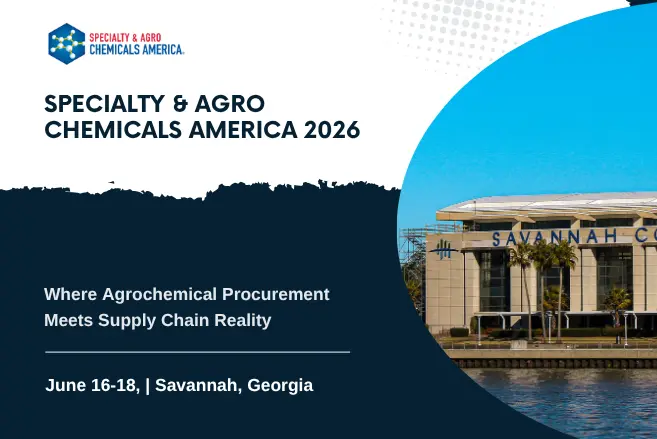
Specialty & Agrochemicals America 2026 convenes June 16-18 in Savannah, GA, bringing together active ingredient (AI) producers, formulation chemical suppliers, and crop protection manufacturers for the primary North American procurement event in the agrochemical calendar. For bulk chemical supplier relationships serving agrochemical formulators, the timing matters more than usual: US tariffs on Chinese chemical imports are running at historic highs, Indian AI producers are scaling capacity aggressively, and EPA’s FIFRA source-change requirements are creating procurement bottlenecks that commercial teams routinely underestimate until a production disruption forces the issue.
This is not the year to attend SAA 2026 for market awareness. The procurement decisions that will determine H1 2027 supply continuity and cost position need to be initiated before Q4 2026. The exhibit floor in June is the concentrated qualification window.
The table below maps the critical agrochemical raw material categories to their immediate procurement implications heading into SAA 2026.
| Raw Material Category | 2026 Status | Procurement Implication |
| Generic AI technicals (glyphosate, imidacloprid, cypermethrin) | Chinese origin dominant; tariff-exposed at 25-145% rates | Qualify Indian-origin technicals now; FIFRA source documentation must precede any origin switch |
| Specialty fungicide AIs (strobilurins, triazoles) | Supply tightening from Chinese environmental enforcement | Build 60-90 day safety stock; secondary source qualification urgent |
| Agrochemical solvents (Aromatic 150, Solvesso grades, methylated esters) | Petroleum-linked volatility; US tariff pressure on Asian origins | Contract H2 volumes with US Gulf Coast and European suppliers |
| Non-ionic surfactants and emulsifiers | Stable but origin-diversification pressure from tariff cascade | Evaluate Indian surfactant manufacturers for 2027 contract displacement |
| Biostimulant raw materials (humic acid, amino acid hydrolysates) | Growing category; supply quality inconsistency from low-cost origins | Spec tightening required; insist on full traceability documentation |
Active ingredient supply chain: China dependency and the tariff reckoning
China accounts for approximately 70% of global agrochemical active ingredient production by volume. That concentration has been a procurement reality for two decades — and for most of that period, the commercial case for diversification was weak. Chinese AIs were cheaper, lead times were acceptable, and quality (while requiring vigilance) was manageable.
2025 and 2026 have changed the arithmetic.
US tariffs on Chinese chemical imports now range from 25% on Section 301 categories to 145% on specific targeted product lines, with agrochemical AIs sitting in one of the most tariff-exposed import categories. The effective landed cost premium on a container of Chinese-origin glyphosate technical versus Indian-origin material has shifted from near-parity to a 15-30% structural disadvantage depending on the specific product and tariff classification. For formulators operating on 8-12% gross margins, that spread cannot be negotiated away.
Indian agrochemical manufacturers, particularly in Gujarat and Telangana, have scaled technical AI production meaningfully over the past 36 months. Lambda-cyhalothrin, cypermethrin, imidacloprid, thiamethoxam, and glyphosate technical are now available from Indian producers in container-load quantities with quality specifications meeting EPA regulatory requirements.
The lead time differential — 10-14 weeks from India versus 8-10 weeks from China — is real but manageable with forward planning. At current tariff levels, Indian pricing runs in favor across a broad range of generic technicals.
Procurement teams attending SAA 2026 that are still sourcing 100% of their technical AI from China need sourcing conversations at the show, not another market briefing.
FIFRA source changes: the compliance constraint procurement can’t shortcut
The most common error procurement teams make when evaluating an origin switch from Chinese to Indian AIs is treating it as a pure commercial decision. Under FIFRA (Federal Insecticide, Fungicide, and Rodenticide Act), pesticide registrations in the US are source-specific. The EPA pesticide label ties the registered product to a specific manufacturing site and source of technical active ingredient.
Switching from a Chinese manufacturer to an Indian manufacturer for the same AI requires an EPA-notifiable formulation change — or, in many cases, an amendment to the pesticide registration.
The regulatory clock
Administrative timelines for EPA source-change notifications range from 60 days for straightforward notifications to 18-24 months for amendments requiring data review. A procurement team that identifies a preferred Indian AI supplier at SAA 2026 and executes a contract in October cannot drop Chinese AI supply in January.
The regulatory pathway has to run first. Starting it in June 2026 means the earliest viable full-supply transition is late Q1 or Q2 2027 for most product categories.
Raw Source & SAA 2026: full agrochemical product range
Raw Source’s SAA 2026 product range extends beyond solvents and surfactants:
- Glyphosate chain intermediates: Glycine (98.5% tech), IDA (iminodiacetic acid), and PMIDA for formulators managing active ingredient input costs directly.
- Organosilicone adjuvants: Trisiloxane superwetters (Silwet L-77 type), Polyether Silicone spreaders (BREAK-THRU type), and defoamer silicones for EC and SC systems.
- Polar aprotic solvents: DMSO, Cyclohexanone, and Isophorone for specialty formulation systems requiring co-solvents beyond standard aromatic grades.
- Chelated micronutrients: EDTA-Fe 13%, EDTA-Zn 15%, DTPA-Mn 5-7%, and EDDHA-Fe 6% (ortho-ortho) for foliar nutrition product lines.
- Sourcing flexibility: India, China, Mexico, and US toll across all categories, with pricing re-quoted as tariff conditions shift.
For biostimulant inputs, Raw Source supplies humic acid concentrates, fulvic acid fractions, and amino acid hydrolysate raw materials. Third-party analytical verification is a standard service option, with specification-referenced COAs and analytical method disclosure included in the standard shipment package.
Request a bulk quote for your agrochemical formulation chemical requirements, including aromatic solvents, non-ionic surfactants, emulsifiers, and biostimulant raw materials in container-load quantities.
Download SAA 2026 product guide
What this means for SAA 2026 sourcing conversations
This shapes how to use the show in two concrete ways:
- FIFRA timeline before price. Source qualification conversations need to start with a compliance timeline, not a price discussion. The price conversation is premature if the regulatory clock hasn’t started.
- Safety stock as regulatory insurance. During the 18-24 month regulatory transition, safety stock from existing approved sources isn’t optional inventory. Model 90-day safety stock for any AI category where you are actively transitioning sources.
The EPA Pesticide Registration portal and FIFRA Part 155 guidance are the authoritative references. Review any source-change decision against current EPA guidance before making commercial commitments.
Agrochemical solvent sourcing: tariff arithmetic and Indian-origin alternatives
Emulsifiable concentrates (ECs) require aromatic hydrocarbon solvents alongside emulsifiers. Suspension concentrates (SCs) require co-formulants, dispersants, and wetting agents. Water dispersible granules (WDGs) require binders and disintegrating agents. These formulation chemicals represent 20-40% of finished product cost in many agrochemical product lines — and carry their own tariff exposure and supply chain risk.
Aromatic solvents: the tariff case for Indian origins
Aromatic solvents for agrochemical use — Aromatic 150, Aromatic 200, and Solvesso-grade equivalents — are sourced primarily from Asian refineries, with Indian and Southeast Asian origins increasingly competitive. The tariff position on Chinese-origin solvents has made Indian-refinery grades a practical commercial alternative for US formulators.
Current pricing comparison:
- Indian origins: $680-780/MT CFR US East Coast
- Chinese origins under current tariff conditions: $820-900/MT landed
- Lead time from India: 10-12 weeks container-load
Non-ionic surfactants: qualifying Indian manufacturers
Non-ionic surfactants — ethoxylated alcohols, castor oil ethoxylates, alkyl polyglucosides — face similar tariff exposure from Chinese origins. Indian surfactant manufacturers have scaled ethoxylated non-ionic production, and several are FDA/EPA compliant with documentation available for US regulatory submissions.
When qualifying new formulation chemical suppliers at SAA 2026, request:
- Full technical data sheets and SDS documentation
- CoA samples from recent production batches, not generic certificates
- Explicit confirmation of manufacturing site registration status under applicable US requirements
Biostimulants: growing category, quality discipline required
The biostimulant market is growing at 10-14% annually across North American agricultural markets, with humic acids, fulvic acids, amino acid hydrolysates, seaweed extracts, and microbial consortia all scaling in usage. For procurement teams at agrochemical distributors and blending formulators, this means new raw material sourcing requirements in categories that most teams haven’t built evaluation frameworks for yet.
Humic acids: the analytical method problem
Humic acid concentrations in commercially traded products range from 40% to 90% on an active matter basis. The analytical method used to measure humic content materially affects the reported number — which means two products with identical COA figures can perform very differently in the field.
Administrative timelines for EPA source-change notifications typically range from approximately 60 days for administrative notifications to 12–24 months or longer for amendments requiring data review: actual timelines depend on the nature of the source change, data requirements, and EPA workload at the time of submission. Confirm the applicable pathway with your regulatory counsel before making commercial commitments.
Amino acid hydrolysates: production method matters
Amino acid hydrolysate quality varies substantially between production methods. Enzymatic hydrolysis produces higher quality material with better free amino acid ratios. Chemical hydrolysis reduces cost but degrades quality in ways that don’t always surface in standard nitrogen content figures.
A supplier COA showing acceptable total nitrogen content does not confirm the hydrolysis method used.
What to require at SAA 2026
For biostimulant raw material sourcing conversations at the show:
- Third-party analytical verification from an accredited lab alongside (not instead of) supplier COAs
- Named analytical methods on all COAs — HPTA for humates, AOAC methods for amino acids
- Explicit confirmation of active matter basis for all humic and fulvic acid products
- Manufacturing site documentation before committing contract volumes
Agrochemical formulation chemical sourcing in container loads: Raw Source
The supply chain transitions that SAA 2026 will surface — AI origin diversification, solvent tariff reshuffling, surfactant qualification from Indian manufacturers, biostimulant quality standardization — tend to run in parallel. Running them through separate suppliers for each category adds management overhead that procurement teams typically don’t budget for until they’re already in it.
Raw Source sources and supplies agricultural chemicals across the formulation chemical portfolio in container-load quantities, with 1 MT as the minimum order. Commercial terms include Incoterm flexibility (FOB, CIF, CFR, DDP), COA-backed quality documentation on all shipments, and supply continuity planning for buyers managing multi-product formulation lines.
Agrochemical solvents from Indian-refinery sources
For procurement teams moving from Chinese to Indian origins for solvents, Raw Source offers Indian-refinery Aromatic 150 and Aromatic 200 on spot or contract terms, alongside methylated fatty acid esters (FAME/biodiesel-grade co-solvents for EC and ME formulations) and specialty solvents for particular formulation systems.
Current CFR pricing benchmarks against US-origin and European-origin comparators are available on request. Technical data sheets, SDS documentation, and specification sheets are provided before shipment to support internal qualification.
Surfactants from Indian manufacturers with established quality systems
Surfactants available through Raw Source for agrochemical use include ethoxylated non-ionic surfactants, castor oil ethoxylates, and blended emulsifier packages for EC formulations, sourced from Indian manufacturers with established quality systems and documentation infrastructure.
Procurement teams transitioning from Chinese-origin surfactants can qualify Indian alternatives without starting a cold supplier search from scratch.
Biostimulant raw materials with third-party analytical verification
For biostimulant inputs, Raw Source supplies humic acid concentrates, fulvic acid fractions, and amino acid hydrolysate raw materials. Third-party analytical verification is a standard service option, with specification-referenced COAs and analytical method disclosure included in the standard shipment package.
Request a bulk quote for your agrochemical formulation chemical requirements, including aromatic solvents, non-ionic surfactants, emulsifiers, and biostimulant raw materials in container-load quantities.
Frequently Asked Questions
What is Specialty & Agrochemicals America 2026?
Specialty & Agrochemicals America 2026 is the primary North American trade conference for the crop protection and specialty chemicals industries, organized by Informa Markets. The 2026 event runs June 16-18 at the Westin Savannah Harbor Resort & Convention Center in Savannah, GA. It brings together active ingredient producers, formulation chemical suppliers, distributors, and agrochemical formulators to discuss supply chain, regulatory, and market developments across the agrochemical value chain.
How do US tariffs affect agrochemical active ingredient procurement in 2026?
US tariffs on Chinese chemical imports now range from 25% to 145% depending on the product category and applicable tariff schedule. For generic agrochemical active ingredients historically sourced from China, these tariffs have made Indian-origin technicals commercially competitive on a landed-cost basis for the first time at scale. Procurement teams should conduct a full landed-cost comparison including tariff, freight, insurance, and duty before assuming Chinese-origin material remains the lowest-cost option.
What are the FIFRA compliance requirements for switching active ingredient sources?
Under FIFRA, US pesticide registrations are source-specific and tied to the manufacturing site of the active ingredient technical.Switching from one country-of-origin or manufacturing facility to another typically requires either an administrative notification (often processed within approximately 60 days) or a formal registration amendment with data review, depending on the scope of the change. Amendment timelines vary and can range from 12 to 24 months or longer. Registrants should verify the applicable pathway with regulatory counsel or EPA directly before making commercial commitments to new sources.
What agrochemical solvents are affected by current US tariffs?
Aromatic hydrocarbon solvents (Aromatic 150, Aromatic 200, Solvesso-equivalent grades) sourced from Chinese origins are subject to Section 301 tariffs that materially increase landed costs versus Indian-refinery equivalents. Current CFR pricing for Indian-origin Aromatic 150 is approximately $680-780/MT into US East Coast ports, versus $820-900/MT landed for Chinese-origin material under current tariff conditions. Container-load quantities from Indian origins carry 10-12 week lead times.
How should procurement teams evaluate biostimulant raw material quality?
Biostimulant raw material quality varies significantly and is not reliably captured by basic COA parameters alone. For humic acids, require third-party analytical verification using HPTA methodology and confirm the percentage reported is on an active matter basis. For amino acid hydrolysates, specify enzymatic hydrolysis production method and request free amino acid ratios alongside total nitrogen content. Require named analytical methods on all COAs and confirm manufacturing site traceability before releasing contract volumes.
What is the lead time for agrochemical formulation chemicals from Indian suppliers?
Container-load orders for agrochemical solvents and surfactants from Indian manufacturers typically carry 10-14 week lead times from order confirmation to CFR arrival at a US port. This compares to 8-10 weeks from Chinese origins under normal conditions. Procurement teams transitioning to Indian origins for tariff-driven reasons should build the additional lead time into safety stock calculations, particularly during the initial qualification period before supply continuity is established.