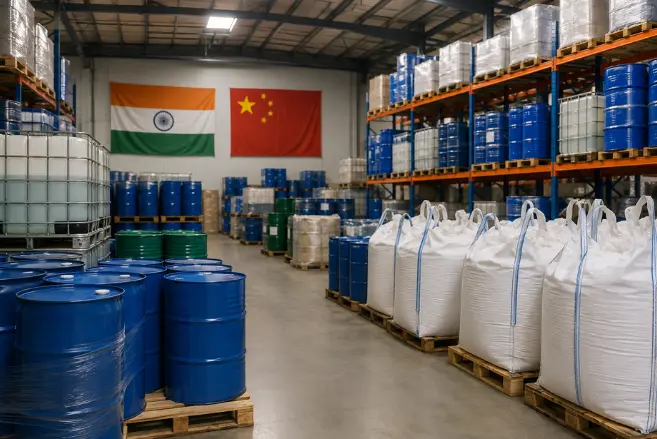
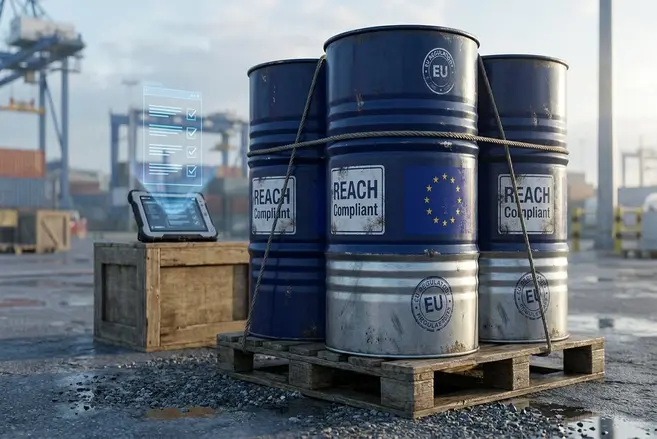
Your shipment is held at Rotterdam customs. The importer’s representative calls: “Your REACH documentation is incomplete. We’re looking at 2-week delay, demurrage charges $5K per day minimum.” You ask why. The answer: You didn’t register with ECHA before importing, and the SDS format doesn’t match EU standards. This article prevents that situation.
REACH (Registration, Evaluation, Authorisation, Restriction of Chemicals) is the EU’s regulatory framework governing chemical imports. If you import chemicals into the EU market, REACH compliance is mandatory, not optional. Non-compliance means customs holds, fines up to €100K, and supply chain disruption. For bulk chemical supplier teams sourcing container loads into the EU, this guide covers what you must do, when, and how to avoid costly mistakes.
Quick REACH Compliance Checklist
- [ ] Determine your role: Are you an importer, distributor, or downstream user?
- [ ] Calculate tonnage: Do you import >1 MT/year of any single substance?
- [ ] Register with ECHA: If >1 MT/year, register before first shipment
- [ ] Verify SDS format: Obtain EU-format Safety Data Sheet (not supplier’s home-country format)
- [ ] Ensure CLP labeling: Containers must have proper hazard labels and GHS pictograms
- [ ] Assess hazards: Document your own use and risk management if substance is hazardous
- [ ] Notify downstream users: Provide SDS to customers with each shipment
- [ ] Maintain records: Keep documentation for 3 years minimum
- [ ] Monitor SVHC updates: Check ECHA SVHC list twice yearly (June, December)
- [ ] Plan lead time: Account for 2-3 weeks extra for REACH documentation pre-shipment
Are You an Importer Under REACH? Understanding Your Role
REACH is the EU’s chemical regulation system. REACH stands for Registration, Evaluation, Authorization, Restriction of Chemicals. It applies to: all chemical substances and mixtures imported into the EU in quantities above 1 metric ton per year. The full regulatory framework is maintained by the European Chemicals Agency (ECHA), which publishes registration requirements, SVHC candidate lists, and enforcement updates.
This is the first and most critical question. Many procurement professionals misunderstand their role, assume they’re distributors, and fail to register. This costs money.
Importer definition under REACH: Any person established in the EU who imports a chemical substance or mixture for the first time across EU borders.
“Established in the EU” means you have an office, warehouse, or operation in the EU. If you’re a US company with an EU subsidiary, that subsidiary is the importer for REACH purposes.
Are you an importer if: You’re sourcing chemicals from China, India, or anywhere outside the EU and bringing them into the EU market for your own use or for sale. Yes, you’re the importer.
Are you NOT an importer if: Your upstream supplier already imported the chemical into the EU and is selling to you ex-EU. Then you’re a distributor (different, lower obligations). Check: Did your supplier bring this chemical across the EU border for the first time, or did they buy it from someone else who did?
Key distinction: If your upstream supplier is an EU manufacturer or an EU-based distributor, you’re a distributor, not an importer. If your supplier is outside the EU, you’re the importer.
The 7 Things Importers Must Do: Actionable Steps
Step 1: Register with ECHA if you import >1 ton/year
ECHA is the European Chemicals Agency. If you import any single chemical substance in quantities exceeding 1 metric ton per calendar year, you must register that substance with ECHA before you import it.
Cost: €50-€500 for registration itself, depending on complexity and company size.
Timeline: Complete registration before your first shipment leaves the origin country.
What to submit: Chemical identity, tonnage band (1-10 MT, 10-100 MT, 100-1000 MT, 1000+ MT), hazard classification, and SDS. ECHA provides an online portal for submission.
Red flag: Underreporting tonnage. If you import 50 MT spread across four suppliers, your total tonnage is 50 MT. Add them all together for threshold calculation.
Step 2: Obtain/Verify a Safety Data Sheet (SDS) from supplier
REACH requires you to have an SDS in the EU language format. Many Asian suppliers provide non-EU format SDS. This is not sufficient for REACH compliance.
EU-format SDS means: 16-section format (EN 4013), GHS hazard classification, CLP-compliant hazard statements, precautionary statements. Non-EU suppliers often provide summaries or simplified versions. Demand the full EU-format SDS.
Cost: $0 (supplier responsibility) if supplier has EU SDS; $500-2,000 if you need professional translation/validation.
Timeline: Obtain before importing. If it arrives after your shipment clears customs, you have a documentation gap.
Verification step: Cross-check SDS hazard classification against your own assessment or a testing lab. If SDS shows “no hazard” but the chemical is flammable, something is wrong.
Step 3: Ensure Chemical Classification & Labeling (CLP) Compliance
CLP is the EU’s hazard classification system. Your supplier should provide CLP classification. You must verify it and ensure all containers are properly labeled.
CLP label requirements: Hazard pictograms (diamond-shaped symbols), hazard statements (H-codes: “H224 Extremely flammable”), precautionary statements (P-codes: “P210 Keep away from heat”), and identity of responsible party.
Containers: All drums, IBCs, ISO tanks must be labeled in the official language of the import country (English in UK, German in Germany, etc).
Cost: $500-2,000 for label design and printing, depending on container types and complexity.
Timeline: Labels must be on containers before import. Relabeling at border is expensive (demurrage charges).
Step 4: Implement Safety Assessment & Risk Management (if substance hazardous)
If your imported substance is classified as hazardous (flammable, toxic, carcinogenic, etc.), you must document your own use and assess the risks.
This means: How will your company use the chemical? What are the exposure risks? What controls (ventilation, PPE, handling procedures) are needed? This is typically done in a Chemical Safety Report (CSR).
For small importers with straightforward uses, the CSR can be simple. For hazardous chemicals with complex downstream uses, CSRs are extensive (50-100 pages).
Cost: $1,000-5,000 for professional CSR preparation, or internal documentation if you have technical resources.
Timeline: Complete before importing. Regulatory audits can request this; lack of documentation = liability.
Step 5: Notify Downstream Users
Every customer who receives your chemical must get a copy of your SDS. This is mandatory. Failure to provide SDS to downstream users = regulatory violation.
Downstream user examples: If you import acetone and sell to a paint manufacturer, the paint manufacturer is your downstream user.
Notification method: SDS via email, mail, or web link. Must accompany first shipment and any time SDS changes.
Cost: $0 (distribution only) if you have email/web system. Minimal cost for paper distribution.
Timeline: With each shipment.
Step 6: Keep Records & Documentation
Maintain: Supplier certificates, SDS versions, ECHA correspondence, testing records, documentation of your risk assessment, customer notification records.
Retention period: 3 years minimum (some items 5+ years for liability reasons).
Purpose: If ECHA conducts an inspection or a customer has a problem, documentation proves you acted responsibly.
Cost: $0 (internal record-keeping) or minimal cost for digital document management system.
Timeline: Ongoing.
Step 7: Monitor SVHC Updates & Adjust if Needed
SVHC stands for Substances of Very High Concern. The ECHA publishes an SVHC Candidate List that updates twice yearly (June and December). If your imported substance is added to the SVHC list, new obligations trigger.
New obligations: You have 45 days to notify downstream users and ECHA that you’re importing a substance now on the SVHC list. Failure = fines €10K-€50K+ per violation.
What to do: Subscribe to ECHA SVHC notifications. Set calendar reminders for June and December. Check if your substances appear on the updated list. If yes, immediately notify downstream users.
Cost: $0 (monitoring only) or minimal cost for compliance software that tracks SVHC updates.
Timeline: Continuous, with critical 45-day notification windows after each SVHC update.
8 Common REACH Mistakes & How to Avoid Them
Mistake 1: Assuming Supplier’s SDS = REACH Compliance
Many Asian suppliers provide a document labeled “SDS” that is not EU-format compliant. It might be 2-3 pages, lack CLP classification, or omit critical hazard information. Customs will reject this.
How to avoid: Request “EU-format SDS per EN 4013 and CLP regulation” explicitly. Validate that the SDS you receive has 16 sections, CLP pictograms, H-codes and P-codes. If it doesn’t, request revision from supplier or hire a translator to format it properly.
Mistake 2: Missing the “Importer” Requirement
Common thinking: “We’re just a distributor. Our supplier handles REACH.” Wrong. If your supplier is outside the EU, you are the importer. Failure to register = compliance gap that falls on you.
How to avoid: Ask your supplier: “Did you import this substance into the EU, or did you buy it from someone who did?” If they bought it from someone else, trace back to the original importer. You must be that importer, not a downstream distributor, if your supplier is outside the EU.
Mistake 3: Underestimating Total Tonnage Across Multiple Suppliers
You import acetone from four suppliers: Supplier A (15 MT), Supplier B (20 MT), Supplier C (10 MT), Supplier D (8 MT). Total: 53 MT. Registration threshold applies to the total, not per-supplier.
How to avoid: Calculate annual tonnage per substance across all suppliers, not per supplier. Spreadsheet: Chemical name, Supplier A volume, Supplier B volume, etc. Total = registration trigger.
Mistake 4: Ignoring SVHC Notifications
ECHA added 12 substances to the SVHC Candidate List in June 2025. If you import one of those substances, 45-day notification deadline passed. Late notification = fines.
How to avoid: Subscribe to ECHA email notifications. Set calendar reminders for June and December. Check the SVHC Candidate List against your chemical portfolio immediately after each update. If any match, notify downstream users and ECHA within 45 days.
Mistake 5: Relying Entirely on Supplier Compliance
You ask your Chinese supplier: “Are you REACH-compliant?” They say yes. They don’t provide documentation. You import based on their word. Customs holds the shipment due to missing SDS. Supplier is unreachable on weekends.
How to avoid: Don’t trust verbal assurance. Request documented evidence: Copy of SDS (EU-format), evidence of registration with ECHA (if they’re the importer), or evidence of ECHA notification if you’re the importer. Get it in writing.
Mistake 6: Not Accounting for REACH Lead Time
You place an order for immediate delivery from your supplier. They ship immediately. You expect the container in 6 weeks. Customs notifies you: SDS is missing, labeling is incorrect. Now you’re in a 2-3 week documentation correction loop. Production stops.
How to avoid: Add 2-3 weeks to your lead time timeline for REACH documentation review. Work with your supplier 3 weeks before shipment to verify: SDS is EU-format, labeling is correct, all documentation is prepared.
Mistake 7: Failing to Update SDS When Requirements Change
ECHA publishes a new hazard classification for one of your chemicals. The SDS is now outdated. You continue supplying the old SDS to downstream users. This is a documentation violation.
How to avoid: Subscribe to supplier notifications for SDS updates. Quarterly, check if any of your imported chemicals have updated SDS versions. When supplier provides updated SDS, review it, notify your downstream customers with the new version.
Mistake 8: Not Building a Compliance Budget into Cost Forecasting
You budgeted $400K for annual chemical purchases. You didn’t budget for ECHA registration ($500), SDS translation ($1,000), CLP labeling ($2,000), risk assessment documentation ($2,000), and potential customs delays ($5,000-10,000). True cost: $410K-415K. Budget shortfall causes approval delays.
How to avoid: For new chemical imports, budget an additional 1-3% for compliance costs. First-year imports are higher (registration, initial documentation). Subsequent years are lower (mainly SDS updates). Compliance cost estimation also ties into your overall landed cost calculation; procurement teams sourcing sustainably should review our sustainable chemical sourcing guide for how ESG documentation requirements layer on top of REACH obligations.
Timeline for New Importers: 2026-2027 Deadlines
Immediately (before importing):
Register with ECHA if your annual volume exceeds 1 MT/year. Obtain EU-format SDS from supplier. Ensure CLP labeling is prepared. This takes 3-4 weeks typically. For procurement teams sourcing coatings and construction chemicals into the EU, this pre-registration window is frequently underestimated on first imports.
3-4 weeks before shipment:
Work with supplier to verify: SDS is final EU-version, labeling is correct, documentation package is complete. Schedule customs pre-clearance if available in your import country.
2 weeks before shipment:
Prepare downstream user SDS notifications (email/letter to customers with SDS attached). File any additional regulatory notifications if substance is on SVHC list.
Upon shipment:
Verify container labeling in person if possible. Keep shipment documentation (BL, commercial invoice, SDS, hazard classification) organized. Alert customs broker to REACH requirements upfront.
Upon arrival:
Verify customs clearance within 24 hours. If held, respond immediately to customs queries. Provide missing documentation. Unstick the container as quickly as possible (demurrage is expensive).
Ongoing (quarterly, annually):
Check SVHC Candidate List (twice yearly: June, December). Update SDS if changes occur. Maintain records for 3-year minimum. Prepare for potential ECHA inspections (audit your documentation annually).
Cost Breakdown: REACH Compliance Budget
Item | Cost Range | Notes |
ECHA Registration (one-time per substance) | €50–500 | Depends on substance complexity and company size |
SDS Validation/Translation to EU format | $500–2,000 | Ensure 16-section EN 4013 format, CLP-compliant |
CLP Label Design & Printing | $500–1,500 | For containers (drums, IBCs, ISO tanks) |
Chemical Safety Report (if hazardous substance) | $1,000–5,000 | Scales with tonnage and hazard complexity |
Risk Assessment & Documentation | $500–2,000 | Internal or consultant-supported |
Legal/Consulting Support (optional) | $2,000–10,000 | Useful for complex substances or first-time importers |
Customs Pre-Clearance & Compliance Software | $200–1,000/year | Optional but reduces delay risk |
Total First-Year Compliance Cost | $4,750–$21,000 | One-time; subsequent years $1K–$2K for updates |
Cost per MT (for 10 MT import) | $475–$2,100/MT | Dilutes significantly at higher volumes |
For a 20 MT container, first-year REACH cost is ~$240–1,050/MT, decreasing to $50–100/MT in subsequent years as most costs are one-time.
India-to-EU Chemical Sourcing: REACH-Specific Considerations
Indian suppliers are increasing in compliance but many still don’t understand EU REACH standards. Lead time impact: 2-3 weeks to obtain compliant SDS before shipment.
Most Indian suppliers provide SDS in Indian or simplified formats, not EU-EN 4013 format. You often need to request this explicitly or hire translation services.
Budget extra: $500-1,500 per import for SDS validation if your supplier can’t provide EU-format documentation immediately.
Advantage: Indian manufacturers are increasingly aware of REACH (due to exports to EU growing). New suppliers may already have EU-format documentation. Older suppliers may need support.
Strategy: When qualifying new Indian suppliers, ask upfront: “Can you provide EU-format EN 4013 SDS with CLP classification?” If they hesitate, factor in lead time and cost for documentation work.
How Raw Source Helps Importers Navigate REACH
REACH compliance is the difference between seamless supply chain execution and costly, avoidable delays. A shipment held at Rotterdam for 2-3 weeks due to incomplete documentation costs $5K-$10K in demurrage alone, plus the internal cost of production disruption. Yet most of these holds are preventable with advance planning.
Raw Source manages REACH compliance as part of every EU import we execute. Our process starts before your order ships: We verify your importer status and registration requirements. If you’re importing a substance for the first time above 1 MT/year, we prepare ECHA registration documentation and submit it before cargo leaves the origin port. We obtain EU-format Safety Data Sheets directly from manufacturers or coordinate third-party translation/validation if needed, ensuring 16-section EN 4013 format with complete CLP hazard classification. We verify CLP labeling on containers before loading, preventing relabeling costs at the border. We prepare Chemical Safety Reports if the substance is hazardous, documenting your intended use and risk controls. We coordinate downstream user SDS distribution so your customers receive documentation automatically with first delivery.
The result: Your chemical clears customs without holds, documentation is audit-ready if regulatory authorities conduct inspections, and your compliance risk is transferred to us (we carry professional liability insurance for REACH advisory).
For container-load quantities requiring EU entry, we’ve systematized REACH registration, documentation preparation, and pre-shipment coordination. You provide chemical identity and intended use; we handle the regulatory legwork. This is especially valuable for first-time EU importers or procurement teams importing for the first time into the EU. The $2K-$5K investment in professional REACH management is cheap insurance against a €50K+ fine or a 3-week supply chain disruption. Request a REACH-compliant quote and we’ll structure compliance into your supply contract from day one.
How many questions should I ask a new chemical supplier before placing a first order?
All 50 questions in this checklist represent the minimum due diligence for a first container-load order from an overseas supplier. In practice, some questions will be answered by documentation the supplier provides upfront. The goal is complete answers to all 50 before any purchase order is issued.
What is the most important section of a chemical supplier audit?
The quality documentation section (Questions 19-28) and the commercial terms section (Questions 44-50) are the most frequently neglected and carry the highest financial risk. Most procurement teams ask about certifications and delivery times but skip the questions about what happens when something goes wrong.
Should I conduct an on-site audit before placing my first chemical order?
For orders above a certain volume threshold or for chemicals with critical specifications, on-site audits are strongly recommended. However, for most first-order situations, a thorough document-based audit using this checklist combined with a pre-shipment inspection by a third-party agency (SGS, Bureau Veritas, Intertek) provides adequate protection.
What is a pre-shipment inspection and how does it protect bulk chemical buyers?
A pre-shipment inspection (PSI) is a third-party verification of the goods at the origin facility before the container is loaded. The inspector verifies the product against specification, confirms packaging compliance, and witnesses the container loading process. PSI costs $300-800 per shipment and eliminates most quality disputes for new supplier relationships.
How do anti-dumping duties affect chemical supplier selection?
Anti-dumping duties (ADD) are import duties imposed when a country determines that a foreign supplier is selling a chemical below fair market value, causing harm to domestic producers. ADD rates can add 10-40% to the landed cost of an imported chemical. Always verify the current ADD status for the specific chemical and origin country before comparing supplier prices.
What should I do if a supplier refuses to answer audit questions?
Refusal to answer specific questions, particularly about certifications, testing methods, and contractual obligations, is itself a qualification result. A supplier unwilling to provide transparent answers before the first order will not provide transparent answers during a quality dispute. Document the refusal and proceed to the next qualified supplier.