
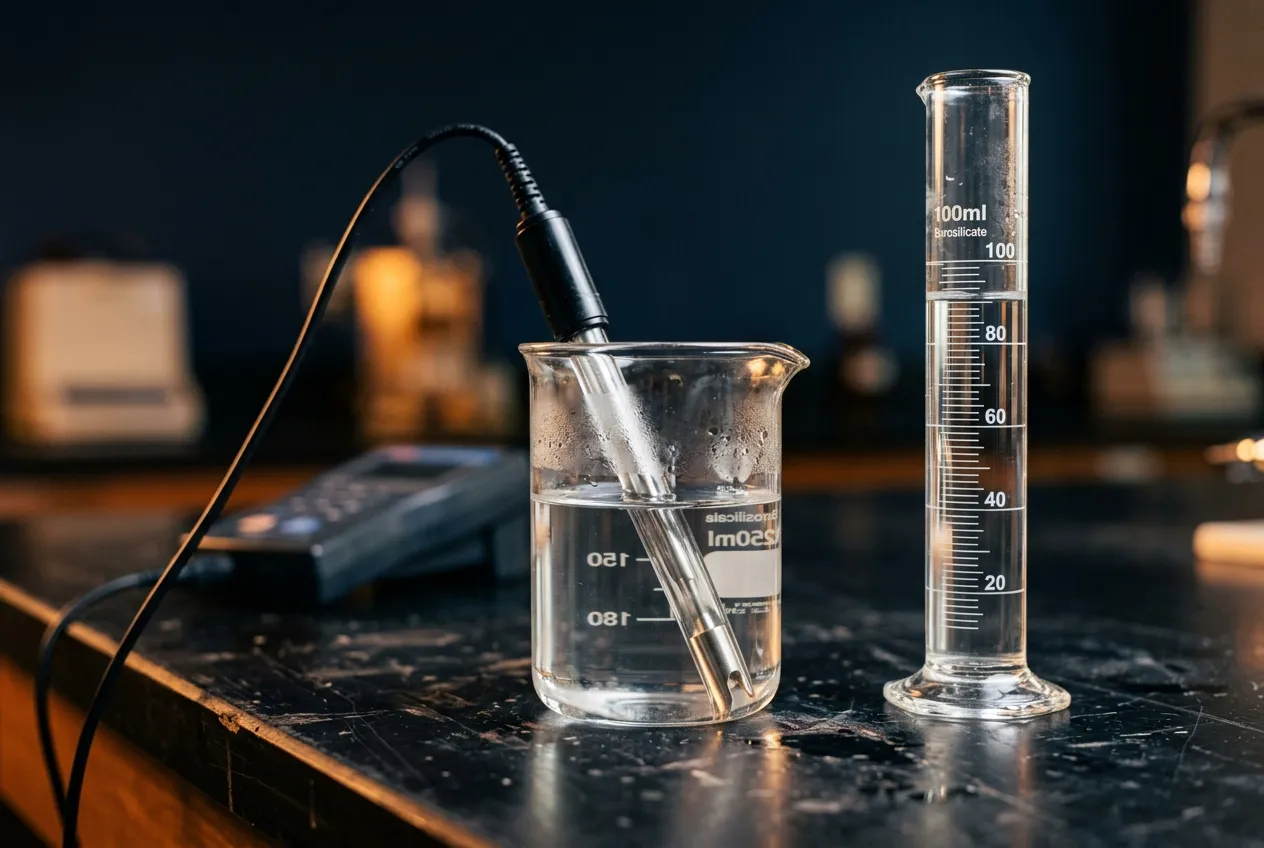
An organosilicone super-spreader that spreads beautifully from a fresh jug can quietly stop working in the tank. Make the mix up in hard, alkaline water, or leave it sitting overnight, and the dramatic spreading is gone the next morning. The cause is not a bad batch; it is chemistry. The same siloxane bonds that make the surfactant so effective also break down in water outside a narrow pH window.
The short version: trisiloxane super-spreaders hydrolyze. The silicon-oxygen (Si-O-Si) bonds in the molecule are cleaved by acidic and alkaline conditions, which destroys the super-spreading. The products are most stable in a roughly neutral window, about pH 6 to 8, and a prepared spray mix should be used quickly, generally within about 24 hours. The neat product stored sealed and dry lasts far longer, on the order of two years. Spray-water pH and tank-mix timing are therefore real buying and handling factors, not fine print.
Why it breaks down: siloxane hydrolysis
The performance of the surfactant comes from its trisiloxane structure (CAS 27306-78-1, PubChem CID 197160; class 67674-67-3), built on silicon-oxygen-silicon linkages. Those siloxane bonds are susceptible to hydrolysis: in water, acid or base catalyzes their cleavage, and once the trisiloxane hydrophobe is broken apart, the molecule can no longer pack at the surface to drop surface tension. The super-spreading disappears along with the intact structure.
The pH window
Hydrolysis is slowest near neutral and accelerates as the solution gets more acidic or more alkaline. In practice, organosilicone super-spreaders perform and survive best between about pH 6 and 8. Strongly alkaline spray water, common with hard or high-bicarbonate sources, is especially damaging, and strongly acidic conditions degrade them too. Checking and, where needed, adjusting spray-water pH into the neutral band is the single most effective step to protect performance.
The short tank life
Even within the right pH range, a diluted mix does not last. Once the surfactant is in water it begins to hydrolyze, slowly near neutral and faster otherwise, so a prepared spray should generally be used within about 24 hours and ideally the same day. Warm temperatures and poor water quality shorten that further. This is why the practical rule is to mix fresh and spray promptly rather than batch ahead.
What to control
| Factor | Practice |
|---|---|
| Spray-water pH | Keep near pH 6 to 8; adjust hard or alkaline water |
| Tank-mix age | Use within ~24 hours; mix fresh, spray the same day |
| Water quality | Watch hard, high-bicarbonate water; it raises pH and speeds hydrolysis |
| Temperature | Higher temperatures accelerate breakdown |
| Neat product storage | Sealed, dry, away from heat; ~24 month shelf life |
How this affects buying
The hydrolysis limit shapes both product choice and logistics. Where spray water is alkaline or mixes must be held, a buyer may choose a more hydrolytically buffered blend, or plan operations around fresh mixing. None of this reduces the value of the super-spreader; it just has to be used the way its chemistry requires. The mechanism behind its performance is in what is an organosilicone super-spreader, and its coverage behavior in organosilicone adjuvants for spray coverage and rain-fastness.
Buying organosilicone super-spreaders in bulk
See the Polyether-Modified Trisiloxane (Silicone Surfactant) product page. Tell us your water quality and how you mix and apply, and we will help you specify a straight super-spreader or a more pH-tolerant blend, and confirm shelf life and handling.
Frequently asked questions
Why did my organosilicone super-spreader stop working?
Most likely hydrolysis. The siloxane bonds that make the surfactant spread are cleaved by acidic or alkaline water, which destroys the super-spreading. Alkaline or hard spray water and holding the mix overnight are the usual causes.
What pH do trisiloxane adjuvants need?
They are most stable and effective in a roughly neutral window, about pH 6 to 8. Adjust strongly acidic or alkaline spray water into that band before adding the surfactant.
How long can I keep a tank mix with an organosilicone adjuvant?
Generally use it within about 24 hours, and ideally the same day. Once diluted, the surfactant begins to hydrolyze, faster in alkaline water and at higher temperatures, so mix fresh and spray promptly.
What is the shelf life of the neat product?
Stored sealed, dry, and away from heat, the concentrated product typically keeps on the order of two years. The short life applies to the diluted spray mix, not the unopened concentrate. Confirm shelf life on the product documentation.
Does hard water affect organosilicone super-spreaders?
Yes. Hard, high-bicarbonate water tends to be alkaline, which accelerates hydrolysis of the siloxane backbone and shortens both performance and tank life. Check water quality and adjust pH.
Editorial note. This article is general technical guidance for agricultural and formulation professionals and is not agronomic, application, or regulatory advice. The behavior described is the physical and chemical stability of the surfactant; nothing here is a claim about pesticide performance, crop yield, or efficacy, and adjuvant use is governed by the pesticide product label and local regulations. The material is classified as harmful and as toxic to aquatic life (GHS Warning), so it is not an environmental-benefit product. Stability, pH, and shelf-life figures are typical values to validate for your product and conditions; the Certificate of Analysis governs the material you buy. Always consult the current Safety Data Sheet (SDS) and the product label before use. RawSource makes no warranty, express or implied, and assumes no liability for use of this information.
Search 1,300+ industrial chemicals by name or CAS, or send us your spec — we quote by the drum, tote, or container.
Browse the Chemical Index → Request a Quote