Pharmaceutical chemical sourcing runs tighter than any other manufacturing category. For teams buying through a chemical raw material supplier at container-load scale, off-spec material on a regulated line stops production, and the cost of that stoppage tracks batch value and how long it takes to recover. A documentation gap at customs holds the whole shipment, and the line gets reshuffled around the delay.
This guide covers the structural decisions pharmaceutical procurement teams face: API versus excipient sourcing strategy, pharmacopeial grade selection, supplier qualification requirements, documentation compliance for key import markets, and how to structure container-load procurement from Asia without introducing regulatory risk.
APIs vs. Excipients: Why the Sourcing Strategy Diverges
Active pharmaceutical ingredients and excipients carry fundamentally different regulatory burdens, and that difference drives every aspect of how you source them. APIs are regulated as drug substances under ICH Q7A Good Manufacturing Practice Guidance, requiring manufacturers to hold pharmaceutical GMP certification specifically covering API production. Excipients fall under ICH Q8 and IPEC-PQG GMP guidelines, which are stricter than food-grade standards but carry lighter audit and documentation obligations than ICH Q7.
For procurement, this distinction means the supplier qualification process cannot be identical across both categories. API suppliers require documented GMP audits, Drug Master File access or reference letters, and confirmation of regulatory status in every market where your finished product seeks registration. Excipient suppliers, depending on the material’s risk tier, may qualify through a documentation-only process with on-site audits reserved for high-risk or functionally critical materials.
A full API supplier qualification carries meaningful internal cost when audit travel, third-party laboratory testing, and internal QA time are accounted for in full. Compressing that process to capture a lower unit price introduces compliance exposure that regulators will surface during an inspection. Quality teams who understand the total cost picture do not approve that trade-off.
Pharmacopeial Grade Standards and What They Cost You
The four pharmacopoeias most relevant to pharmaceutical procurement are USP, BP, EP, and IP. Each defines its own analytical test methods, purity thresholds, and impurity limits for the same chemical. EP and BP limits can differ from USP limits for identical materials, and IP compliance does not automatically satisfy USP or EP requirements. For multi-market supply chains, grade specification must be made deliberately, not defaulted.
Procurement teams sourcing for multiple regulatory markets need pharmacopoeial references embedded in purchase orders and matched on every CoA. A CoA that lists purity against an internal specification rather than a named pharmacopoeial monograph is insufficient for pharmaceutical quality release regardless of the actual purity value. QA will reject it, and the discussion about whether to conduct incoming testing or return the shipment belongs to a conversation you do not want to have 8 weeks into a production cycle.
Grade over-specification adds meaningful cost to per-MT unit pricing without delivering a compliance benefit. Procuring EP-grade material for an application where NF or technical grade is adequate is a recurring procurement cost that most teams accept because QA has not reviewed the specification in years. Periodic specification reviews, with QA sign-off against current formulation and regulatory filings, are the correct remedy.
Supplier Qualification for Pharmaceutical Chemical Supply
WHO-GMP certification and ISO 9001 are not equivalent qualifications, and treating them as interchangeable is one of the most consequential errors in pharmaceutical supplier qualification. ISO 9001 certifies a quality management system. WHO-GMP (or equivalent national pharmaceutical GMP authorization) certifies that a specific facility produces drug substances or drug products under conditions that meet pharmaceutical manufacturing standards. For APIs, ISO 9001 alone is not acceptable documentation regardless of what a supplier’s sales team implies.
The qualification sequence for a new API supplier from a regulated market: request the GMP certificate from the national competent authority (CDSCO for India, NMPA for China, EMA EudraGMDP for European suppliers), verify it on the issuing authority’s public register, review recent inspection outcomes and Warning Letter history, obtain the DMF number for the relevant regulatory market, and then conduct the site audit. Each step produces documentation. Skipping any step creates a gap that regulators will identify.
For excipients, qualification threshold depends on risk classification. High-risk materials with complex sourcing chains, natural origin, or high functional criticality warrant GMP audits and incoming testing protocols. Standard excipients from established suppliers in regulated markets can often qualify through vendor questionnaires, CoA review, and documented incoming testing routines. Matching qualification rigor to actual risk avoids both over-resourcing low-risk materials and under-qualifying high-risk ones.
Documentation Requirements for Pharmaceutical-Grade Imports
The minimum documentation set for a container-load pharmaceutical raw material shipment includes: pharmacopoeial-referenced CoA, GHS-compliant SDS, Technical Data Sheet, Certificate of Origin, and TSE/BSE declaration where animal-derived or at-risk materials are involved. This baseline applies regardless of origin country or material type. Any gap in this set produces a customs hold, which in pharmaceutical logistics translates directly to production schedule impact.
Markets layer additional requirements on top. US-bound API shipments require valid FDA establishment registration for the manufacturing facility; materials from unregistered facilities will not clear customs regardless of quality. EU API imports require a GMP attestation from the manufacturing country’s competent authority under Article 46b of Directive 2001/83/EC. India-bound scheduled APIs require a CDSCO Form 29 import license obtained before the shipment departs origin. Documentation requirements for each destination market must be confirmed before the purchase order is placed, not when the vessel is three days from port.
CoA verification for pharma-grade material requires more than a visual review. Documented CoA fraud, where suppliers issue certificates not backed by actual batch testing, appears in multiple FDA and MHRA enforcement actions. The verification protocol is straightforward: test with a qualified third-party laboratory for the first three to five shipments from any supplier, cross-reference batch numbers against the supplier’s quality system, and conduct periodic re-verification at a frequency that matches the material’s risk tier. A supplier who objects to incoming testing on pharmaceutical-grade material has provided its own disqualification.
Sourcing Origins and Lead Times for Pharma Raw Materials
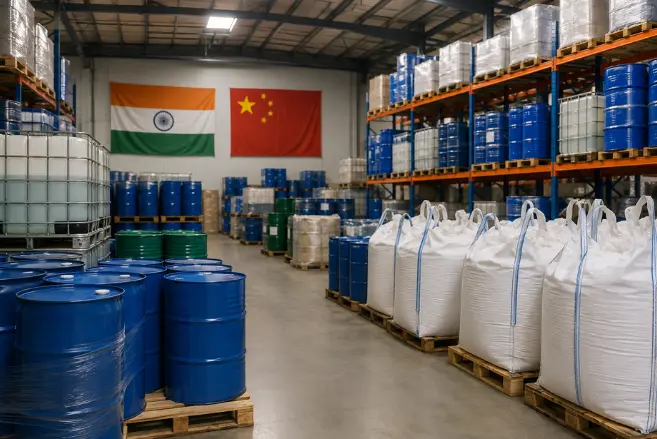
India and China supply the majority of global API raw materials and a substantial share of excipient volume. The dynamic between these two origins has shifted as India expanded pharmaceutical manufacturing capacity under PLI scheme incentives, increasing its competitive position for both API intermediates and finished APIs in markets seeking supply diversification. Understanding the chemical lead times from India vs. China across origin types is essential for safety stock planning in pharmaceutical procurement.
Container-load lead times for pharmaceutical-grade material from India run 6 to 10 weeks door-to-door: 2 to 3 weeks for production scheduling and QA release, 1 to 2 weeks for documentation preparation and export clearance, and 3 to 5 weeks ocean transit depending on destination port. China-origin pharmaceutical materials to US and EU destinations run 7 to 12 weeks, with the longer end reflecting pre-shipment inspection requirements and the additional scrutiny applied to Chinese pharmaceutical imports following recent FDA enforcement actions.
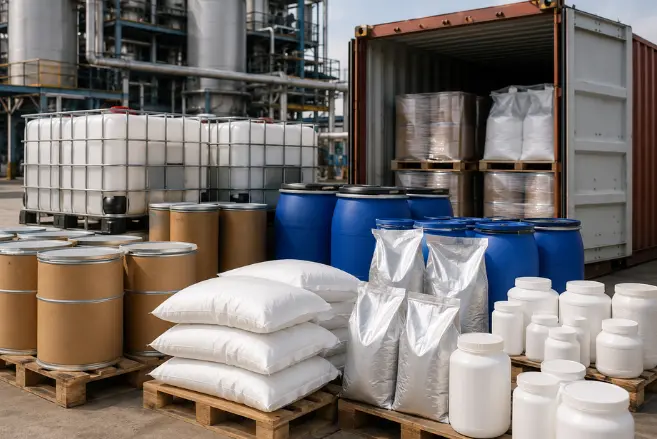
Container consolidation gets complicated for pharmaceutical chemicals in a way that general industrial procurement does not deal with. Co-loading pharmaceutical-grade material with general chemicals in shared LCL space breaks the documentation traceability QA depends on, regardless of whether physical contamination is plausible. Regulators want a clean documented path from GMP origin to your receiving dock. That is what FCL gives you and LCL does not.
The real cost of bulk chemical procurement analysis covers what single-source dependency actually costs: emergency sourcing premiums on top of contract pricing, plus the line-stop exposure that pharmaceutical manufacturing carries. Keeping a second approved supplier qualified for critical APIs and high-volume excipients is not over-engineering. It is what separates a supply disruption you can manage from one that turns into a regulatory event.
Sourcing Pharmaceutical Chemicals Through Raw Source
Pharmaceutical procurement teams sourcing in container-load volumes face a structural challenge that most chemical distributors are not equipped to solve: consistent supply of pharmaceutical-grade chemicals with the documentation integrity that regulated manufacturing requires, without the complexity of managing multiple direct supplier relationships across different origin countries.
Raw Source’s pharmaceutical supply capability: excipients, pharmaceutical-grade solvents, acids, amino acids, and specialty ingredients to USP, BP, EP, and IP specs, matched to your target regulatory market. The supply arrangements are built around what pharmaceutical procurement teams actually need on the documentation side: pharmacopoeial-matched CoA, GMP-certified origin, and compliance-grade documentation sets for US, EU, and Indian clearance.
The operating floor is 1 MT. FCLs of 20 to 25 MT are where the volume economics work. FCL for pharmaceutical material is also the cleaner chain of custody, which matters to QA more than the per-MT freight saving does.
Documentation packages for pharmaceutical-grade supply include pharmacopoeial-referenced CoA, GHS-compliant SDS, Technical Data Sheet, Certificate of Origin, and TSE/BSE declaration where applicable. Facility GMP certification documentation is included as part of the standard supply package. For US-bound pharmaceutical chemical imports, FDA establishment registration details are provided. For EU-bound shipments, GMP attestation documentation is coordinated as part of the supply arrangement.
Lead time benchmarks for Indian-origin pharmaceutical-grade materials run 6 to 8 weeks from order confirmation to vessel loading, plus 3 to 5 weeks ocean transit to major destination ports. Safety stock planning at 10 to 12 weeks of consumption coverage is standard for pharmaceutical raw material categories at these lead times. For procurement teams whose safety stock models have not been calibrated to account for documentation preparation and QA release time, these numbers typically require upward revision on first review.
Pricing for pharmaceutical-grade chemicals is structured by Incoterm, grade, origin, and volume commitment. CFR pricing into JNPT, Mundra, and Chennai is standard for domestic Indian pharmaceutical manufacturers. FOB pricing from Indian and Chinese origins is available for international procurement teams managing their own freight arrangements. For annual contract volumes across multiple pharmaceutical chemical categories, blanket purchase agreements with scheduled call-offs provide pricing certainty and supply priority that spot purchasing cannot guarantee during periods of market tightness. Pharmaceutical-grade solvent and specialty excipient markets experience periodic tightening that affects spot availability more sharply than contracted supply, and locking annual volumes at agreed pricing is the structurally sound approach for this category.
Request a bulk quote for pharmaceutical-grade chemicals or discuss your container-load requirements with Raw Source’s sourcing team by grade, pharmacopoeial standard, and destination regulatory market.
Frequently Asked Questions
What is the difference between API and excipient sourcing compliance requirements?
API sourcing requires manufacturers to hold pharmaceutical GMP certification under ICH Q7, with documented Drug Master File access and facility registration in each target regulatory market. Excipient sourcing follows IPEC-PQG GMP guidelines with risk-tiered qualification: high-risk excipients require GMP audits and incoming testing, while standard excipients from established suppliers can often qualify through documentation review and routine incoming testing protocols. The audit depth, documentation requirements, and regulatory filing obligations differ substantially between the two categories.
Which pharmacopeial grade should pharmaceutical procurement teams specify?
Grade specification depends on the target regulatory market and formulation requirements. USP applies for US-registered products, EP and BP for European registrations, and IP for products registered in India. For multi-market supply chains, EP is often the broadest specification that satisfies multiple regulatory markets simultaneously. Over-specification adds meaningful cost to per-MT unit pricing without compliance benefit, and QA sign-off on grade requirements against current regulatory filings is mandatory before procurement establishes the supply specification.
What documentation is required for pharmaceutical-grade chemical imports?
The minimum documentation set includes a pharmacopoeial-referenced Certificate of Analysis, GHS-compliant Safety Data Sheet, Technical Data Sheet, Certificate of Origin, and TSE/BSE declaration for at-risk materials. US-bound API shipments additionally require FDA establishment registration details for the manufacturing facility. EU-bound API imports require a GMP attestation from the manufacturing country's competent authority under Article 46b of Directive 2001/83/EC. India-bound scheduled API imports require a CDSCO Form 29 import license obtained before shipment departure.
What are typical lead times and MOQs for pharmaceutical-grade chemical sourcing?
Container-load pharmaceutical-grade materials from Indian manufacturers typically run 6 to 10 weeks door-to-door, including production scheduling, QA release, documentation preparation, and ocean transit. China-origin materials run 7 to 12 weeks to the same destinations. Minimum order quantities start at 1 MT, with full container loads of 20 to 25 MT representing the volume-efficient procurement threshold. Safety stock coverage of 10 to 12 weeks of consumption is standard for pharmaceutical raw material categories with these lead times.
How should pharmaceutical procurement teams verify supplier GMP certification?
Request the GMP certificate issued by the national competent authority: CDSCO for Indian manufacturers, NMPA for Chinese facilities, and the EMA EudraGMDP database for European suppliers. Verify the certificate against the specific manufacturing site and product scope listed on the supplier's CoA, not just the company name. A GMP certificate that covers a different site or production scope than the material being purchased does not constitute valid qualification. Third-party laboratory verification of the first three to five incoming shipments provides an additional validation layer for new supplier relationships.
Why should pharmaceutical raw materials be shipped FCL rather than LCL?
Pharmaceutical-grade materials require a documented chain of custody from origin facility to receiving facility to support regulatory traceability requirements. LCL shipments in shared container space create commingling risk and a documentation chain that pharmaceutical QA teams will not accept for production-bound materials. FCL shipments, consigned specifically to the receiving manufacturer, provide the unambiguous traceability that regulated pharmaceutical manufacturing requires. The per-MT cost premium for FCL versus LCL is secondary to the compliance and documentation integrity argument.