
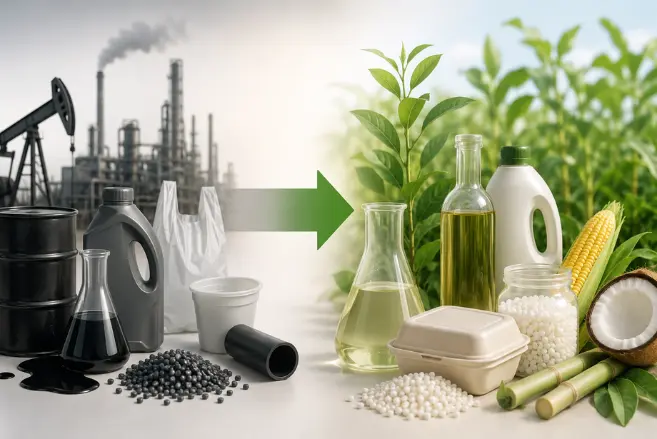
The viable bio-based alternatives to petroleum-derived chemicals today are the ones that meet your spec at container-load volume without a cost premium your customers won’t fund, and that list is shorter than the marketing suggests. Bio-glycerin, bio-ethanol-derived solvents, and several bio-based surfactants are genuinely drop-in at scale; many advertised “green” intermediates are not yet available in the multi-ton, spec-stable supply a procurement team can build a contract on. Sourcing teams working with a chemical raw material supplier need to separate what is commercially viable from what is still pilot-scale.
This piece sorts the field by what you can actually buy in bulk today, at what cost, and against which specification.
What “Viable” Means at Bulk Scale
Viability for a procurement team is not whether a bio-based molecule exists; it is whether it ships in container loads, holds a stable specification batch to batch, and lands at a cost the end product can absorb. A material that meets two of those three is a pilot project, not a sourcing decision.
The maturity spread is wide. Some bio-based chemicals are chemically identical to their petroleum equivalents and qualify with no reformulation, while others are functional substitutes that require requalification and may shift downstream performance.
Bio-based category | Bulk availability | Cost vs petroleum | Drop-in status |
Bio-glycerin (from biodiesel) | Strong, multi-ton | Often at or below | Drop-in |
Bio-ethanol / ethanol solvents | Strong | Comparable | Drop-in |
Bio-based surfactants | Growing | Modest premium | Mostly drop-in |
Bio-based MEG / polyols | Limited, regional | Premium | Functional, requalify |
Bio-based solvents (specialty) | Variable | Premium | Case by case |
The drop-in column is the one that matters for sourcing speed. A chemically identical bio-based grade qualifies on its CoA; a functional substitute restarts your qualification clock.
The Cost and Supply Reality
Bio-glycerin is the clearest win, since it is a co-product of biodiesel production and frequently lands at or below petroleum-derived glycerin while meeting the same specification. For many applications it is already the default rather than the alternative.
Beyond that, most bio-based grades carry significant premiums over their petroleum equivalents, driven by feedstock cost and smaller production scale. Bio-based polyols run 30 to 50 percent above petroleum-derived equivalents; bio-based building blocks such as bio-butadiene trade at 100 percent or more above fossil-derived pricing; and only around 40 percent of bio-based chemical applications have reached cost parity as of 2025, per S&P Global’s Bio-Chemicals 2025 analysis. Those premiums are fundable when a customer mandate or a regulatory driver pays for them, and unfundable when competing purely on cost.
Supply continuity is the second constraint that catches teams out. Several promising bio-based intermediates are produced at one or two facilities globally, which concentrates supply risk in a way petroleum-derived commodities do not. Single-source dependency on a pilot-scale producer is a different risk profile than a commodity with dozens of suppliers, and it belongs in your sustainable chemical sourcing assessment from the start.
How to Evaluate a Bio-Based Switch
Run the evaluation as a sourcing decision, not a sustainability statement, and the viable candidates separate from the aspirational ones quickly. The sequence below keeps the assessment grounded in supply reality.
- Confirm drop-in versus functional status: establish whether the bio-based grade is chemically identical (qualifies on CoA) or a functional substitute (requires full requalification and trials).
- Verify multi-ton availability: confirm the producer can supply your annual container-load volume with spec stability, not just a sample or pilot quantity.
- Map the feedstock and supply concentration: identify how many facilities produce it, since single-source bio feedstock is a supply-continuity risk.
- Price the premium against a funded driver: confirm whether a customer mandate, regulatory requirement, or carbon target pays for any premium, since cost-only switches rarely survive.
- Run the carbon math honestly: confirm the lifecycle benefit is real for your application, since some bio-based routes carry land-use or processing emissions that narrow the advantage.
Start with the drop-in, cost-neutral candidates such as bio-glycerin and bio-ethanol-derived solvents. They deliver a sustainability gain with minimal qualification cost and no margin sacrifice, which builds the internal case for the harder switches later.
What Comes Next in Bio-Based Supply
Capacity is the variable to watch. As bio-based production scales over the next 24 to 48 months, premiums on surfactants and select intermediates should compress, moving more grades from “premium alternative” to “cost-competitive default.” The teams that have already qualified the drop-in candidates will be positioned to expand as the economics improve.
Regulatory and customer-driven demand is the second force, with carbon-reduction targets and bio-content mandates pulling demand forward faster than supply in some categories. That can create temporary shortages and price spikes in the most-mandated grades, which argues for qualifying supply early rather than at the point of a mandate deadline.
How Raw Source Helps You Source Bio-Based Chemicals in Bulk
Switching to bio-based chemicals is a qualification-and-supply problem before it is a sustainability win. Raw Source works with procurement teams to source bio-based grades in the container-load and metric-ton quantities a real program requires, with a 1 MT minimum, so the evaluation moves past pilot samples to a supply you can contract on.
The practical starting point is documentation and spec confirmation. Each shipment carries a Certificate of Analysis, which lets a procurement team confirm that a drop-in bio-based grade actually matches the petroleum-equivalent specification it is replacing, the single fastest path to qualification. For drop-in candidates such as vegetable glycerin and bio-ethanol-derived solvents, that means a switch can often be qualified on the CoA rather than through a full reformulation trial.
Raw Source’s catalog spans solvents such as ethyl alcohol, glycerin, surfactants, and specialty intermediates, which lets a team evaluate bio-based and petroleum-derived options for the same application through one supply relationship. That matters for supply continuity, because several bio-based grades carry single-source feedstock risk, and having a partner who can also supply the petroleum equivalent keeps your line running if a bio feedstock tightens.
Not every bio-based alternative is ready for bulk commitment, and a partner who tells you a grade is still pilot-scale is more useful than one who oversells availability. Raw Source’s guidance is to start with the drop-in, cost-neutral candidates, qualify them on CoA, and expand into premium grades only where a funded driver supports the cost. To evaluate a bio-based switch for a specific application, share your target spec, annual volume, and the driver funding the change with the sourcing team.
Source Bio-Based Chemicals at Container-Load Scale
Separate the viable bio-based grades from the pilot-scale promises before you commit a contract. Request a bulk quote and discuss your container-load requirements and bio-based options with the Raw Source team.
Frequently Asked Questions
Which bio-based chemicals are viable at bulk scale today?
Bio-glycerin, bio-ethanol and ethanol-derived solvents, and several bio-based surfactants are available in container-load quantities with stable specifications today. Bio-based MEG, polyols, and many specialty intermediates remain limited or regional in supply and are not yet reliable for large annual contracts.
Are bio-based chemicals more expensive than petroleum-derived?
It varies by molecule. Bio-glycerin frequently lands at or below petroleum-derived glycerin. Beyond that, premiums rise sharply: bio-based polyols typically cost 30 to 50 percent more than petroleum equivalents, and bio-based building blocks such as bio-butadiene trade at 100 percent or more above fossil-derived pricing. Cost-only switches rarely survive without a mandate or regulatory driver funding the premium.
What is a drop-in bio-based chemical?
A drop-in bio-based chemical is chemically identical to its petroleum-derived equivalent, so it meets the same specification and qualifies on its Certificate of Analysis without reformulation. Functional substitutes, by contrast, behave similarly but require full requalification and downstream performance trials.
What is the main supply risk with bio-based chemicals?
The main risk is supply concentration, since several bio-based intermediates are produced at only one or two facilities globally. That single-source dependency creates a continuity and price-spike risk that commodity petroleum-derived chemicals, with many suppliers, do not carry.
How do I qualify a bio-based chemical for my application?
Confirm first whether it is drop-in or a functional substitute, then verify multi-ton availability and spec stability through the Certificate of Analysis. Drop-in grades can often qualify on the CoA alone, while functional substitutes require reformulation trials and downstream testing.