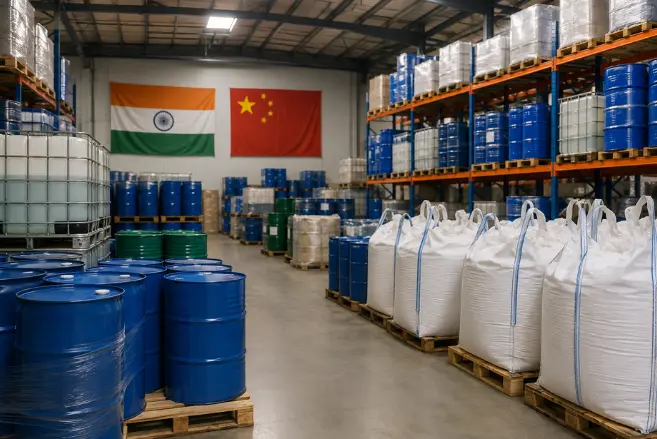
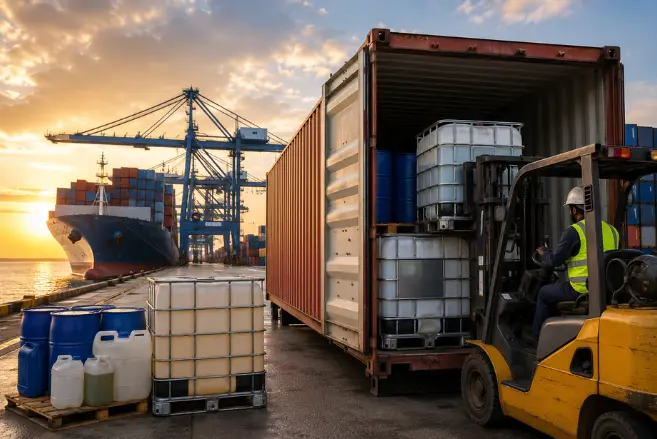
Procurement teams sourcing multiple chemicals from overlapping origins face a recurring logistics decision: ship each product separately as LCL, or consolidate into a shared FCL. For teams working with an industrial chemical distributor at container-load scale, the answer changes depending on volume, origin, product mix, and the hidden costs that do not appear on the ocean freight quote. Getting the decision wrong adds material cost to your landed price without appearing as a line item on the freight invoice.
This analysis covers the FCL versus LCL cost break-even for chemical shipments, the consolidation triggers that shift the decision toward FCL, and the chemical-specific considerations that do not apply to general cargo.
The FCL vs. LCL Cost Structure
Ocean freight is only the visible piece of LCL cost. The handling charges on either end of the journey are what make the quoted per-CBM rate misleading.
LCL cost components:
- Ocean freight per CBM, varying significantly by trade lane and carrier
- CFS (Container Freight Station) charges at origin
- CFS charges at destination
- LCL surcharges and documentation fees per shipment
- Longer transit time (additional days for consolidation and deconsolidation)
FCL benchmarks: Container rates are published in real time through public indices such as the Freightos Baltic Index, which tracks 40-foot container spot rates across major trade lanes. Procurement teams should reference current published rates when running consolidation math rather than relying on historical benchmarks, since container rates have shown wide variability across recent quarters.
A 20ft container carries approximately 25 to 28 CBM of volume, loaded to a practical weight limit of 20 to 24 MT for dense liquid chemicals and up to 26 MT for solids depending on packaging and vessel capacity. The FCL per-CBM equivalent at typical market pricing makes the math clear: once LCL volume exceeds 12 to 15 CBM on most trade lanes, FCL is cheaper.
The Chemical-Specific Break-Even: Why 12 CBM Is Not the Real Number
The general logistics rule that LCL becomes uncompetitive above 12 to 15 CBM applies to commercial cargo. Chemical shipments shift the break-even lower, for three reasons that affect the calculation before the first CBM is measured.
Documentation integrity: Pharmaceutical-grade, food-grade, and regulated industrial chemicals need a documented chain of custody from origin to destination. LCL in a shared container creates the kind of traceability gap quality teams and regulatory auditors will spot. For anything CoA-traceable at the batch level, the break-even math does not apply. The decision is FCL.
Contamination risk: LCL consolidation places your chemical shipment in a container with cargo you did not select, inspect, or control. For solvents, surfactants, food-grade materials, and any chemical with low contamination tolerance, a shared container creates a risk that manifests as a rejected shipment or quality hold. The cost of one rejected LCL shipment, in demurrage, retesting, and production delay, exceeds the freight savings from twelve months of LCL optimization.
Hazardous goods classification: Many industrial chemicals are classified as hazardous materials (IMO Class 3, 6, 8, or 9). Consolidating hazardous chemicals in an LCL shipment creates compatibility requirements that consolidators may not meet or may charge significantly to accommodate. Some consolidators refuse co-loading of hazardous materials entirely, forcing an LCL-to-FCL upgrade at the shipper’s cost.
The practical chemical procurement break-even: for regulated, quality-sensitive, or hazardous-classified chemicals, FCL from the first container load. For non-hazardous, non-regulated chemicals where quality exposure is low, the 12 to 15 CBM rule applies but should be tested against actual CFS costs on the specific trade lane, not assumed from the ocean freight quote alone.
When Multi-Product Consolidation Beats Separate Shipments
The consolidation decision is not only about FCL vs. LCL. It is also about whether to consolidate multiple products from the same origin into one FCL versus shipping each product separately in its own container.
The consolidation trigger framework:
Scenario | Consolidate? | Rationale |
2–4 chemicals from same country, total volume 15–24 CBM | Yes | Combined volume reaches FCL break-even; separate LCL shipments would cost significantly more |
Multiple chemicals from same supplier | Yes | Single supplier documentation, single customs entry, freight economies |
Compatible chemicals, same port of discharge | Yes | Reduces customs entries, CHA fees, port handling |
Incompatible chemical classes (oxidizer + flammable) | No | IMDG segregation requirements override cost logic |
Pharma-grade + industrial chemicals | No | Documentation traceability requires separate custody chains |
Products with very different lead times | No | Waiting for the slower product delays the faster one, adding inventory cost |
The real cost of bulk chemical procurement analysis covers what procurement teams consistently undercount: CHA fees charged per customs entry, port handling at destination per container, and the internal administrative cost of processing separate shipment documentation. Consolidation reduces all three.
The Per-MT Freight Math: Where Consolidation Wins
The cost structure of three separate LCL shipments versus one consolidated FCL for the same combined volume reveals the consolidation advantage. For a procurement team sourcing three specialty solvents from China to JNPT totaling 18 MT (approximately 20 CBM packed in drums), the comparison is structural.
Three separate LCL shipments accumulate:
- Ocean freight per CBM × total CBM
- CFS charges at origin per CBM
- CFS charges at destination per CBM
- Three separate documentation fees
- Three separate CHA fees at customs clearance
One consolidated FCL of equivalent volume incurs:
- A single FCL freight rate per container
- Single destination handling charge
- Single CHA fee at customs clearance
For mid-range trade lane rates referenced from public freight indices, the per-MT cost difference between three LCL shipments and one consolidated FCL at 18 MT is typically a multiple, not a marginal difference. The savings magnitude scales with volume; the principle holds above 12 to 15 MT of compatible chemical products from the same origin.
Consolidation Across Suppliers: The Logistics Coordination Cost
Consolidating across multiple suppliers adds a layer of complexity that erodes the cost advantage if not managed. Origin-level consolidation, where goods from multiple suppliers are co-loaded at an origin CFS before FCL dispatch, is possible but introduces timing dependency risk.
If one supplier’s production or documentation is delayed, the entire consolidated shipment waits. In chemical procurement, a 2-week delay from one supplier can push the vessel by 3 to 4 weeks on monthly sailings, adding inventory carrying cost that offsets the freight savings. The consolidation efficiency only materializes when all suppliers are on the same production and documentation timeline.
The cleaner alternative is sourcing multiple chemicals through a single supply partner, where the partner coordinates origin-level consolidation and assumes the timing risk. This is the structural case for multi-category sourcing through a single supplier: the freight consolidation benefit is captured without the multi-supplier coordination overhead.
Planning Container Consolidation: A Decision Checklist
Before committing to a consolidated FCL, procurement teams should clear the following questions:
- Compatibility: Do all chemicals in the consolidation meet IMDG co-loading requirements? (Oxidizers, flammables, and corrosives have specific segregation rules that override cost optimization.)
- Quality grade segregation: Does any chemical require a separate chain of custody for regulatory or quality documentation purposes?
- Lead time alignment: Can all chemicals be ready for origin loading within the same 5 to 7 day departure window?
- Port of discharge: Are all chemicals destined for the same discharge port? (Split discharge defeats the consolidation.)
- Supplier location: Are all chemicals from suppliers within practical trucking distance of the same origin port?
If all five clear, consolidation is the right call at volumes above 12 MT. If either of the first two fails, the decision moves to FCL or separate shipments regardless of volume.
Sourcing Multi-Product Container Loads Through Raw Source
Teams managing multiple chemical categories from overlapping origins run the consolidation question every purchase cycle. Freight economics favor consolidation at container-load scale, but the supplier coordination and compatibility check eat into the savings if you are managing it yourself across multiple suppliers.
Raw Source runs multi-product consolidated shipments as a standard service for buyers across its portfolio. Sourcing multiple chemicals through one arrangement removes the origin-coordination problem: one shipping instruction, one set of export documents, one customs entry, and one documentation package for your quality file.
The 1 MT floor applies per product inside a consolidated shipment. Total shipment volume of 20 MT or above is where standard FCL economics kick in. Lower individual product volumes that add up to FCL scale across categories pick up the freight advantage without hitting the single-product minimum a separate FCL would require.
For procurement teams sourcing water treatment chemicals, coatings raw materials, or personal care ingredients across multiple chemical families, the consolidation opportunity typically exists across standard procurement cycles without requiring any change in purchasing frequency or volume commitment. The only change is routing multiple product inquiries through a single supply partner instead of separate supplier relationships.
Container load optimization also affects payment term efficiency. A single consolidated FCL shipment requires one LC or one TT transaction rather than separate payment processing for each product. For procurement teams managing foreign exchange exposure or letter of credit costs, this simplification has a measurable administrative cost reduction beyond the freight savings.
Pricing for consolidated container loads is structured per product at standard FCL pricing, with no consolidation surcharge. Raw Source provides combined commercial invoices and packing lists for customs clearance, consolidated CoA documentation packages, and single-point shipping communication for the combined shipment. Lead time for consolidated shipments requires the longest lead time product to be used as the planning baseline across all products in the container.
Request pricing for a consolidated container load across your chemical categories, or discuss your current shipment volumes with Raw Source’s sourcing team to identify consolidation opportunities on your next procurement cycle.
Frequently Asked Questions
At what volume does FCL become cheaper than LCL for chemical shipments?
For general cargo, the FCL break-even is typically 12 to 15 CBM. For chemicals, the effective break-even is lower because LCL incurs CFS handling charges at both origin and destination in addition to ocean freight. On heavy trade lanes such as China to India, a 10 MT chemical shipment in LCL with full handling costs often exceeds the equivalent FCL rate. For regulated, pharmaceutical, or food-grade chemicals with documentation traceability requirements, FCL is the only viable option regardless of volume.
Where can procurement teams reference current FCL freight rates?
Container rates are published in real time through public indices such as the Freightos Baltic Index and the Drewry World Container Index, both of which track major trade lanes and update weekly. Procurement teams should reference current published rates when running consolidation math, since container rates have shown wide variability across recent quarters. Chemical shipments classified as hazardous materials (IMO Classes 3, 6, 8, or 9) carry additional surcharges that vary by carrier and trade lane.
Can multiple chemicals from different suppliers be consolidated into one FCL?
Yes, but with conditions. All chemicals must meet IMDG co-loading compatibility requirements (no incompatible hazard classes co-loaded in the same container). All must be destined for the same discharge port. All must be ready for loading within the same departure window. If chemicals have different quality grade requirements (e.g., pharmaceutical-grade mixed with industrial-grade), separate documentation chains may be required that defeat the consolidation efficiency.
What hidden costs make LCL more expensive than the quoted per-CBM rate?
The main hidden costs are CFS charges at origin and at destination, which add a meaningful per-CBM cost on top of the ocean freight quote. Fixed per-shipment fees for documentation and separate customs entries and CHA fees further increase the effective cost per MT. Longer transit times from consolidation and deconsolidation warehouses add inventory carrying cost that rarely appears in the freight comparison.
How does multi-product consolidation through a single supplier work?
When sourcing multiple chemicals through a single supply partner, all products are co-loaded at the supplier's origin before export, under a single shipping instruction and combined documentation set. This eliminates the multi-supplier timing coordination risk that arises when consolidating across different suppliers at an origin CFS. The supply partner issues a combined commercial invoice, packing list, and CoA package, and the buyer processes one customs entry and one CHA fee at destination regardless of how many products are in the container.
What is the cost impact of separate LCL shipments versus a consolidated FCL at 18 MT?
For an 18 MT shipment of specialty solvents from China to JNPT (approximately 20 CBM packed in drums), three separate LCL shipments accumulate ocean freight, dual CFS handling, separate documentation, and three customs entries. A single consolidated FCL replaces those with one container rate, one destination handling fee, and one CHA entry. Using current published trade-lane rates from public freight indices, the per-MT cost differential between the two structures typically runs as a multiple in favor of FCL, with the absolute savings scaling with volume.