
The acid did its job and then kept going. On a well, that shows up as metal loss on the tubing inspection and iron in the flowback after a hydrochloric acid stimulation. On a pickling line, it shows up as acid consumption running ahead of the scale load, strip thinner than the mill ordered, and more rejects on high-strength grades. Both are inhibitor shortfalls, and in both services the inhibitor program is often propargyl alcohol or a package built around it.
The useful point is that the same molecule fails for different reasons in the two services. In a well, it fails on time at temperature. In an open pickling tank, it fails on depletion. A dose rule written for one is wrong for the other, yet most purchasing conversations treat the two as the same buy of the same drum.
How does propargyl alcohol stop the acid at the steel surface?
Propargyl alcohol (prop-2-yn-1-ol, CAS 107-19-7, C3H4O, 56.06 g/mol) is the simplest acetylenic alcohol: a hydroxyl group at one end of a short carbon chain and a carbon-carbon triple bond at the other. The PubChem compound record (CID 7859) carries its identity and property data.
In hydrochloric acid, the triple bond adsorbs on bare iron. The adsorbed molecules then react with one another on the surface and build a multilayer polymer film. That film slows the acid where it meets the metal, while the acid keeps dissolving scale, rust and carbonate that the film does not cover. Protection depends on the film forming fast and holding long, and both change with temperature and with how much inhibitor stays in the acid.
Six properties from the PubChem experimental properties section decide how it behaves once it leaves the drum.
| Property | PubChem value | What it changes in acid service |
|---|---|---|
| Solubility in water | Miscible (NIOSH, 2024) | Enters aqueous acid without a dispersant, unlike oil-soluble inhibitor actives |
| Boiling point | 236.5 °F at 760 mmHg | Below the temperature of many wells, where pressure keeps it in solution; in an open tank, loss to vapor grows as the bath heats |
| Vapor pressure | 12 mmHg (NIOSH, 2024) | Volatile enough that a heated tank with fume extraction loses some of it to the air |
| Flash point | 91 °F (NTP, 1992) | Below summer yard temperatures in many oil basins, so storage and blending follow the current SDS |
| Melting point | -54 °F (NTP, 1992) | Stays liquid in winter storage without freeze protection |
| Density | 0.9485 at 68 °F (USCG, 1999) | Volume-based and mass-based dose rates disagree unless someone converts |
In the well, the limit is protection time at temperature
In matrix acidizing and acid fracturing, hydrochloric acid (or a hydrochloric-hydrofluoric blend for sandstone) travels down the tubing, sits against casing and tools at the perforations, and returns as spent acid. The steel meets the acid at the hottest point of the job, at bottomhole. The inhibitor has to hold the corrosion rate down for the whole contact time, from the start of pumping until the acid is spent or back at surface.
Downhole, pressure is on the inhibitor’s side: the fluid sits far above atmospheric pressure, so a boiling point of 236.5 °F does not mean propargyl alcohol boils out of a hotter well; it stays dissolved in the acid. The limit is the film. As temperature climbs, the film holds for less time, and a package that protects tubulars through a long job in a cool well can run out partway through the same job in a hot one.
Intensifiers buy back that time. Potassium iodide and formic acid are the usual ones, with quaternary ammonium compounds as co-inhibitors. Past the range where an intensified acetylenic package holds, some operators move to Mannich-base or unsaturated-aldehyde inhibitors; others switch for toxicity or offshore discharge reasons. The buyer’s test is direct: ask for weight-loss coupon data at your bottomhole temperature, for your pump time, in your acid strength. A coupon test on carbon steel says nothing about chrome-alloy tubulars, which need their own.
Pipe life is not the only cost. Corrosion adds ferrous iron, which stays dissolved until near-neutral pH. What drops out in the near-wellbore as the acid spends is mainly ferric iron from rust and mill scale, plus iron sulfide in sour wells, which corrosion iron also feeds. Iron control handles that load and inhibition shrinks it, so a shortfall shows up in the production response as well as in the tubing inspection.
In the pickling tank, the limit is depletion
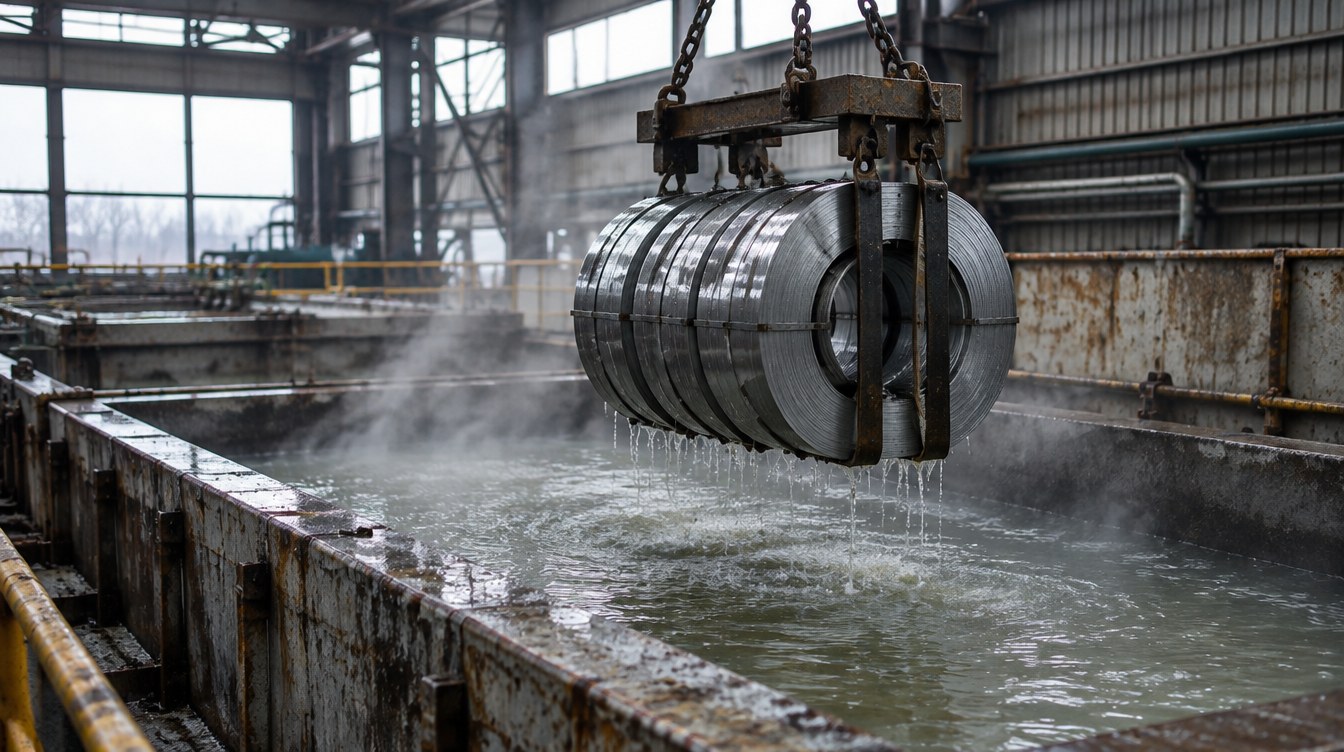
A hydrochloric acid pickling line fails a different way. The tank is open, heated and under fume extraction, and it runs on the same bath for days or weeks with make-up additions. Each coil sees the acid briefly, but the inhibitor lives in the bath for a long time. Propargyl alcohol leaves that bath by three routes: consumed building film on each coil, carried out on the strip as drag-out, and lost to the air above a hot surface.
The third route is where the physical properties matter. A vapor pressure of 12 mmHg and a boiling point of 236.5 °F at 760 mmHg describe a molecule that does not stay put in a heated tank with air moving across it. None of this makes it a poor pickling inhibitor. It means the dose added on Monday is not the dose in the bath on Friday, and a fixed schedule drifts low as line speed, bath temperature and extraction change.
The fix is measurement. Run coupons in bath samples on a set schedule, or track acid consumption and iron build-up per tonne of steel against the scale load, and add inhibitor to hold measured protection. Plants that dose by the calendar learn about depletion from over-pickled coils and a rising acid bill.
Over-pickling costs more than acid and metal. The acid’s attack on bare steel generates atomic hydrogen at the surface, and some of it diffuses into the metal. High-strength grades pay for that through hydrogen embrittlement. An inhibitor that suppresses the base-metal reaction cuts hydrogen at its source, so the dose on a line running high-strength coil deserves its own validation.
One claim worth testing on your own line: propargyl alcohol is a hydrochloric-acid inhibitor first. Its application record is hydrochloric-acid pickling and well acidizing, and acetylenic alcohols are generally weaker in sulfuric acid. A sulfuric pickling line should not adopt it as the lead active on the strength of its hydrochloric performance. Put it on coupons beside your current inhibitor before you switch.
Well versus tank: where the dose decision splits
| Decision point | Oil-well acidizing | Steel pickling tank |
|---|---|---|
| What ends protection | Time at bottomhole temperature | Depletion of inhibitor in the bath |
| Pressure | Far above atmospheric; inhibitor stays in solution | Atmospheric and heated, with air moving over the surface |
| Contact pattern | One job, pumped and returned | Continuous bath with periodic make-up |
| How the dose is set | Autoclave coupon test at job temperature and pump time | Bath coupons or consumption tracking on a schedule |
| What a shortfall costs | Tubular metal loss and a heavier iron-control load | Acid consumption, base-metal loss, hydrogen uptake in high-strength grades |
| When to intensify or switch | As bottomhole temperature passes the tested window, or for toxicity or discharge reasons | When the acid is sulfuric, or bath tests show protection falling despite additions |
Should you buy neat propargyl alcohol or a formulated package?
This is the purchasing decision underneath both services. Inhibitor formulators and acid blenders buy neat propargyl alcohol and build packages; many operators and pickling plants buy the finished package. Because the molecule is miscible with water, it needs no dispersant to enter the acid, which makes a neat program workable in hydrochloric acid inside its temperature window.
Above that window, you are buying the formulator’s test data, not the molecule. The intensifier ratios, the surfactants that keep the package compatible with formation fluids, and the autoclave work behind the label are the product. Paying a package price for a cool, short pickling duty is often overpaying. Buying neat material for a hot well and blending it without coupon data is the larger risk.
Three items belong on the purchase specification either way. First, a Certificate of Analysis (CoA) with assay and water content for each lot, tied to the lot number on the drum or tote. Second, a single qualified source for the program, so the material you tested is the material you run. Third, density on the specification sheet, because a program written by volume and a skid that meters by mass disagree unless someone converts with the density, listed by PubChem as 0.9485 at 68 °F.
Storage follows from the same record. The neat material stays liquid down to -54 °F, so winter storage in northern basins needs no freeze protection. Its 91 °F flash point is one input; the hazard statements in the current Safety Data Sheet (SDS) for your lot and the product page’s safety section set the remaining blending and storage rules, not general acid-handling practice.
Methodology: physical properties are taken from the PubChem record for propargyl alcohol (CID 7859), which compiles NTP (1992), USCG (1999) and NIOSH (2024) values. Mechanism and dosing practice are general corrosion-engineering knowledge, not RawSource test data; validate any program by coupon testing on your own acid and steel.
Frequently asked questions
Why is propargyl alcohol used in acidizing fluids?
How much propargyl alcohol goes into an acid job or a pickling bath?
Does propargyl alcohol work at high bottomhole temperature?
Is propargyl alcohol a good inhibitor for sulfuric acid pickling?
What should a buyer ask for on the Certificate of Analysis?
Sources & methodology
Figures are RawSource sourcing data unless attributed to a named source. Regulatory citations are current as of publication. Chemical identities verified by CAS number against the RawSource catalog.
Search 1,300+ industrial chemicals by name or CAS, or send us your spec — we quote by the drum, tote, or container.
Browse the Chemical Index → Request a Quote