TABLE OF CONTENTS
TABLE OF CONTENTS
Introduction: Why Logistics in Chemical Industry Is Different
Logistics in chemical industry operates under one of the most demanding regulatory and safety environments of any global supply chain. Chemicals are often hazardous, temperature-sensitive, reactive or environmentally sensitive, requiring specialised documentation, certified packaging and trained handlers. Any lapse — even a minor one — can lead to environmental contamination, operational shutdowns, compliance penalties or severe reputational risk.
In 2025, several macro disruptions have made chemical logistics even more complex: supply chain fragmentation, regulatory tightening across major markets, escalating port congestion and increased geopolitical unpredictability. Simultaneously, sustainability requirements and customer transparency expectations have elevated chemical logistics from a support function to a mission-critical strategic capability.
What Does Logistics in the Chemical Industry Mean?
Logistics in the chemical industry encompasses the complete movement, management and storage of chemicals across the supply chain, including:
- Inbound logistics of raw materials, feedstocks and additives
- Intra-plant movements of intermediates and packaged materials
- Storage in specialised warehouses or tank farms designed for hazardous goods
- Outbound distribution of finished chemicals to global customers
- Compliance, safety, documentation and emergency response are integrated into every step
Unlike general logistics, chemical logistics is defined by strict regulatory frameworks, complex temperature and contamination controls, dangerous goods classifications and a deep focus on operational discipline. Industry specialists treat it as a high-hazard environment that requires dedicated assets, trained staff, specialised carriers and advanced monitoring systems.
Key Logistics Challenges in Chemical Industry
The most critical logistics challenges in chemical industry operations today include:
1. Persistent supply-chain disruptions
Lead times remain unpredictable. Many chemical producers have experienced delayed shipments, congestion at origin ports and volatile carrier capacity, forcing them to redesign inventory strategies and strengthen demand planning.
2. Regulatory overload and complex compliance
Chemical supply chains must adhere to multiple overlapping dangerous-goods regulations, labelling standards, export controls and environmental rules. Documentation errors often cause shipment holds, delays or fines. Compliance is a continuous process — not a one-time task.
3. Hazardous materials handling
Chemicals can be corrosive, flammable, reactive or explosive. They require classified packaging, secure containment, temperature-controlled transport and strict segregation from incompatible materials. With industry-wide shortages of trained hazmat personnel, safe handling is increasingly difficult to maintain at scale.
4. Port congestion and infrastructure gaps
Many ports still lack dedicated dangerous-goods capabilities. Chemical shipments face extended dwell times, limited hazardous-storage zones and higher inspection frequencies, contributing to cost overruns and bottlenecks.
5. Geopolitical instability and route volatility
Chemical logistics networks face rapid changes in routing due to conflicts, sanctions, maritime security advisories and insurance restrictions. Rerouting increases transit time and operational cost.
6. Rising sustainability expectations
Customers now expect transparent reporting of emissions, waste, packaging and safety performance. Many procurement teams require logistics providers to demonstrate real sustainability progress, not just declarations.
These pressures are accelerating the need for digitisation, automation, multimodal transport optimisation and stronger collaboration between chemical producers and logistics partners.
Top Industry Overview: What Top Industry Sources Emphasise
The top industry for Logistics in the Chemical Industry consistently highlights three fundamental principles shaping modern chemical logistics:
1. Safety and compliance as the foundation
Safety-first operations are the central message: correct hazard classification, compliant packaging, emergency response readiness and intrinsically safe equipment in handling and storage zones. Chemical logistics teams are expected to have deep knowledge of both process safety and transport regulations.
2. End-to-end specialist logistics solutions
Industry leaders describe chemical logistics as a specialised end-to-end service — not just transportation. They emphasise the need for chemical-dedicated warehouses, temperature-controlled bulk transport, multimodal route planning and teams trained specifically for hazardous cargo.
3. Innovation under constraint
Capacity shortages and regulatory complexity are pushing chemical shippers and 3PLs to redesign networks, adopt contingency routing, improve demand collaboration and deploy technology-driven solutions. Creative, integrated approaches are now necessary to maintain efficiency and safety.
Automating Logistics and Manufacturing in the Chemical Industry
Automation is becoming the backbone of operational excellence and safety in chemical supply chains. Automating logistics and manufacturing in the chemical industry improves visibility, reduces human error and ensures consistent compliance.
Key automation layers include:
1. Digital visibility platforms and control towers
Chemical logistics teams increasingly rely on unified platforms that offer:
- Real-time shipment tracking
- Temperature and shock monitoring
- Automated exception alerts
- Integrated data from carriers, warehouses and plants
This level of visibility enables proactive decision-making and reduces downtime from unexpected events.
2. Automated compliance engines
Automation now plays a major role in:
- Validating dangerous-goods documentation
- Checking export controls and licence requirements
- Ensuring up-to-date labels and Material Safety Data Sheets
- Preventing errors before shipments depart
This drastically lowers the risk of non-compliance and shipment detentions.
3. Warehouse automation in chemical environments
Advanced warehouses use:
- Automated palletisers and conveyors
- Segregation rules embedded in WMS
- Machine-assisted picking in non-hazard zones
- Sensorised storage for temperature-sensitive materials
These systems enhance speed while minimising worker exposure to hazardous substances.
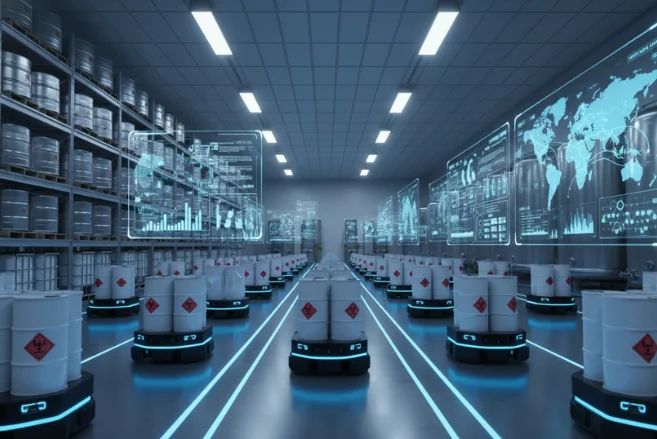
4. AMR in logistics and manufacturing in the chemical industry
Autonomous Mobile Robots (AMRs) are gaining major traction. In chemical supply chains, they are used to:
- Move drums, IBCs and sealed containers between processing areas
- Support repeatable, predictable material movements
- Reduce human interaction in potentially hazardous zones
- Improve traceability and workflow standardisation
AMRs designed for chemical plants often require intrinsically safe or ATEX-rated specifications to operate safely around vapours or combustible atmospheres.
5. Intelligent network design and AI optimisation
Through AI-driven simulations, chemical companies can now optimise:
- Modal mixes (road, rail, ocean, short-sea)
- Inventory placement
- Transport emissions
- Lead-time variability under multiple scenarios
Automation and AI are redefining what efficient, safe and resilient chemical logistics looks like.
Sustainability and Emerging Chemical Industry Trends
Sustainability has become a defining driver of chemical industry trends. Three major shifts are shaping decision-making in logistics:
1. Decarbonising transportation
Chemical companies are shifting to rail and short-sea freight for bulk flows, adopting low-emission routing strategies and optimising load planning to reduce empty runs. Sustainability criteria are increasingly embedded into RFPs and carrier scorecards.
2. Circular packaging and waste reduction
Reusable IBCs, reconditioned drums, lighter packaging formats and enhanced spill-prevention technologies are becoming standard. Many chemical logistics teams are also investing in better containment systems to eliminate leaks and product loss.
3. Regionalisation and supply-chain rebalancing
To reduce emissions and risk exposure, manufacturers are moving production and distribution nodes closer to key demand centres. Regional hubs with chemical-compliant infrastructure are growing in importance across Asia, Europe and the Americas.
4. ESG transparency
Buyers demand clear reporting on:
- CO₂ per tonne-kilometre
- Waste generated and recovered
- Safety incident frequency
- Percentage of shipments using sustainable modes
Transparent ESG reporting is quickly becoming a competitive advantage.
Best-Practice Blueprint for Logistics in the Chemical Industry
Organisations aiming to build world-class chemical supply chains should orient around six strategic pillars:
1. Safety-first design
- Correctly classify all chemicals
- Follow strict segregation rules
- Deploy sensorised and compliant packaging
- Mandate frequent training and safety audits
2. Partner with specialised logistics providers
Choose partners with:
- Hazardous-material certifications
- Strong safety records
- Chemical-ready infrastructure
- Multimodal capabilities
3. Invest in digital visibility and automated compliance
- Integrate TMS, WMS and carrier data for a unified view
- Automate dangerous-goods documentation
- Deploy digital control towers for end-to-end tracking
4. Scale automation and AMR deployment
- Start with stable, high-volume processes
- Expand into AMR-based intra-plant logistics
- Use certified robotics in hazardous zones
- Integrate automation with MES and WMS systems
5. Build resilience and scenario planning
- Develop alternate routing strategies
- Model supply-chain risks proactively
- Strengthen supplier diversification and buffer strategies
6. Embed sustainability into every decision
- Track emissions at the shipment level
- Improve packaging reuse and recycling
- Optimise routing for cost and carbon
- Incorporate sustainability KPIs into supplier evaluations
Conclusion
As the sector pivots toward high-value Speciality Chemicals, the expectations on logistics have escalated beyond traditional performance metrics. The organisations that will lead this decade are the ones operationalising disciplined safety, real-time visibility, intelligent automation and specialised chemical-handling infrastructure as core capabilities — not optional enhancements.
Logistics in the chemical industry has become a strategic control point. By embedding automation, AMR-led workflows, compliant digital ecosystems and sustainability-centric design, companies can unlock operational resilience and accelerate competitive advantage. The mandate is clear: build logistics architectures that are agile, compliant and innovation-ready, or risk falling behind in a market where precision and reliability define leadership.
Contact Us
Questions or looking for a quote?