A procurement VP at a specialty polymer manufacturer made a public commitment in mid-2021: his company would reduce its dependence on Chinese chemical suppliers to below 40% of critical raw material spend within 24 months. He qualified four Indian manufacturers, visited two of them, approved three trial containers, and presented the diversification progress to his board quarterly. By late 2023, Chinese prices had recovered their competitive advantage, the Indian manufacturers had delivered two late shipments and one quality hold, and the company’s China concentration for critical raw materials had quietly returned to 68%. The board commitment was retired without announcement.
This story is not unusual. The 2021–2022 period generated enormous proclamations about permanent supply chain transformation in global chemical supply partnerships and across industrial procurement broadly. Six years on, the honest assessment is more nuanced than either “everything changed” or “nothing changed.” Some shifts are genuinely structural. Others reverted faster than the conference presentations anticipated. This article separates the permanent from the temporary.
Five Years On: Separating Structural Change from Temporary Disruption
The test of whether a supply chain change is permanent is not whether companies claimed it would be. The test is whether it shows up in procurement policy documents, organization structures, contract templates, and supplier master files in 2026. Changes that exist only in strategy presentations have not actually happened.
With that test in mind, some changes are clearly durable: they have been formalized in procurement policy, written into standard contract language, and embedded in supplier qualification processes at large industrial manufacturers globally. Others reverted when the market conditions that drove them normalized. The table below summarizes the assessment before the sections below explain the reasoning.
Change | Status in 2026 | Notes |
Dual sourcing mandates for critical categories | Permanent | Now formal policy at most large manufacturers |
Higher safety stock targets | Permanent | Working capital accepted as insurance cost |
Supply chain visibility investment | Permanent | Technology spend locked in; tracking is standard |
Force majeure clause upgrades | Permanent | Legal teams rewrote; new agreements use updated templates |
Supplier concentration risk as a KPI | Permanent | Board-level metric at most public industrials |
Just-in-time inventory for commodity chemicals | Largely reverted | Cost pressure drove reversion when supply normalized |
China as dominant sourcing origin | Largely reverted | China+1 held for specialty and pharma; reverted for commodities |
Premium pricing tolerance | Fully reverted | Price discipline returned in 2023 as supply eased |
Near-shoring of chemical manufacturing | Minimal progress | Still theoretical for most categories; China remains dominant |
What Is Genuinely Permanent in Chemical Supply Chain Strategy
Dual and Multi-Sourcing as Formal Policy
Before COVID, most chemical procurement teams had a “primary supplier plus a qualified backup” structure that looked formal on paper but operated in practice as a single-supplier model. The backup supplier received occasional trial orders to maintain qualification status but almost never received meaningful volume. COVID exposed the fragility of this model when primary suppliers in China and Europe simultaneously restricted allocation.
The change that has held is the formalization of dual sourcing as a mandatory policy for critical raw material categories, with actual volume allocation (not just paper qualification) split across origins. This is now standard procurement policy at large manufacturers in the FMCG, automotive, pharmaceutical, and specialty chemical sectors. The threshold for what counts as “critical” has also been permanently lowered: before 2020, criticality assessments focused on high-spend categories; post-2020, they focus on categories where supply failure would stop a production line regardless of spend level.
Safety Stock Targets Are Structurally Higher
The just-in-time inventory model, where safety stock for raw materials was calculated to provide two to four weeks of coverage at demand-driven reorder points, was systematically exposed as inadequate for chemicals during 2021–2022. Lead times that had averaged 6–8 weeks from Asia doubled to 14–18 weeks during the container shipping crisis, and safety stock buffers designed for the former were exhausted well before supply recovered.
The change that has held: most large manufacturers recalculated safety stock targets using lead time variance as an input (not just average lead time), and the resulting targets are 15–30% higher in days of coverage than pre-2020 levels. This represents a significant working capital increase, and procurement teams have had to make the case to finance that the additional inventory carrying cost is insurance against line stoppage events. That argument has largely succeeded, and the higher targets have been maintained even as lead times normalized.
Supply Chain Visibility Investment
Demand for real-time shipment tracking, ETA alerts, and production event monitoring exploded during COVID when procurement teams had no visibility into where their containers were or when their factory orders would ship. Platforms like project44, FourKites, and Flexport saw massive adoption; every major logistics company built or acquired tracking capability.
This investment is not reversing. Procurement teams that now have real-time container tracking for their chemical shipments are not going back to phoning freight forwarders for manual updates. Supplier risk monitoring platforms (Resilinc, riskmethods, and similar) that aggregate news, regulatory, and logistics events into early warning signals have similarly become standard at large manufacturers. The technology spend is locked in.
Force Majeure and Supply Contract Language
Chemical supply agreements signed before 2020 typically contained boilerplate force majeure language that had not been seriously tested in decades. COVID generated a wave of force majeure claims from suppliers invoking provisions that were often vague about what qualified, what notice was required, and what obligations remained for partial supply during a declared FM event.
Legal teams at industrial manufacturers rewrote force majeure clauses starting in 2020 and 2021, and those updated templates are now standard for new agreements. Specific additions include: explicit allocation policies during shortage (buyer’s proportional share of available supply rather than supplier’s discretion), minimum notice periods for FM declarations, requirements for alternative sourcing efforts before invoking FM, and shortening the maximum FM duration before buyer cancellation rights activate. These changes are permanent in the sense that they are now in template libraries and will govern agreements for years.
Supplier Concentration Risk as a Board-Level Metric
Before 2020, supplier concentration risk was a procurement internal metric if it was measured at all. Post-2020, it became a question boards ask. Public industrial companies now routinely include supply chain risk disclosure in annual reports, and procurement is asked to provide annual supplier concentration assessments showing the percentage of critical spend concentrated in single countries, single suppliers, and single logistics routes.
This formalization has permanently raised procurement’s organizational profile. Supply chain risk is now a topic in C-suite and board presentations at companies where procurement had historically been a cost center with limited executive visibility. The new governance structures created during the crisis have not been unwound.
What Reverted: The China-Centric Model Is Largely Back
The China+1 strategy received enormous attention from 2020 to 2023. The reality in 2026 is that diversification held selectively and reverted broadly.
For commodity inorganic chemicals (TiO2, soda ash, basic chlorinated compounds, commodity polymers), China-dominant sourcing has largely returned. Chinese manufacturers recovered capacity faster than anticipated, invested aggressively in new capacity during 2021–2023 to capture the demand moment, and by 2023–2024 were offering prices that India and Southeast Asian alternatives could not match. Procurement teams that had qualified Indian alternatives kept them as second-source qualifications rather than converting them to meaningful volume allocation.
The exceptions where diversification has genuinely held: pharmaceutical API and intermediate categories, where FDA compliance requirements and the EU’s API sourcing diversification push under its pharmaceutical strategy have created regulatory pressure to diversify away from Chinese supply. Specialty chemicals with direct geopolitical sensitivity (rare earth processing chemicals, certain energetic materials) where US and EU government pressure on supply chain security has affected procurement policy. And companies with European end-customers facing growing scrutiny of China supply chain exposure.
The honest assessment for commodity chemical procurement teams: the China+1 strategy was real as a qualification exercise but limited as a volume reallocation exercise. Most companies successfully qualified India and Southeast Asia alternatives for their major categories. Most did not shift meaningful volume when Chinese prices recovered.
The New Normal in Freight and Logistics
Container freight rates have not returned to the pre-COVID floor of approximately $1,000–1,500 per FEU for Asia-Europe and $1,500–2,000 per FEU for Asia-US West Coast. They have also not stayed at the 2021–2022 peak of $10,000–14,000 per FEU. The current environment (2025–2026) is a structurally elevated “new normal” in the range of $3,000–5,000 per FEU for standard lanes, with surcharge volatility layered on top.
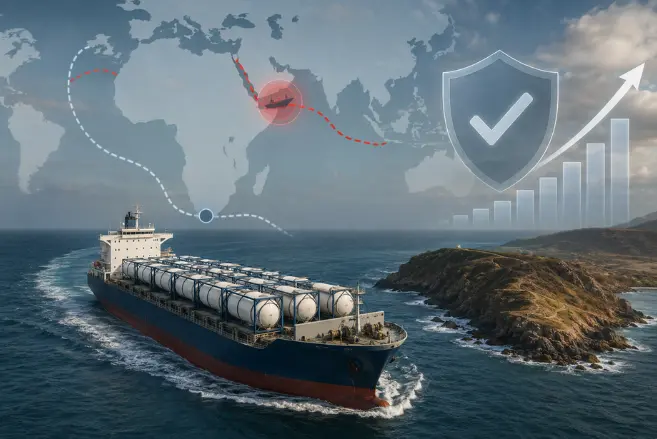
Structural factors keeping freight costs elevated: higher fuel costs from IMO 2020 low-sulfur regulations baked permanently into bunker adjustment factors; Red Sea rerouting adding cost and transit time to Asia-Europe lanes (likely a 2–3 year feature at minimum, possibly longer); new ship capacity additions partially offset by growing global trade demand; and port infrastructure congestion at key hubs that occasionally triggers demurrage spikes.
The shift from China in chemical manufacturing has added complexity to freight lane economics. As India’s chemical export volume grows, India-origin freight capacity and competition has improved, partially offsetting rate increases for buyers who have India-origin supply relationships. For procurement teams budgeting 2026–2027 freight costs, the appropriate baseline is approximately 2–3x pre-COVID rates for standard lanes, with additional war risk and surcharge volatility for trades transiting the Gulf of Aden.
How Chemical Procurement Organizations Have Changed
Beyond strategy and policy, procurement organizations themselves changed structurally in response to COVID, and most of those changes have been maintained.
New roles appeared: supply chain risk manager (focused on supplier concentration and disruption early warning), near-shore supplier development manager (tasked with qualifying non-China alternatives), and in some companies, a dedicated raw material market intelligence function. These roles did not exist at most mid-size manufacturers before 2020.
New metrics were added alongside cost savings in procurement KPIs: supply reliability rate (on-time, on-spec delivery performance by supplier and category), supplier concentration risk score, days of inventory cover for critical raw materials, and lead time variance (not just average lead time). Procurement teams are now expected to report against these metrics as well as traditional purchase price variance.
For procurement teams managing coatings and construction chemicals — a sector that saw particularly acute TiO2 and specialty pigment supply disruption during 2021–2022 — these organizational changes have translated into formal dual-sourcing policies and higher safety stock mandates that have been maintained through 2025–2026.
What Is Still Evolving: The Next Two to Three Years
Several dynamics remain genuinely in motion and will determine which way the remaining areas of uncertainty resolve.
US-China tariff escalation: Section 301 tariff rates on Chinese chemical imports have expanded in 2024–2026 and remain under active policy review. For US-based procurement teams, tariff exposure is reshaping China-origin sourcing economics in real time. Categories that were China-advantaged on cost in 2022 may not be in 2027 if tariff rates increase further.
India’s chemical manufacturing capacity build-out: The results of India’s PLI (Production Linked Incentive) scheme for specialty and pharmaceutical chemicals are becoming visible in 2025–2026. Export capacity in several chemical categories has expanded materially, and quality and delivery consistency from the new capacity is still being established by the global buyer base. Whether India becomes a credible scale alternative to China for commodity chemical categories, or remains a specialty and pharma play, will be resolved over this period.
EU CBAM and green chemistry mandates: Supply chain carbon requirements will create new sourcing pressure for European chemical buyers, potentially favoring lower-carbon origins even when unit prices are higher.
Sourcing Bulk Chemicals Through Raw Source
The permanent shifts described in this article, particularly dual sourcing mandates and supplier concentration risk requirements, have a direct implication for how procurement teams structure their sourcing relationships. Qualifying and managing individual manufacturer relationships in two countries simultaneously requires investment in audit, documentation, logistics, and communication infrastructure that many procurement teams underestimated during the diversification push.
Raw Source operates as a multi-origin sourcing partner with established manufacturer relationships across both India and China, across a wide range of chemical categories. For procurement teams implementing dual-source policies, the ability to access both origins within a single commercial relationship substantially reduces the qualification and management cost of maintaining genuine supply redundancy.
For the commodity chemical categories where China-origin supply remains cost-advantaged, Raw Source’s China sourcing network in Shandong, Zhejiang, Jiangsu, and Guangdong provides access to established manufacturers with export documentation capability and consistent quality track records. For categories where India-origin supply is strategically preferred for compliance, regulatory, or concentration risk reasons, Raw Source’s relationships with manufacturers in Gujarat, Maharashtra, Andhra Pradesh, and Rajasthan cover acid, intermediate, and specialty categories with the documentation quality that EU and US regulated markets require.
For procurement teams specifically responding to board-level supplier concentration requirements, Raw Source can structure origin-diversified supply arrangements that provide the dual-source qualification documentation, split volume allocation, and supply continuity planning that concentration risk KPIs require. This is not hypothetical: it is an operational capability that procurement teams sourcing through Raw Source have used to demonstrate supplier diversification compliance in annual supply chain risk reviews.
For procurement teams managing amines and specialty chemical categories where pharmaceutical-grade supply chain documentation and dual-origin qualification are priorities, Raw Source provides the structured dual-source arrangements that satisfy board-level supplier concentration requirements introduced since 2020. For procurement teams reviewing their post-pandemic sourcing structure and looking to build genuine supply resilience rather than paper qualification programs, request a bulk quote that includes origin-diversification options for your priority chemical categories.
Frequently Asked Questions
Has China+1 sourcing strategy actually worked for chemical procurement teams?
Selectively. China+1 has worked as a qualification exercise: most large manufacturers have now qualified India or Southeast Asian alternatives for major categories. As a volume reallocation strategy, it reverted in commodity categories when Chinese prices recovered in 2023–2024. The durable China+1 adoption has been in pharmaceutical APIs, regulated specialty chemicals, and categories directly affected by US Section 301 tariffs. For most commodity inorganic chemicals, China remains the dominant sourcing origin despite the diversification rhetoric of 2020–2022.
Which post-pandemic supply chain changes have become permanent procurement policy?
The permanent changes are: formal dual sourcing mandates for critical raw materials, structurally higher safety stock targets (15–30% above pre-2020 levels), real-time supply chain visibility technology, updated force majeure contract language, and supplier concentration risk as a formal KPI reported to boards. These changes are embedded in policy documents, contract templates, and organization structures at large industrial manufacturers and are not reversing.
How have safety stock targets for chemical raw materials changed since COVID?
Most large manufacturers recalculated safety stock targets post-COVID using lead time variance as an input rather than average lead time alone. The result was targets approximately 15–30% higher in days of coverage than pre-2020 levels. The additional working capital cost has been accepted as insurance against line stoppage events, and the higher targets have been maintained even as lead times normalized from their 2021–2022 peak. Just-in-time inventory management for chemical raw materials is now reserved for categories with high supply security and short, reliable lead times.
What is the "new normal" for container freight rates on chemical shipments?
Container freight rates have settled at approximately 2–3x pre-COVID levels for standard trade lanes, not at the 2021–2022 peak but significantly above the pre-2020 floor. The range of $3,000–5,000 per FEU for standard Asia-Europe and Asia-US lanes (excluding surcharges) represents the current structural level, with surcharge volatility on top. Red Sea rerouting around the Cape of Good Hope has added cost and transit time to Asia-Europe trades that is likely to persist for several years. Procurement teams should budget at current levels plus 10–15% surcharge buffer, not revert to pre-2020 freight cost baselines.
How have procurement organizations changed structurally since 2020?
New roles appeared: supply chain risk manager, near-shore supplier development manager, and raw material market intelligence functions. New KPIs were added alongside cost savings: supply reliability rate, supplier concentration risk score, days of inventory cover, and lead time variance. Procurement has gained organizational influence: supply chain risk is now a board-level topic at most large industrial companies, and procurement is expected to report against supply chain resilience metrics as well as price performance. These structural changes have held.
Is just-in-time inventory still viable for chemical raw materials?
In limited cases. Just-in-time is viable for categories with short, reliable lead times (domestically sourced chemicals, established regional supply relationships), high supply security (multiple substitutable suppliers, standardized products), and low line-stoppage cost if supply fails. For imported chemicals from Asia with 6–10 week lead times and meaningful lead time variance, the COVID experience demonstrated that JIT creates unacceptable production risk. The industry has structurally moved toward higher safety stock and demand-driven reorder points that incorporate variance, not just average lead times.