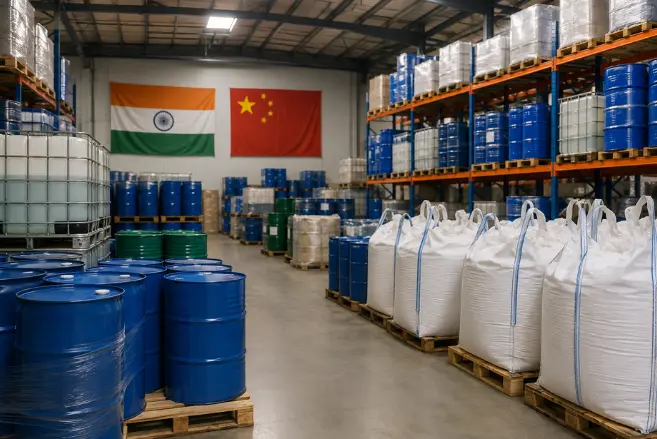
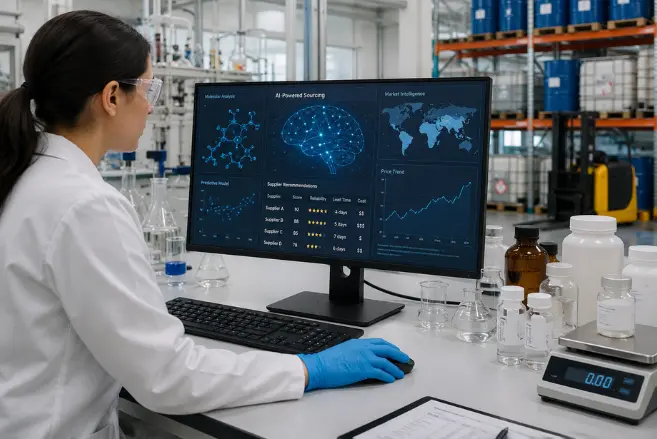
Every procurement software vendor now claims to be “AI-powered.” The 2026 conference circuit has been wall-to-wall presentations on how machine learning will transform chemical sourcing. Meanwhile, a head of procurement at a mid-size specialty chemicals manufacturer spent six months implementing an AI procurement platform, only to discover that its price prediction module had a 34% error rate on her top three chemical categories and its supplier discovery tool returned almost exclusively companies she had already evaluated or disqualified years ago.
The gap between what AI vendors claim and what AI tools actually deliver in the specific context of bulk chemical procurement is substantial — and it is driven by structural features of chemical procurement data that most AI vendors either do not understand or do not acknowledge in their sales process.
This article provides a frank assessment of where AI adds genuine value for chemical buyers, where it falls short, and what questions to ask before committing budget to any AI procurement tool.
Why Chemical Procurement Is Harder for AI Than Other Categories
Most AI procurement tools were built on data from categories where the data problems are smaller: electronics, office supplies, services, software. Chemical procurement has three structural data problems that these tools were not designed for.
Non-standard product descriptions. The same chemical can appear in a procurement dataset as “sodium hydroxide,” “NaOH,” “caustic soda,” “caustic soda flakes 98%,” “caustic soda pearls,” “NaOH solution 50%,” and a dozen other variations. Before AI can analyze spend or match suppliers, someone has to solve the normalization problem. This is not trivial — it typically requires 3–6 months of data cleaning and taxonomy work before AI tools can operate on chemical spend data with any reliability.
Opaque pricing. Unlike electronics or MRO categories where catalog pricing provides a transparent benchmark, most industrial chemical pricing is negotiated bilaterally and never published. The ICIS, Argus, and Platts price indices cover a fraction of traded chemicals and are paywalled. AI tools trained on publicly available data have thin and often outdated chemical price signals to work with.
Supply chain opacity. The supplier networks for many industrial chemicals involve multiple tiers of traders, distributors, and manufacturers that are not well-represented in commercial supplier databases. AI-powered supplier discovery tools that rely on web-scraped data and company registry information miss a large proportion of the actual global supplier pool for niche specialty chemicals.
These are not insurmountable problems. They are problems that require acknowledged data infrastructure investment before AI delivers value — and that investment is rarely mentioned in vendor demonstrations.
Where AI Genuinely Adds Value Today
Despite the caveats, several AI use cases work well for chemical procurement teams right now.
Spend Classification and Analysis
The single highest-value AI application in chemical procurement is spend taxonomy normalization. Natural language processing (NLP) models trained on chemical nomenclature can classify and standardize product descriptions across ERP systems with 85–95% accuracy — compared to 60–70% for manual categorization. For procurement teams trying to understand their actual chemical spend across categories, business units, and geographies, this is transformative.
The downstream benefits: identifying consolidation opportunities across business units ordering the same chemical under different supplier names, quantifying tail spend exposure, and enabling meaningful cross-category benchmarking. One large coatings manufacturer ran an AI spend classification exercise and discovered that three business units were buying the same grade of TiO2 from different suppliers at prices ranging from $2,100/MT to $2,450/MT. The consolidation opportunity was worth $180,000/year — and it was invisible until the spend data was properly classified.
Contract Analysis and Risk Flagging
NLP-based contract review tools provide genuine value as a first-pass screen on chemical supply agreements. They reliably identify missing or weak force majeure clauses, non-standard payment terms, absent quality specification parameters, and vague rejection criteria. For procurement teams evaluating digital tools for chemical procurement more broadly, contract analysis consistently ranks as the highest-ROI AI application across early adopters in the chemical buying space.
This is not a replacement for legal review. It is a prioritization tool that directs legal attention to the highest-risk clauses across a large contract portfolio without requiring manual review of every document. For procurement teams renewing 30–50 supply contracts per year, this is a practical time saving.
Supplier Risk Monitoring
AI-powered supplier risk monitoring tools (riskmethods, Resilinc, and similar) aggregate news, regulatory filings, financial data, and supply chain events to provide early warning signals about supplier disruptions. For large, publicly-reporting chemical manufacturers, this works reasonably well. A force majeure declaration in a Chinese province, an environmental enforcement action in Shandong, or a financial stress indicator at a major European producer will surface in these systems within hours.
The limitation: most chemical procurement involves private companies, small manufacturers, and traders who generate little publicly available data for AI systems to monitor. A mid-size Indian dye intermediate manufacturer experiencing quality problems or financial stress will not appear in an AI risk monitoring alert until the problem has already affected supply.
Demand Forecasting and Inventory Optimization
AI-based demand forecasting adds value where order patterns are regular and historical data is clean (at least 2 years of consistent records). For commodity chemicals on monthly or quarterly procurement cycles, machine learning models can reduce forecast error by 15–30% compared to simple moving average methods — which directly translates to lower safety stock requirements and fewer spot market emergency purchases.
The prerequisite is data quality. AI forecasting models trained on dirty historical data (inconsistent units, missing records, reclassified products) produce worse forecasts than simple rule-based approaches. Most procurement teams have 12–24 months of cleanup work to do before their demand data is suitable for ML forecasting.
Where AI Falls Short (The Honest Assessment)
Chemical Price Prediction
The most aggressively marketed AI capability for chemical procurement is price prediction — and it is the area where the gap between vendor claims and operational reality is widest.
Chemical prices are driven by geopolitical decisions (OPEC production quotas, Chinese environmental enforcement actions, trade tariff announcements), regulatory events (new substance restrictions, anti-dumping duty orders), and capacity events (plant shutdowns, force majeures) that are not predictable from historical price patterns. The statistical foundation of machine learning — that past patterns predict future patterns — is fundamentally weaker for chemical prices than for the financial markets where price prediction models were originally developed.
Several vendors demonstrate price prediction models with impressive backtested accuracy on commodity chemicals with high liquidity (ethylene, benzene, propylene). These models work in stable market conditions. They have failed systematically during every major market dislocation since 2020: COVID supply chain disruption, the 2021–2022 container crisis, the 2024–2026 US-China tariff escalation, and the Red Sea disruption. These are exactly the market conditions where price prediction would be most valuable — and where the models are least reliable.
What AI price tools can do: flag directional trends and identify anomalous price movements against historical patterns. What they cannot do reliably: predict price levels 3–6 months forward with the accuracy needed to make material contract timing decisions.
Supplier Discovery for Specialty Chemicals
AI-powered supplier discovery tools (Scoutbee, Thomasnet AI, and similar) work well for commodity categories with large, well-documented global supplier populations. They work poorly for specialty chemicals with narrow global supplier bases, where the relevant manufacturers are not well-represented in commercial databases and where informal trading relationships are central to access.
A procurement team looking for a new source of a specialty silicone intermediate or a niche pharmaceutical precursor will find that AI discovery tools return largely the same large distributors and trading companies — not the actual manufacturers who produce the material.
Quality Prediction
Supplier quality performance cannot be reliably predicted from the publicly available data that AI monitoring tools access. A supplier’s future quality consistency depends on their production equipment condition, raw material quality from their own suppliers, workforce stability, and quality management rigor — none of which are visible in news feeds, financial filings, or shipping data.
AI “quality risk scores” derived from indirect data signals are essentially noise for chemical procurement purposes. Incoming QC testing and direct supplier audit remain the only reliable quality assessment tools.
What to Ask AI Procurement Vendors Before Signing
Any vendor claiming AI capability for chemical procurement should be able to answer these questions. Inability or reluctance to answer is informative:
- What chemical-specific training data does your model use? What is the source and how current is it?
- How does your system handle non-standard chemical product descriptions and nomenclature normalization?
- For your price prediction module: what is the documented accuracy rate on a chemical category similar to mine, and over what time period? Can you provide a specific reference customer in chemical procurement?
- What is your data security protocol for our chemical spend data? (Competitive intelligence sensitivity)
- What data cleanup does my team need to perform before your tool delivers meaningful output?
- What is the implementation timeline before the tool produces actionable results?
The last two questions are particularly revealing. Vendors who acknowledge a 3–6 month data preparation period and a 12-month ramp-up to meaningful output are being honest about AI implementation reality. Vendors who claim “plug in and go” for chemical spend analysis are oversimplifying.
Where Chemical Procurement AI Is Heading (2027–2029)
The near-term genuine improvements to watch:
Better chemical ontologies: Chemical informatics companies including CAS and others are building richer machine-readable chemical databases. As AI tools integrate these ontologies, the nomenclature normalization problem will get easier.
Price signal aggregation: Emerging platforms are building real-time aggregation of chemical price signals from multiple sources (customs data, import/export records, spot market reports). This will improve the signal quality available for price forecasting, even if full predictive accuracy remains out of reach.
Supply chain mapping: New tools are mapping multi-tier chemical supply chains by combining import data, corporate registry data, and shipping records. This will improve supplier discovery quality for specialty chemicals within 2–3 years.
The combination of better data quality tools with improved AI models will produce a materially better AI procurement capability by 2028–2029 than exists today. The current period requires realistic expectations: invest in AI where it works now (spend classification, contract analysis, basic risk monitoring), and avoid overpaying for capabilities (price prediction, specialty supplier discovery) that are not yet reliable.
Sourcing Bulk Chemicals Through Raw Source
The fundamental value that AI procurement tools promise — better market intelligence, supply risk anticipation, and supplier performance insight — is what an experienced sourcing partner with active market relationships already provides through human intelligence rather than algorithmic prediction.
Raw Source monitors chemical markets daily across its active sourcing relationships in India and China. The supply disruption signals that AI monitoring tools attempt to derive from public data — factory shutdowns, environmental enforcement actions, port congestion events — are known to Raw Source’s sourcing team through direct supplier communication, often before they appear in any public data feed.
For teams managing chemical categories such as coatings and construction chemicals — where spend is concentrated in a small number of high-value materials like TiO2 and specialty pigments — AI spend classification delivers the highest early value, because consolidating multi-business-unit spend on a single classified category is immediately actionable. Raw Source’s recommendation to procurement teams broadly is to invest in AI where the data quality prerequisites are met (spend classification for teams with 3+ years of clean ERP data) and to be skeptical of any AI tool that promises to replace the market relationships and operational judgment that experienced sourcing professionals provide.
Market intelligence from Raw Source covers specialty and commodity chemical categories with high price volatility, including current pricing benchmarks for silicones and other specialty procurement categories where AI price tools are least reliable. This intelligence is grounded in active market transactions, not model predictions, which makes it more reliable for procurement decisions than AI price forecasts during the market dislocations that matter most.
For procurement teams evaluating AI tools for chemical spend analysis or contract review, Raw Source can provide market context that helps calibrate what AI outputs mean in operational terms. Discuss your requirements with the team and request a bulk quote that includes current market intelligence for your specific chemical categories.
Frequently Asked Questions
Can AI accurately predict chemical prices 6–12 months in advance?
Not reliably. Chemical prices are driven by geopolitical events, regulatory changes, and capacity events that are not predictable from historical price patterns — the foundation of machine learning models. AI price tools can identify directional trends and flag anomalies against historical patterns, but they have failed systematically during every major market dislocation since 2020. Use AI price tools for context and signal, not for precise forward commitments.
Which AI procurement tools are most useful for bulk chemical buyers?
The highest-value applications today are: spend classification and normalization tools (NLP-based; dramatically improve spend visibility for teams with messy ERP data), contract analysis tools (NLP-based; flag risk clauses across large contract portfolios efficiently), and basic supplier risk monitoring (useful for large public manufacturers; limited for private Asian manufacturers). Demand forecasting tools add value for commodity categories with at least 2 years of clean historical order data.
What data quality is needed before AI procurement tools add value?
AI tools require: consistent product descriptions (or a willingness to invest 3–6 months in normalization), at least 24 months of historical purchase data with complete fields, a standardized supplier master (no duplicate entries for the same supplier), and unit of measure consistency across records. Most chemical procurement datasets require significant cleanup before AI tools produce reliable output. Vendors who claim otherwise are underselling the implementation reality.
How does machine learning help with chemical spend analysis?
NLP-based spend classification can standardize inconsistent chemical product descriptions across an ERP system with 85–95% accuracy, compared to 60–70% for manual categorization. This enables procurement teams to see their actual spend by chemical category, identify consolidation opportunities across business units ordering the same material from different suppliers, and quantify tail spend exposure — all of which are typically invisible in uncleaned procurement data.
What questions should procurement teams ask AI vendor sales teams?
Ask: What chemical-specific training data does the model use? What is the documented accuracy rate on a chemical category similar to mine? What data cleanup does my team need to perform before the tool produces meaningful output? What is the realistic implementation timeline? Can you provide a specific reference customer in chemical procurement? The quality and candor of the answers will tell you more about the tool's actual capability than any demonstration.
Is ChatGPT or a general AI assistant useful for chemical procurement work?
Yes, for well-defined tasks: drafting RFQ templates, analyzing supplier contract language, summarizing market reports, writing specification documents, and structuring supplier evaluation scorecards. General AI assistants are not reliable sources of current chemical market pricing or supply chain intelligence — they have training data cutoffs and no access to real-time market data. Use them as a drafting and analysis tool, not as a market intelligence source.