
TABLE OF CONTENTS
TABLE OF CONTENTS
Introduction: The Data Center Thermal Challenge Has Changed
Data centers are no longer dominated by traditional air-cooled CPU racks.
The rapid rise of AI, machine learning, and high-density GPU workloads has fundamentally changed thermal design requirements. Power densities that were once manageable with air cooling now demand advanced heat transfer solutions that deliver:
The rapid rise of AI, machine learning, and high-density GPU workloads has fundamentally changed thermal design requirements. Power densities that were once manageable with air cooling now demand advanced heat transfer solutions that deliver:
- Higher heat flux removal
- Long-term reliability
- Electrical safety
- Compatibility with sensitive electronics
- Predictable performance over years of continuous operation
As a thermal systems engineer, one thing is clear: cooling fluids are now a strategic design choice, not a commodity.
Why Heat Transfer Fluids Are Critical in Data Center Cooling
Whether the system is direct-to-chip liquid cooling, cold plate cooling, or single-phase immersion cooling, the thermal fluid plays a central role in:
- Heat removal efficiency
- System reliability
- Maintenance intervals
- Materials compatibility
- Total cost of ownership
Traditional solutions—air cooling or water-based systems—are reaching their practical limits in many high-performance environments. This has accelerated interest in dielectric heat transfer fluids, including silicone-based cooling fluids.
Silicone-Based Heat Transfer Fluids: A Proven Option for Electronics Cooling
Silicones have been used for decades in electronics, aerospace, and industrial thermal management. In modern data centers, silicone heat transfer fluids offer a compelling balance of performance, safety, and longevity.
Key Advantages of Silicone Cooling Fluids
1. Electrical Insulation (Dielectric Safety)
Silicone fluids are inherently non-conductive, making them well-suited for:
- Immersion cooling
- Proximity to live electronics
- High-voltage components
This reduces risk compared to water-based systems and simplifies system design.
2. Thermal Stability Over Long Service Life
Data center cooling systems operate 24/7, often for years without shutdown. Silicone fluids are known for:
- Excellent thermal stability
- Resistance to oxidation
- Minimal degradation under continuous heat cycling
This translates to predictable performance and reduced fluid replacement frequency.
3. Wide Viscosity Range for System Optimization
Silicone fluids are available across a broad viscosity spectrum (from very low cSt to high cSt grades), allowing engineers to tune fluids for:
- Natural convection
- Pumped circulation
- Reduced evaporation or misting
- Materials compatibility
This flexibility is critical as cooling architectures continue to evolve.
4. Compatibility With Electronics and Materials
Well-specified silicone fluids show strong compatibility with:
- Plastics and elastomers
- PCB materials
- Seals and gaskets
- Metals commonly used in server hardware
This minimizes long-term reliability risks.
5. Growing Interest as Alternatives to Fluorinated Fluids
As regulatory and cost pressures increase around PFAS-based fluorinated fluids, many data center operators and OEMs are actively evaluating silicone-based alternatives that offer:
- Lower environmental risk
- Supply chain flexibility
- Competitive lifecycle costs
Where Silicone Heat Transfer Fluids Are Used in Data Centers
Silicone-based materials are already established in several critical areas:
• Thermal Interface Materials (TIMs
Silicone formulations dominate:
- Thermal greases
- Gap fillers
- Pads and elastomers
These materials bridge the interface between chips and heat sinks or cold plates.
• Immersion Cooling Systems
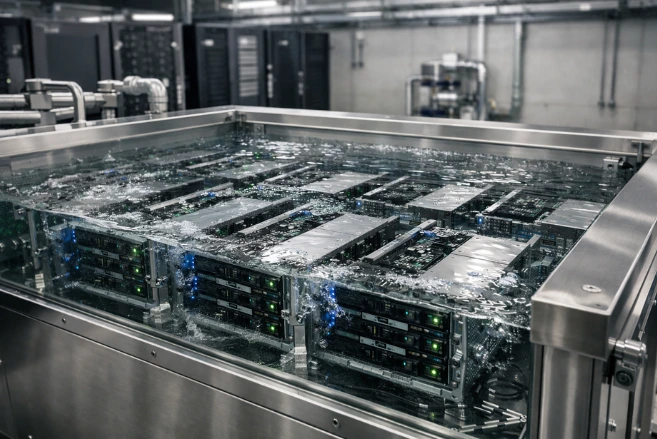
Silicone dielectric fluids are increasingly evaluated for:
- Single-phase immersion cooling
- Specialty immersion applications requiring stability and safety
• Power Electronics & Supporting Infrastructure
Silicone materials support thermal management in:
- Power distribution units (PDUs)
- Voltage regulators
- Memory modules
- Auxiliary electronics
What Data Center Engineers Actually Look for in a Cooling Fluid Partner
Selecting a heat transfer fluid is not just about viscosity or thermal conductivity. Engineering teams care about:
- Moisture control (low water content)
- Dielectric strength and resistivity
- Volatility and outgassing behavior
- Long-term thermal aging data
- Materials compatibility testing
- Supply reliability and consistency
Just as important: they need a partner who understands these requirements and can support qualification, testing, and long-term supply.
Why Partner Choice Matters as Much as Fluid Choice
Major chemical manufacturers produce excellent silicone fluids—but they are often:
- Rigid on specifications
- Slow to adapt formulations
- Limited in customization
- Focused on very large, standardized customers
Modern data center cooling projects often require flexibility, engineering support, and multiple sourcing options.
RawSource: A Technical Partner for Data Center Heat Transfer Solutions
RawSource supports data center cooling initiatives by acting as a silicone sourcing and formulation partner, not just a reseller.
How RawSource Adds Value
- Access to silicone heat transfer fluids across a wide viscosity range
- Support for low-moisture, electronics-grade specifications
- Ability to match or tune properties for specific cooling architectures
- Experience across immersion cooling, TIMs, and thermal management materials
- Flexible sourcing strategies not tied to a single OEM
- Support for pilot testing, qualification, and scale-up
For data center operators, cooling OEMs, and system integrators, this flexibility reduces risk and accelerates deployment.
The Future of Data Center Cooling Is Materials-Driven
As AI workloads increase and power densities rise, thermal performance will increasingly define:

- Rack design
- Hardware longevity
- Energy efficiency
- Operating cost
Silicone-based heat transfer solutions are positioned to play a growing role—especially where safety, reliability, and long service life matter most.
Choosing the right material is important.
Choosing the right partner is critical.
Choosing the right partner is critical.
Conclusion
Advanced data center cooling is no longer just an infrastructure problem—it is a materials science problem.
Silicone heat transfer fluids offer a proven, adaptable solution for modern thermal challenges, and organizations evaluating next-generation cooling architectures benefit from working with partners who understand both engineering requirements and supply realities.
RawSource works alongside data center stakeholders to support silicone-based thermal solutions that are engineered, qualified, and ready to scale.
Contact Us
Questions or looking for a quote?