
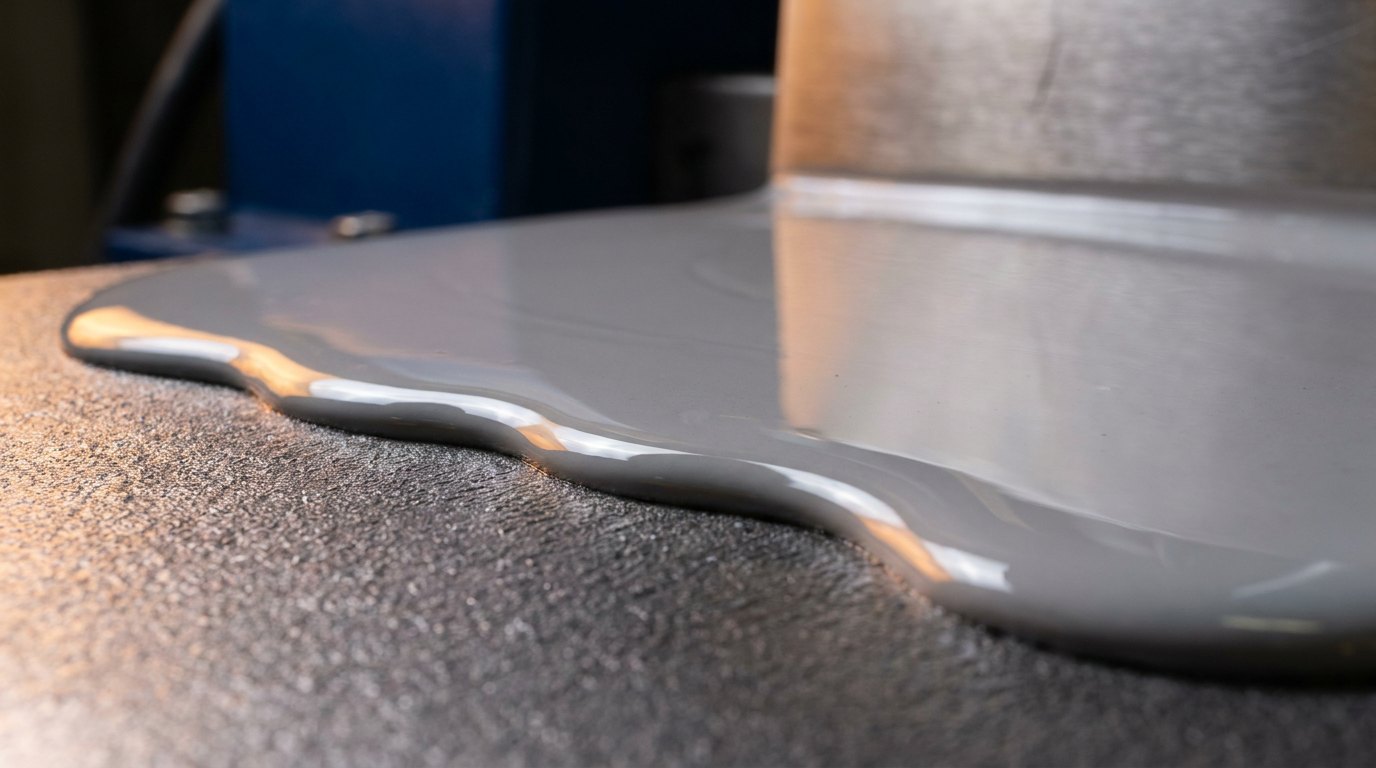
A spray polyurea line keeps losing its working window. The formulator moves to a secondary polyetheramine to slow the gel, rebuilds the mix ratio from the lot amine value, and the first trial sprays clean. The second lot gels noticeably faster. Total amine sits inside the range on both certificates.
Nobody looked at the line below it. The Certificate of Analysis (CoA) for each lot also reports residual primary amine, and that single number moved between the two lots. It is the number that moves gel time.
What changes when a polyether diamine becomes a secondary amine?
N,N’-diisopropyl polyoxypropylene diamine caps each terminal amine of the 2000 molecular weight polyoxypropylene diamine with an isopropyl group. Each nitrogen keeps one reactive hydrogen instead of two, and the hindered amine reacts more slowly with isocyanate. The specification caps residual primary amine at 5% maximum, and that residue governs early gel.
RS-SD2001 is built for exactly that: its relatively low reactivity suits applications that need a slower cure, and it can extend working time and lower the reaction exotherm. The primary parent, RS-D2000 (polyetheramine D-2000), has low viscosity, low color (25 max APHA) and low vapor pressure.
No viscosity figure is specified for the secondary grade. If your process depends on pumping or spray atomization, measure viscosity on the qualification lot before you assume the parent’s behavior carries over.
Both grades sit inside the wider polyetheramine family. The polyetheramine supplier hub maps the other molecular weights and functionalities, which matters if the secondary diamine turns out not to be the right lever for your problem.
Why the primary amine line moves gel time
A primary aliphatic amine reacts with isocyanate far faster than a hindered secondary amine on the same backbone; the general reactivity order is set out in the overview of amine types, properties and uses. In a slow-cure system that difference does not average out. The fast fraction consumes isocyanate first, builds molecular weight first and starts the viscosity climb that ends your working window.
That is why the primary amine result deserves reading before the total amine value. Total amine tells you how much reactive nitrogen is in the drum. The primary amine fraction tells you how much of it is fast. Two lots with identical total amine can behave differently at the spray gun if one sits near the ceiling and the other near zero.
This position could be wrong for your formulation, and the reason matters. If your resin side also carries a fast aromatic chain extender or a catalyst, the extender may set gel time and residual primary amine becomes a second-order term. Process temperature and isocyanate index shift the window too. The rule holds most firmly where the secondary polyetheramine is the dominant amine and the system was chosen for its slow cure.
The action follows. Record the primary amine result of the lot you qualify on. Treat the 5% maximum as the specification limit, set your own acceptance band around the qualification lot, and gel-test any incoming lot that sits well above it.
The two grades side by side
The RS-SD2001 product page has the full specification. The table keeps each value in its grade’s own unit: amine value in mmol/g and in meq/g reads straight across for an amine titration, and Pt-Co and APHA name the same color scale.
| Property | RS-SD2001 | RS-D2000 |
|---|---|---|
| CAS | 81455-53-0 | 9046-10-0 |
| Functionality | difunctional secondary amine | difunctional primary amine |
| Molecular weight | Approx. 2,000 g/mol | 2000 g/mol nominal |
| Total amine value | 0.875 to 1.03 mmol/g | 0.98 to 1.10 meq/g |
| Primary amine | 5% max | 97 wt% min |
| Moisture | 0.20% max | 0.25 wt% max |
| Color | 100 max Pt-Co | 25 max APHA |
| AHEW | – | 505 g/eq |
| Specific gravity | Approx. 0.98 at room temperature | 0.99 g/cm³ at 25 °C |
| Packaging | 200 kg net drums (nitrogen blanketed) | 200 kg drums (nitrogen blanketed), 1,000 kg IBC totes |
– not specified; ask the desk.
Two lines in that table carry the sourcing risk. The first is AHEW. The 505 g/eq AHEW of RS-D2000 is an epoxy-basis figure that counts every reactive hydrogen on the nitrogen. It does not set a polyurea index for either grade, and it says nothing about the secondary grade. The index runs on amine equivalents, with the method below.
The second is the total amine range on the secondary grade, which is wide. A lot at the bottom of 0.875 to 1.03 mmol/g and a lot at the top are both in specification, and they do not take the same amount of isocyanate. Calculate stoichiometry for each lot as it arrives.
How do you set the isocyanate index from the amine value?
Isocyanate does not count amine hydrogens the way epoxy does. Each amine nitrogen, primary or secondary, reacts with one NCO group to form a urea. A polyurea index is therefore built on amine equivalents read from the lot CoA amine value, not on an AHEW. The method holds for both grades, and three conditions decide whether you can apply it to a lot.
The basis has to be clear. RS-SD2001 gives amine value in mmol/g and RS-D2000 in meq/g; for an amine titration those are the same number, so the two read straight across. The index needs total amine nitrogen by acid titration, so a lot certificate that reports only the primary amine fraction is not yet an index input.
The residual primary amine has to be read separately. In the index it counts like any other nitrogen: one NCO group each. What it changes is rate, not demand. That is how a lot can be dosed correctly and still gel early, and why the stoichiometry check and the primary amine check are two different lines.
The figure has to be lot-specific. Recompute amine equivalents from each incoming lot’s amine value, and keep the calculation, the lot number and the CoA in the batch record. If the result changes enough between lots to move your mix ratio outside its tolerance, adjust the ratio and leave the acceptance criteria where they are.
What to hold on every Certificate of Analysis
The spec is the contract. Anything not written into the purchase specification is a line no lot is obliged to meet. For the secondary grade, write these lines into it and check them on arrival.
- Primary amine. Reject above 5%. Set an internal alert band around your qualification lot’s result and gel-test any lot outside it before it reaches the line.
- Total amine value. Accept within 0.875 to 1.03 mmol/g, then recompute amine equivalents and isocyanate demand from the lot value with the method above. Write the test basis into the specification.
- Moisture. Reject above 0.20%. Water reacts with isocyanate and releases carbon dioxide, which shows as pinholes or foam in a polyurea film. Retest a drum that has been opened and partially drawn, since the grade is stored protected from moisture and contamination.
- Color. Reject above 100 max Pt-Co. If the finished part is clear or pale, set a tighter internal limit and state it on the RFQ.
- Identity. Require CAS 81455-53-0 on the CoA and the purchase order. A certificate citing 9046-10-0 describes the primary grade, whatever the product name says.
The identity line has a public reference. EPA’s Substance Registry Services record for CAS 81455-53-0, retrieved 2026-10-23, carries the Chemical Abstracts index name and lists the substance on the TSCA Inventory. That Inventory is the list the Toxic Substances Control Act at 2607(b) of the U.S. Code directs the EPA Administrator to compile, keep current and publish.
Compare at least three consecutive lot certificates before you call the grade qualified. Drift in the primary amine result across those lots is the earliest signal that working time will move on the line.
Where does the slower grade cost you?
Slower gel and lower exotherm are the reason to buy the secondary grade, and they are also its cost. A longer working window usually means a longer wait before a sprayed surface can be walked on or a molded part demolded. In reaction injection molding, one of its applications, a grade chosen to stop surface defects can lengthen every shot. Decide which constraint binds before you switch.
The color allowance is looser. The secondary grade is held to 100 max Pt-Co; the primary grade to 25 max APHA. For a pigmented floor or a black elastomer that difference buys nothing to worry about. For a clear topcoat, the primary grade or a blend may be the safer choice even at the expense of working time.
Packaging differs between the grades. RS-SD2001 comes in 200 kg net drums under a nitrogen blanket; RS-D2000 also comes in 1,000 kg IBC totes. A drum-only material means more partially drawn containers, and each one is a moisture exposure. If you draw small quantities, re-blanket opened drums with nitrogen and retest moisture against the 0.20% limit before use.
The isocyanate side deserves the same scrutiny. In polyurea and hybrid systems the A-side is often a prepolymer built on polyether polyols, and its own reactivity and water content set the window as much as the amine does; the polyurethane polyols page covers the polyether and polyester options. If the real question is whether a slower polyurea is the right chemistry at all, the comparison of polyurea, polyaspartic and polyurethane raw materials sets out that decision, and the polyaspartic coatings post covers the other secondary-amine route to a slower aliphatic cure.
The decision in front of you
Whether N,N’-diisopropyl polyoxypropylene diamine solves your working-time problem comes down to one test. Does the gel time of your qualification lot shift when the next lot arrives with a different primary amine result? If it does, primary amine is driving your working window, and its band belongs in the specification. If gel time holds, the amine is not what sets your window, and the fix lies elsewhere in the system.
Methodology: each grade value is what the technical data sheet for that RS code states, in its units, typical where marked typical; typical values are not a guaranteed specification, and the lot CoA governs. Isocyanate stoichiometry follows the one-NCO-per-amine-nitrogen urea reaction and is a lot check only; substance identity and Inventory listing are from EPA Substance Registry Services and 15 U.S.C. 2607.
Frequently asked questions
Is the polyoxypropylene diamine of about 2,000 g/mol the same material as the diisopropyl secondary grade?
Can I blend the primary and secondary grades to tune gel time?
Is the Pt-Co color figure comparable to the APHA figure on the primary grade?
Does the secondary grade belong in an epoxy system?
Sources & methodology
Figures are RawSource sourcing data unless attributed to a named source. Regulatory citations are current as of publication. Chemical identities verified by CAS number against the RawSource catalog.
Search 1,300+ industrial chemicals by name or CAS, or send us your spec — we quote by the drum, tote, or container.
Browse the Chemical Index → Request a Quote