
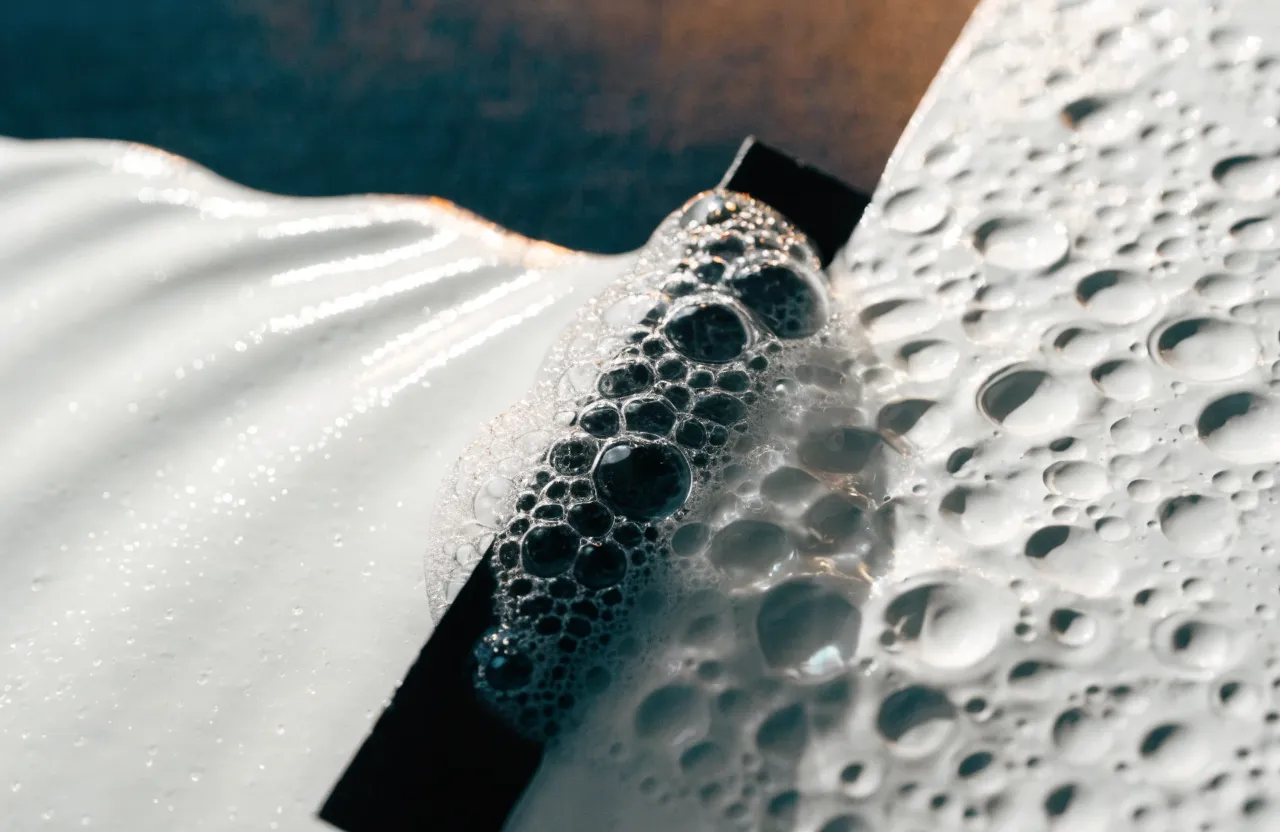
The batch looked clean in the can. Then the first drawdown came back pocked with small round craters, a classic fisheye near the edge, and a haze across the gloss that was not there yesterday. So you add a little more defoamer to knock down the foam, and the next panel is worse. That is the trap built into foam control in water-based coatings: the additive that collapses your foam is the same additive that, matched wrong or dosed wrong, leaves the craters and fisheyes you are now staring at. The good news is that the mechanism is well understood, and the trade-off is controllable once you know which lever you are pulling.
The short version: Foam in water-based coatings comes from the surfactants that stabilize the latex and pigment, whipped into air during high-speed dispersion, pumping, rolling, and spraying. A defoamer is a deliberately incompatible, low-surface-tension oil droplet that enters the foam film, spreads, and bridges-then-dewets it so the bubble ruptures. Silicone (PDMS) defoamers are the most powerful, but that same incompatibility is what causes fisheyes, craters, hazing, and recoat-adhesion loss when the grade is too incompatible, poorly incorporated, or over-dosed. Dose at the lowest level that clears the foam (commonly 0.1–0.5% on total formula), incorporate under enough shear, run a ladder study on your own system, and step toward a silicone emulsion or a non-silicone (mineral-oil or polyether) defoamer when defect-free gloss and recoatability matter more than maximum knockdown.
Where the foam actually comes from
Water-based coatings foam because they are built to. Latex binders, pigment dispersants, wetting agents, and associative thickeners are all surface-active, and a surfactant is exactly what stabilizes a bubble. The surfactant migrates to the air-water interface and forms an elastic skin that keeps entrained air from escaping. Add mechanical energy and you make air faster than it can leave.
Most of the air gets in at four points:
| Where air enters | Why it foams |
|---|---|
| High-speed dispersion (the grind / let-down) | The high-shear blade folds air into a surfactant-rich liquid; the worst single source |
| Pumping, filling, and transfer | Turbulence and free-fall entrain air into the finished product |
| Roller and brush application | The nip and release of a roller pumps air into the wet film |
| Airless and conventional spray | Atomization and air-assist drive fine bubbles into the coating |
Two different problems hide under the word “foam,” and they need different answers. Macrofoam is the visible froth on the can or in the roller tray, the large bubbles you can see. Microfoam is the harder one: fine, dispersed air entrained throughout the wet film, often invisible until it surfaces in the drying coat as pinholes, a matte haze, or round craters. Macrofoam looks worse on the bench; microfoam usually costs you more, because it shows up after application as a defect you cannot brush out. Before you reach for an additive, decide which one you actually have, because the cheap macrofoam killers are frequently the weakest on entrained microfoam.
How a silicone defoamer actually works
A defoamer cannot dissolve in the coating. It has to stay as discrete, insoluble droplets dispersed through the liquid, and that controlled incompatibility is the whole point. When a foam bubble forms, its wall is a thin film of water held apart by two surfactant layers, a structure called a lamella. A defoamer droplet, carried to that lamella, does three things in fast sequence: it enters the air-water interface, it spreads across the film because its surface tension is lower than the surrounding liquid, and as it spreads it drags liquid away and forms a bridge across the film that dewets and ruptures it. The bubble collapses, and the released air escapes.
Pure polydimethylsiloxane (PDMS) fluid has the low surface tension and insolubility to do this, but the strongest silicone defoamers pair the PDMS oil with hydrophobic silica. The silica particles ride the oil to the interface and puncture the film mechanically; peer-reviewed work on PDMS-silica antifoams shows that adding roughly 4 wt% hydrophobized silica sharply lowers the droplet’s entry barrier and raises antifoam activity. On its own, hydrophobic silica does almost nothing; it needs the oil to carry it. That oil-plus-silica compound is the chemistry behind both simethicone (a PDMS-and-silica antifoam compound) and the silica-loaded grades built from dimethicone. PDMS identity and structure are documented on PubChem.
The trade-off that makes formulators fear silicone
Here is the uncomfortable part. The droplet has to be incompatible enough to leave the bulk liquid and act at the interface. Push that incompatibility too far, or leave too much of it in the dried film, and the same physics that ruptured your bubbles now ruins your surface. Three failure modes follow directly from over-dose or a mismatched grade:
- Fisheyes and craters. An incompatible silicone droplet that survives into the wet film is a local low-surface-tension spot. The coating dewets away from it exactly the way the foam film did, leaving a round crater or a fisheye with a defoamer droplet at its center.
- Hazing and gloss loss. Excess silicone or oversized droplets scatter light and cloud a clear or high-gloss film.
- Recoat-adhesion loss. Silicone migrating to the surface leaves a slick, low-energy layer the next coat cannot wet out or bond to, so the topcoat fishes or delaminates later. This is the same surface-contamination failure formulators chase when amine bloom blocks an epoxy recoat, covered in our guide to amine blush in epoxy.
So the job is not “add the strongest defoamer.” It is to find the narrow window where the additive is incompatible enough to break foam and compatible enough to leave no defect. That window is real, it is findable, and it is the entire reason silicone defoamers have a reputation for being both the best and the most dangerous choice.
Silicone defoamer emulsion vs. neat PDMS
The active is the same family; the delivery form decides how forgiving it is.
| Form | What it is | Trade-off |
|---|---|---|
| Neat PDMS / 100% compound | Undiluted PDMS, or PDMS plus hydrophobic silica | Most powerful and persistent, but shear- and solvent-sensitive; can shock-release incompatible oil that craters a waterborne film if under-dispersed |
| Silicone antifoam emulsion | The PDMS-silica active pre-dispersed in water to fine, controlled droplets | Pre-emulsified to sub-micron/low-micron droplets, so it incorporates without “silicone spots”; easier to dose in-window, generally lower persistence than a neat compound |
In a solvent-borne system you can often run a neat PDMS compound directly. In a water-based coating, a raw 100% compound is harder to disperse evenly, and a poorly dispersed slug of silicone is precisely what seeds craters. That is why most waterborne formulators reach for a silicone antifoam emulsion first: the active is already broken down to small droplets, so it distributes uniformly and acts at the interface without leaving large, defect-forming domains. The practical rule is that the smaller and more uniform the droplet at the moment it enters your film, the wider your defect-free dosing window.
How to dose it without making craters
Foam control is a balancing act between compatibility and incompatibility, and you tune it with four levers, not one:
1. Start low and use a ladder study. Defoamers typically run 0.05–0.8% on the total formula, most often 0.1–0.5%; silicone actives can be effective at 30–300 ppm. Make a dose ladder (for example 0.1 / 0.2 / 0.3 / 0.5%), then read both ends: foam knockdown by density or roller test, and defects by drawdown and gloss. The right dose is the lowest one that clears the foam *before* defects appear. 2. Give it enough shear to incorporate. A defoamer that is not distributed cannot work, and a defoamer dumped in with low shear leaves concentrated droplets that crater. Add at a point with real mixing energy. Many formulators split the dose: a strong grade in the grind for process foam, a finer or more compatible grade in the let-down for application foam. 3. Choose the addition point on purpose. Grind-stage addition fights the air folded in during dispersion; let-down or post-add fights the foam generated at fill, roller, and spray. Splitting between the two usually beats a single large dose at one point. 4. Balance persistence against defects. A strong, persistent neat compound holds foam down through the can’s shelf life but widens your defect risk; a compatible emulsion or non-silicone is gentler on the film but may need a touch-up dose. Decide which failure you can least afford on that product.
Validate every change on your own system. Foam behavior depends on your exact binder, surfactant package, pigment loading, viscosity, and application method, and a defoamer that is perfect in a flat interior wall paint can craters a high-gloss trim enamel.
When a non-silicone defoamer is the lower-risk choice
Silicone is not always the right tool. When defect-free gloss, clarity, and recoatability outrank maximum knockdown, a non-silicone defoamer is often the better trade because it can sit inside the coating’s compatibility tolerance and still control foam.
| Type | Strength | Weakness |
|---|---|---|
| Mineral-oil defoamers | Low cost, broad latex compatibility, good on macrofoam, lower crater risk at sensible doses | Weaker on fine entrained microfoam; can hurt gloss and clarity in high-end systems |
| Polyether defoamers | Good compatibility with most waterborne systems, low defect tendency, longer-lasting persistence | Slower foam break than silicone; can affect water sensitivity if over-used |
| Silicone-polyether copolymers | Hydrophilic/hydrophobic balance is tunable to acrylic, PU-dispersion, or waterborne-epoxy systems | Must be grade-matched to the resin or you lose the compatibility advantage |
A reasonable default: mineral-oil or polyether grades for flat-to-eggshell architectural and construction coatings where craters are the bigger risk; silicone emulsions or tuned silicone-polyethers where you need to clear stubborn microfoam in a gloss or industrial finish and are willing to dial in the dose. There is no universal best defoamer, only the right one for that resin, that application, and that gloss target.
Buying defoamers for water-based coatings
Tell us your system (acrylic latex, PU dispersion, waterborne epoxy), your gloss and clarity targets, your application method, and whether your problem is macrofoam or entrained microfoam, and request a sample to run a ladder study on your own line before you commit a batch.
Frequently asked questions
What causes fisheyes and craters from a defoamer?
A defoamer works by being incompatible with the coating. When a silicone droplet is too incompatible for the system, poorly dispersed, or over-dosed, some of it survives into the wet film as a local low-surface-tension spot. The coating dewets away from that spot the same way the foam film did, leaving a round crater or a fisheye with the droplet at its center. The fixes are a more compatible grade or emulsion, better high-shear incorporation, and a lower dose set by a ladder study.
Silicone vs. non-silicone defoamer — which for water-based coatings?
Silicone (PDMS) defoamers are the most powerful and the best at clearing fine entrained microfoam, but they carry the highest crater, haze, and recoat-adhesion risk if mismatched or over-dosed. Non-silicone defoamers — mineral-oil and polyether types — are gentler on gloss, clarity, and recoatability and are often the better choice for flat-to-eggshell architectural and construction coatings. Reach for silicone (usually as an emulsion) when you need to kill stubborn microfoam in a gloss or industrial finish and are willing to dial in the dose.
How much defoamer should I add to paint?
Defoamers typically run 0.05–0.8% on the total formula, most commonly 0.1–0.5%; silicone actives can be effective in the 30–300 ppm range. There is no single correct number; it depends on the resin, surfactant load, viscosity, and application. Run a dose ladder (for example 0.1 / 0.2 / 0.3 / 0.5%) and pick the lowest dose that clears the foam before craters, haze, or gloss loss appear.
What is the difference between a silicone defoamer emulsion and neat PDMS?
Neat PDMS (or a 100% PDMS-plus-silica compound) is the undiluted active: most powerful and persistent, but shear- and solvent-sensitive, and harder to disperse evenly in a water-based system, which raises crater risk. A silicone antifoam emulsion is that active pre-dispersed in water to fine, controlled droplets, so it incorporates uniformly without leaving large defect-forming domains. For most waterborne coatings the emulsion gives a wider defect-free dosing window.
Where in the process should I add the defoamer?
Match the addition point to the foam source. A strong grade added in the grind fights the air folded in during high-speed dispersion; a finer or more compatible grade added in the let-down or post-add fights the foam generated at fill, rolling, and spray. Wherever you add it, give it enough shear to distribute, because an under-incorporated droplet is what craters the film. Splitting the dose between grind and let-down usually beats one large dose at a single point.
Why does my defoamer work at first but the foam comes back?
That is a persistence problem. Some defoamers, especially more compatible emulsions and polyethers, slowly migrate into the coating or get consumed, so foam knockdown fades over the can’s shelf life or during a long production run. A more persistent neat silicone compound holds longer but widens your defect risk. The usual answer is to balance the two — enough persistence for your shelf and process window, set against the lowest defect risk — and confirm it with an aged-sample foam test.
Editorial note. This article is general technical guidance for coatings and industrial formulation professionals. Foam behavior, defect risk, defoamer dose, and recoat performance depend on your specific binder, surfactant package, pigment loading, viscosity, application method, and environment, and must be validated on your own system; the Certificate of Analysis governs the grade you buy. Dosing figures are typical reference ranges, not a specification. Review the current Safety Data Sheet (SDS) and use appropriate PPE before handling. Products are sold for industrial and professional use only. Nothing here is a medical, health, or safety claim. RawSource makes no warranty, express or implied, and assumes no liability for use of this information.
Search 1,300+ industrial chemicals by name or CAS, or send us your spec — we quote by the drum, tote, or container.
Browse the Chemical Index → Request a Quote