You mix a chelant that holds calcium beautifully on the bench at pH 7, then drop it into a hot caustic bottle wash or a high-alkalinity cooling loop, and the hardness drops out as scale anyway. The chemistry that wins at neutral pH is not always the chemistry that wins in caustic. This is exactly the gap sodium gluconate fills, and it is why the same white powder shows up in concrete trucks, steel cleaning lines, and cooling towers.
The short version: Sodium gluconate (CAS 527-07-1) is the sodium salt of gluconic acid, a white, highly water-soluble crystalline powder. Its standout property is chelation that gets stronger as pH rises — it sequesters calcium, magnesium, iron, copper, and aluminum, and in concentrated alkaline solutions it out-performs EDTA and NTA, per the technical literature. That single trait makes it a workhorse across four jobs: a concrete set retarder and water-reducer, a steel corrosion and scale inhibitor in cooling water, an alkaline metal cleaner and derusting additive, and a sequestrant in textile and detergent systems. It is also readily biodegradable. The trade-off: below neutral pH its chelation is weaker than EDTA’s, so chelant choice still comes down to your pH, the metal ion, biodegradability needs, and discharge limits.
What sodium gluconate actually is
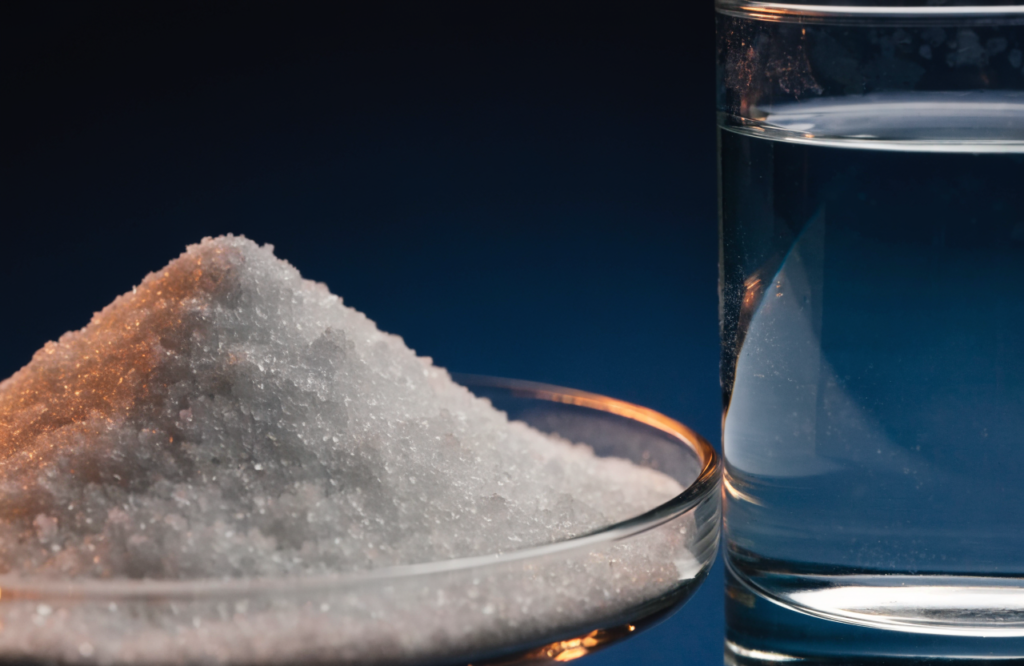
Sodium gluconate is the sodium salt of gluconic acid (gluconic acid is the mild organic acid produced by oxidizing glucose). Its molecular formula is C₆H₁₁NaO₇, molecular weight 218.14, and it carries the food-additive number E576 when used as a sequestrant (PubChem). In the drum it is a white to off-white granular or fine crystalline powder that is very soluble in water and dissolves to a clear, near-neutral solution.
The functional part is the gluconate anion. It carries a carboxyl group and a row of hydroxyl groups along a short carbon chain, and those oxygen sites wrap around a metal cation to form a stable, water-soluble complex. That is the whole basis of its industrial value: it grabs a problem metal ion and keeps it dissolved instead of letting it precipitate, deposit, or interfere.
One housekeeping note on grades. Industrial-grade material (typically 98%+ assay) is what goes into concrete, cleaning, and water treatment. A food-grade (E576) quality also exists. The two are not interchangeable on paper, so confirm the grade against your application before you spec it, and treat any food or pharmaceutical use as a grade-and-documentation question for your QC team.
What sodium gluconate does — the function table
Most of sodium gluconate’s industrial uses trace back to the same chelation mechanism, expressed in different systems.
| Function | How it works | Where it shows up |
|---|---|---|
| Chelation / sequestration | The gluconate anion forms stable, water-soluble complexes with Ca, Mg, Fe, Cu, and Al ions; strongest in alkaline and concentrated-caustic systems | Alkaline cleaners, bottle wash, textile scouring and dyeing, detergents |
| Steel corrosion inhibition | Adsorbs on the steel surface and forms gluconate–calcium complexes that suppress the metal-dissolution reaction | Recirculating cooling-water and process-water systems |
| Scale control | Sequesters hardness ions and disrupts carbonate and sulfate crystal growth, keeping scale-formers in solution | Cooling water, alkaline cleaning baths, membrane pretreatment |
| Concrete set retarder / water-reducer | Adsorbs onto cement grains, slows early hydration to extend working time, and disperses particles so less water is needed | Ready-mix and precast concrete, mortar, gypsum |
| Metal cleaning / derusting | Chelates iron oxides and hardness in hot caustic baths, lifting rust and scale without strong mineral acids | Steel cleaning and pickling prep, electroplating prep, glass-bottle wash |
The recurring theme is alkalinity. Three of these five jobs (alkaline cleaning, caustic metal cleaning, high-pH cooling water) put sodium gluconate in exactly the conditions where it is strongest.
Why does sodium gluconate chelate so well in alkaline conditions?
This is the question that decides whether gluconate is the right pick, so it is worth being precise. The hydroxyl groups on the gluconate chain are weak acids. As pH climbs, those hydroxyls progressively deprotonate, and each deprotonated oxygen becomes a stronger donor site for binding a metal cation. In strongly alkaline solution the anion offers more and better binding sites, so its effective stability with ions like Ca²⁺, Fe³⁺, and Al³⁺ rises rather than falls.
Published manufacturer technical data states the practical consequence directly: in alkaline and concentrated alkaline solutions sodium gluconate’s chelating power “surpasses all other chelating agents, such as EDTA, NTA and related compounds” (technical data). That is the opposite of how aminopolycarboxylates and many phosphonates behave, where high pH and high hardness can work against you.
The flip side is the honest limitation: at neutral and acidic pH, gluconate’s sequestration of Ca²⁺ and Mg²⁺ is weaker than EDTA’s. If your system runs near neutral, or swings across a wide pH range, or you need to hold a transition-metal ion under acidic conditions, EDTA’s broad-pH stability usually wins. Gluconate is a specialist for the high-pH end of the range, not a universal chelant.
Sodium gluconate vs EDTA vs phosphonates
There is no single “best” chelant; there is the right one for your pH, your target ion, your biodegradability requirement, and your discharge permit. Here is the honest comparison among the three families RawSource supplies.
| Chelant | Strength profile | Biodegradability | Best fit |
|---|---|---|---|
| Sodium gluconate | Strongest in alkaline and caustic systems; weaker than EDTA at neutral/acidic pH | Readily biodegradable (manufacturer technical data reports ~98% degradation after 2 days) | High-pH cleaning, bottle wash, caustic metal cleaning, concrete admixtures, mild cooling-water duty |
| EDTA / tetrasodium EDTA | Strong, stable complexes across a wide pH range, including acidic conditions | Poorly biodegradable; persistent in surface water | Broad-pH chelation and demanding metal-ion control where pH range matters most |
| Phosphonates (e.g. HEDP) | Strong threshold scale and calcium control plus corrosion inhibition at sub-stoichiometric dose | Poorly biodegradable; add phosphorus to the discharge | Threshold antiscalant and corrosion programs where discharge phosphorus is acceptable |
In practice the decision reads like this. If you are running a hot caustic clean, a bottle wash, or an alkaline derust, reach for sodium gluconate first; it is in its element and it degrades readily. If you need broad-pH chelation or you are holding metals under acidic conditions, EDTA or its tetrasodium salt (EDTA·4Na) is the more versatile tool, with the known environmental-persistence cost. If your real problem is threshold scale inhibition and steel protection at low dose in a recirculating loop, a phosphonate such as HEDP is built for that duty (and is covered in our guide to scale inhibitors and antiscalants). Many real formulations blend families to cover more than one condition.
Application notes that matter on the plant floor
Concrete: dose for the set, not just the slump. As an admixture, sodium gluconate is both a retarder and a water-reducer; it extends working time in hot-weather pours and long hauls, and it lets you cut water for a denser, stronger set. Typical dosing runs roughly 0.05% to 0.3% by weight of cement, adjusted for temperature and mix design. The caution is overdose: too much gluconate can extend set time far beyond what you want and stall early strength gain, so trial-batch any new dose against your cement and your ambient temperature before you scale it to a pour.
Metal cleaning and bottle wash: let the caustic do its job. In hot alkaline cleaning and derusting baths, gluconate sequesters the iron oxides and hardness that would otherwise redeposit on the steel or fur up the bath, so the caustic cleans cleanly without resorting to aggressive mineral acids. The same chelation keeps hardness scale off glass in bottle-washing lines. Because performance climbs with temperature and alkalinity, these baths are where gluconate earns its keep.
Cooling and process water: a complexing inhibitor, dosed in a program. In recirculating cooling water, gluconate adsorbs on mild-steel surfaces and forms gluconate–calcium complexes that suppress corrosion while helping hold scale-formers in solution; its inhibition efficiency rises with temperature and concentration (Corrosion Science study). Treat it as one component of a treatment program rather than a standalone fix, and validate dose against your water chemistry, cycles of concentration, and metallurgy. Confirm compatibility with any oxidizing biocide you run.
Buying sodium gluconate
RawSource supplies sodium gluconate in industrial 98%+ grade for water treatment, construction, metal-finishing, and industrial manufacturing buyers, in bags, drums, and bulk, with Certificate of Analysis (CoA) documentation. We also carry the comparison chelants in this guide — EDTA, tetrasodium EDTA, and the phosphonate HEDP — so you can spec against the right pH and discharge profile rather than the nearest shelf item. Tell us your system pH, the metal ion you are fighting, your biodegradability and discharge constraints, and your volume, and request a sample to qualify it on your own water, bath, or mix. For the broader treatment toolkit, see our water-treatment chemicals guide.
Frequently asked questions
What is sodium gluconate used for?
Sodium gluconate is used as a chelating and sequestering agent across several industries. Its main industrial roles are a concrete set retarder and water-reducer, a corrosion and scale inhibitor in cooling water, an additive in alkaline metal cleaning and derusting and in glass-bottle washing, and a sequestrant in textile and detergent formulations. All of these rely on its ability to bind calcium, iron, and other metal ions and keep them in solution, especially at high pH.
Is sodium gluconate a chelating agent?
Yes. The gluconate anion forms stable, water-soluble complexes with metal cations such as calcium, magnesium, iron, copper, and aluminum, which is the definition of a chelant (or sequestrant). Its distinguishing feature is that its chelating power increases in alkaline and concentrated-caustic solutions, where the technical literature reports it out-performing EDTA and NTA.
Sodium gluconate vs EDTA — which is the better chelant?
It depends on pH. Sodium gluconate is the stronger and more readily biodegradable choice in alkaline and caustic systems (high-pH cleaning, bottle wash, caustic metal cleaning). EDTA forms stable complexes across a much wider pH range, including acidic conditions, so it is the more versatile chelant where pH range matters, at the cost of being poorly biodegradable and persistent in surface water. Match the chelant to your operating pH, your target metal ion, and your discharge limits.
How is sodium gluconate used in concrete?
It functions as both a set retarder and a water-reducer. By adsorbing onto cement grains it slows early hydration to extend working time, which is useful in hot-weather pours and long transit, and it disperses cement particles so the mix needs less water for a given workability, yielding a denser, stronger set. Typical dosing is roughly 0.05% to 0.3% by weight of cement; overdosing can over-extend the set, so trial-batch any new dose against your cement and ambient temperature.
Is sodium gluconate biodegradable?
Yes. Published manufacturer technical data reports sodium gluconate as readily biodegradable, citing roughly 98% degradation after two days. This is one reason it is selected over persistent chelants such as EDTA where discharge or environmental-persistence requirements drive the choice. Confirm the specific biodegradation data and regulatory status against your own permit and jurisdiction.
What grade of sodium gluconate do I need?
For concrete, cleaning, metal finishing, and water treatment, industrial grade (typically 98%+ assay) is standard. A food-grade quality (E576) also exists and is documented separately. The grades are not interchangeable on paper, so confirm the grade and its accompanying documentation against your application — and treat any food or pharmaceutical use as a grade-and-CoA question for your QC and regulatory teams.
Editorial note. This article is general technical guidance for water-treatment, construction, metal-finishing, and industrial formulation professionals. Chelation performance, corrosion and scale control, concrete set behavior, and cleaning results depend on your specific water chemistry, pH, temperature, metallurgy, cement, and dose, and must be validated on your own system; the Certificate of Analysis governs the grade you buy. Confirm the correct grade and its documentation before any food or pharmaceutical use, and confirm regulatory status and discharge limits against your own permit and jurisdiction. Nothing here is a medical, health, safety, or environmental-benefit claim, and nothing here addresses potable-water suitability. Products are sold for industrial and professional use only. RawSource makes no warranty, express or implied, and assumes no liability for use of this information.