
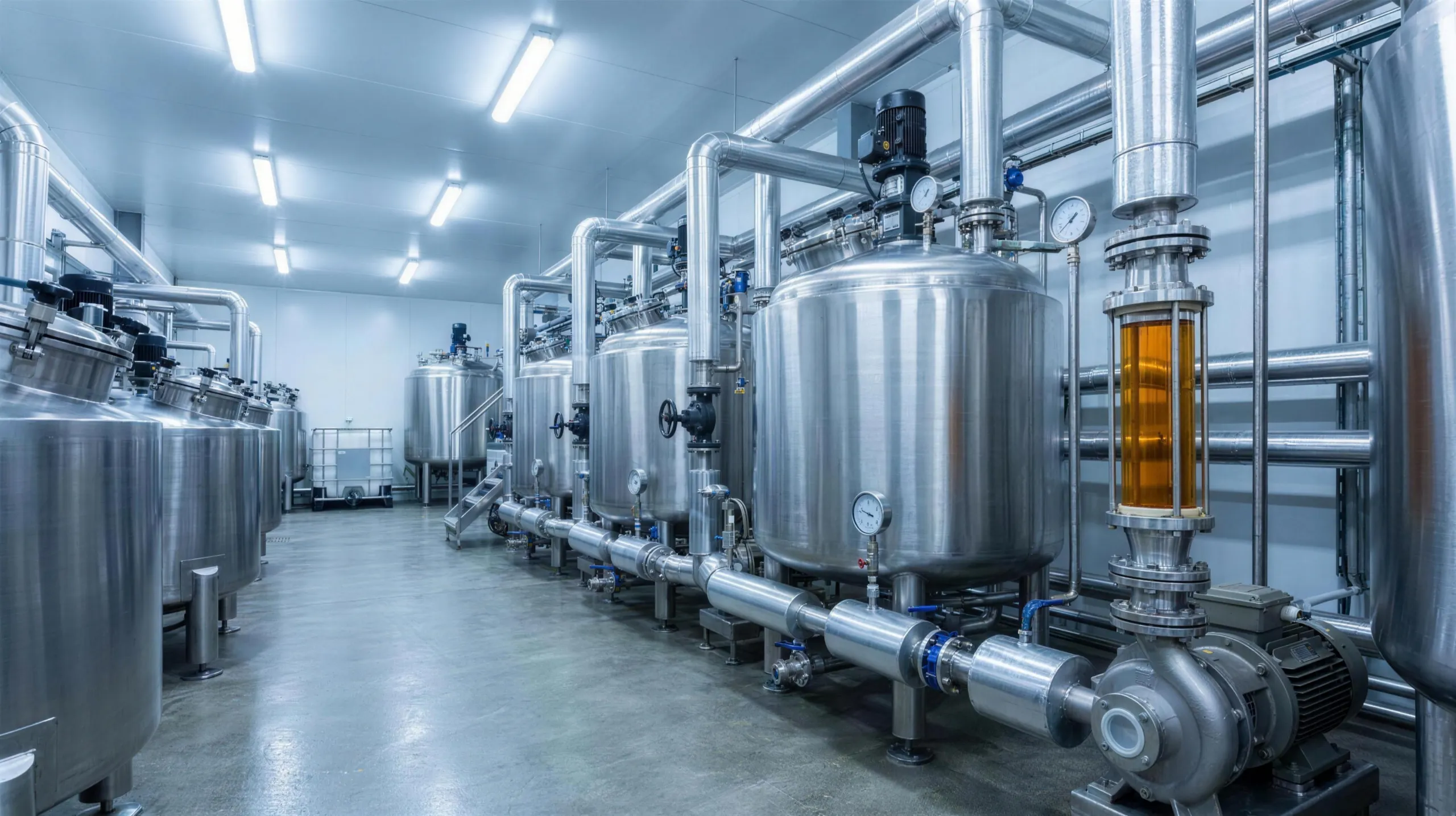
A finished lubricant is not a single substance. It is a formulation: a base oil, which typically makes up 70–99% of the blend and provides the lubricating film, plus an additive package that delivers anti-wear, oxidation resistance, viscosity control, detergency, and corrosion protection. Get either half wrong and the finished oil fails in service—the base oil sets the foundation, the additives do the specialized work.
This is the chemistry that lubricant blenders, grease manufacturers, and metalworking-fluid formulators buy as raw material. This guide breaks down what goes into a lubricant, why each component is there, and which chemistries map to which job.
What goes into a lubricant?
Every liquid lubricant is built from two parts. The base oil carries the load and separates moving surfaces with a fluid film; it dominates the formula by volume and largely determines viscosity, volatility, and the oil’s natural oxidation and low-temperature behavior. The additive system—usually a few percent up to roughly 25% in a heavy-duty engine oil—is a deliberate stack of functional chemistries, each one solving a failure mode the base oil cannot handle alone.
Greases follow the same logic with one extra component: a thickener (a metallic soap or non-soap structure) turns base oil and additives into a semi-solid that stays in place on bearings and open gears. The base-oil-plus-additive thinking is the foundation in both cases.
Base oils: the foundation of every formulation
Base oils are classified by the American Petroleum Institute (API) into five groups. The first three are refined from crude oil; Groups IV and V are synthetics. The group sets the performance ceiling—saturates, sulfur, and viscosity index (VI) all rise as you move up—and it drives cost. Formulators pick a group to hit a target balance of oxidation stability, temperature range, and price.
| API Group | Type | Key property | Typical use |
|---|---|---|---|
| Group I | Solvent-refined mineral | VI 80–120; sulfur >0.03%; saturates <90% | Industrial oils, general-purpose lubricants, process oils |
| Group II | Hydrotreated mineral | VI 80–120; sulfur <0.03%; saturates >90% | Modern engine oils, hydraulic and gear oils |
| Group III | Severely hydrocracked mineral | VI >120; very low sulfur; high saturates | Full-synthetic-grade engine oils, long-drain formulations |
| Group IV | Polyalphaolefin (PAO), synthetic | VI ~125–200; wide temperature range; low pour point | Synthetic engine and gear oils, compressor and aerospace fluids |
| Group V | Esters, PAG, naphthenic, others | Varies by chemistry; tailored polarity and solvency | Specialty fluids, refrigeration oils, co-base for additive solvency |
Mineral base oils (Groups I–III) are refined from petroleum. Group I is solvent-refined and still serves cost-sensitive industrial work; Group II and III are hydroprocessed for higher purity, better oxidation stability, and (for III) synthetic-grade VI. Naphthenic oils are a distinct mineral cut prized for low pour points and excellent solvency—qualities that make them a workhorse in transformer oils, refrigeration oils, metalworking fluids, and as a carrier where additive solubility matters. See the Naphthenic Oil product page.
Synthetic base oils are engineered molecules. Polyalphaolefin (PAO) is the dominant Group IV synthetic: a uniform, saturated hydrocarbon with a naturally high VI, low volatility, and excellent cold-flow, used where temperature extremes or long drain intervals justify the cost. Group V covers everything else—esters add polarity, biodegradability potential, and high-temperature stability and are often blended with PAO to improve additive solubility and seal compatibility; polyalkylene glycols (PAG) bring very high VI and strong load-carrying for gear and compressor duty. For a deeper treatment of selecting between these, see our guide to base oil selection for lubricant formulation.
Lubricant additives by function
Additives are where a formulation earns its specification. Each one targets a specific failure mechanism—wear, oxidation, viscosity loss, deposits, rust, foam. Most finished oils carry a balanced package of several, and chemistries can interact (ZDDP, for instance, is both an anti-wear agent and an antioxidant). The table below maps the major additive functions to representative chemistries and what each does; the discussion that follows explains the “why.”
| Function | Example chemistry | What it does |
|---|---|---|
| Anti-wear / extreme pressure (EP) | ZDDP, phosphate esters, sulfurized olefins, MoDTC | Forms a sacrificial film on metal under load to prevent scuffing and wear |
| Antioxidants | Hindered phenols, aminic antioxidants, ZDDP | Interrupt oxidation to slow sludge, varnish, and acid formation |
| Viscosity index improvers | Olefin copolymers (OCP), polymethacrylates (PMA) | Reduce viscosity change with temperature for multigrade performance |
| Detergents | Overbased calcium / magnesium sulfonates, phenates | Neutralize acids and keep high-temperature surfaces clean |
| Dispersants | Polyisobutylene succinimides (ashless) | Suspend soot and contaminants so they cannot agglomerate into sludge |
| Friction modifiers | Fatty acids/esters/amides, MoDTC, molybdenum compounds | Lower boundary friction to cut energy loss and improve efficiency |
| Corrosion / rust inhibitors | Sulfonates, succinic acid derivatives, amines, triazoles | Form a protective layer on ferrous and yellow metals |
| Pour-point depressants | Polymethacrylates, alkylated naphthalenes | Disrupt wax crystallization for low-temperature flow |
| Anti-foam | Silicone (PDMS) and non-silicone polyacrylates | Break surface foam and speed air release |
| Demulsifiers | Polyglycols, ethoxylated resins | Promote rapid water separation in industrial and turbine oils |
| Slip / amide additives | Oleamide, erucamide | Provide internal/external lubricity and surface slip in polymer and wax systems |
| Solid lubricants | Molybdenum disulfide (MoS₂), graphite | Carry load by shear of layered solids where fluid film fails |
| Grease thickeners | Lithium, calcium, and complex soaps | Gel the oil into a semi-solid that stays on bearings and gears |
Anti-wear and extreme-pressure additives
Under boundary lubrication—startup, shock load, slow heavy contact—the oil film thins to where metal nearly touches metal. Anti-wear (AW) and extreme-pressure (EP) additives react with the hot metal surface to grow a thin, sacrificial film that shears instead of the component. Zinc dialkyldithiophosphate (ZDDP) is the benchmark AW additive in engine oils, valued because it is multifunctional—it also scavenges peroxides as an antioxidant. Phosphate esters, sulfurized olefins, and molybdenum dithiocarbamate (MoDTC) extend protection into the higher-load EP regime of gear and industrial oils.
Antioxidants
Oxidation is the primary aging mechanism of a lubricant. Oxygen attacks the base oil, generating acids, sludge, and varnish that thicken the oil and corrode metal. Hindered-phenol and aromatic-amine (aminic) antioxidants intercept the free-radical chain, extending oil life and protecting both the fluid and the equipment—the single biggest lever on drain interval.
Viscosity index improvers
A base oil naturally thins as it heats. VI improvers—long-chain polymers such as olefin copolymers and polymethacrylates—coil at low temperature and expand at high temperature, flattening the viscosity-temperature curve. This is what makes a multigrade oil (a 5W-30, for example) flow at cold start yet hold film strength when hot. Shear stability of the polymer is the formulator’s constant trade-off.
Detergents and dispersants
These two work as a team to keep an engine clean. Detergents—overbased calcium or magnesium sulfonates and phenates—neutralize acidic combustion by-products and keep hot surfaces (pistons, rings) deposit-free; their reserve alkalinity is measured as TBN. Dispersants—typically ashless polyisobutylene succinimides—surround soot and contaminant particles so they stay finely suspended instead of clumping into sludge.
Friction modifiers
Where AW additives protect against wear, friction modifiers reduce the coefficient of friction itself to save energy. Organic friction modifiers—fatty acids, esters, and amides—form adsorbed boundary layers; molybdenum-based modifiers such as MoDTC form low-shear-strength tribofilms. Both are central to modern fuel-economy engine oils.
Corrosion and rust inhibitors
Metal surfaces need protection from water and acids. Rust inhibitors (sulfonates, amines, succinic-acid derivatives) form a film on ferrous metals; metal deactivators such as triazoles passivate copper and other yellow metals to stop catalytic corrosion. Essential in hydraulic, turbine, and metalworking fluids that routinely see moisture.
Pour-point depressants and anti-foam
Mineral oils contain wax that crystallizes in the cold and gels the oil. Pour-point depressants (polymethacrylates) interfere with wax-crystal growth so the oil keeps flowing at low temperature. Anti-foam additives—silicone (PDMS) at trace levels, or non-silicone polyacrylates where air release matters—collapse surface foam that would otherwise starve pumps and degrade the oil. Demulsifiers, conversely, help the oil shed water cleanly in industrial systems.
Slip and amide additives
In polymer, wax, and coating systems, fatty amides act as slip and lubricity agents—migrating to the surface to reduce friction and blocking. Erucamide and oleamide are the two workhorse slip agents, with erucamide favored where lower volatility and thermal stability are needed. Related wax chemistries such as polyethylene wax serve as internal/external lubricants and dispersants in plastics and masterbatch.
Solid lubricants and grease thickeners
When a fluid film cannot survive—very high load, high temperature, vacuum, or intermittent motion—layered solids carry the load by shearing between their own planes. Molybdenum disulfide (MoS₂) and graphite are the two principal solid lubricants, used as additives in greases and as the active phase in bonded dry films; expandable graphite serves related high-temperature roles. Our guide to solid-film and dry lubricants covers these in depth. For greases, thickeners—lithium, calcium, and complex metallic soaps—are what turn liquid lubricant into a structured semi-solid that resists slumping and stays where it is applied.
Applications: matching chemistry to the job
The same building blocks are recombined to hit very different specifications:
Engine oils carry the most complex packages—ZDDP for anti-wear, detergent/dispersant systems for cleanliness, VI improvers for multigrade flow, antioxidants for drain life, and friction modifiers for fuel economy—on a Group II/III or PAO base.
Industrial, hydraulic, and gear oils emphasize oxidation stability, rust and demulsibility performance, anti-foam, and (for gears) EP additives, usually on Group I/II mineral or PAO base oils chosen by load and temperature.
Metalworking fluids balance lubricity, EP, corrosion protection, and—in water-miscible products—emulsifier and biocide systems, often on naphthenic base oils for their solvency.
Greases combine a base oil, an additive package, and a soap or complex thickener, with solid lubricants like MoS₂ or graphite added for shock-load and high-temperature duty.
Frequently Asked Questions
What are lubricant additives?
Lubricant additives are functional chemicals blended into a base oil—typically from a few percent up to about 25%—to give the finished lubricant properties the base oil alone cannot provide. They include anti-wear agents, antioxidants, viscosity index improvers, detergents, dispersants, friction modifiers, corrosion inhibitors, pour-point depressants, and anti-foam agents. Each targets a specific failure mode such as wear, oxidation, deposits, or rust.
What is a base oil?
A base oil is the foundational fluid of a lubricant, making up roughly 70–99% of the blend and providing the lubricating film that separates moving surfaces. Base oils are classified by the API into five groups: Groups I–III are refined from crude oil (mineral and hydroprocessed), Group IV is polyalphaolefin (PAO) synthetic, and Group V covers esters, PAG, naphthenic, and other specialty chemistries.
What is ZDDP used for?
ZDDP (zinc dialkyldithiophosphate) is the most widely used anti-wear additive in engine and industrial oils. It reacts with metal surfaces under load to form a sacrificial protective film that prevents scuffing and wear, and it is multifunctional—it also acts as an antioxidant by neutralizing peroxides, helping extend oil life.
What is the difference between mineral and synthetic base oil?
Mineral base oils (API Groups I–III) are refined from crude petroleum. Synthetic base oils are chemically engineered—Group IV polyalphaolefin (PAO) and Group V esters and PAGs—built from uniform molecules. Synthetics generally offer a higher viscosity index, better oxidation stability, lower volatility, and wider temperature range, at higher cost; mineral oils remain cost-effective for many industrial and general-purpose lubricants.
What additives are in motor oil?
A typical motor oil contains anti-wear additives (ZDDP), detergents and dispersants to keep the engine clean, antioxidants to extend drain life, viscosity index improvers for multigrade performance, friction modifiers for fuel economy, pour-point depressants for cold flow, and anti-foam and corrosion inhibitors—all blended into a Group II, Group III, or PAO base oil.
How do I source lubricant additives and base oils in bulk?
Split the RFQ: base oils quoted by API Group, viscosity grade, and volume; additive packages quoted by function (anti-wear, antioxidant, VI improver) against your finished spec. A distributor should return both with CoA and SDS commitments per lot.
Can base oils and additives be exported from the US?
Yes — they ship worldwide as standard ocean freight. Hazard classification varies by product, so confirm each item’s class with the SDS before booking. The quote should state Incoterms, destination port, and the document set (CoA, SDS, certificate of origin, bill of lading).
Lubricants Sourcing: Base Oils and Additive Packages in Bulk
Lubricant sourcing splits into two buys: base oils, which move as commodity volume where freight economics dominate, and additive packages, where the qualification burden sits. Source them on separate RFQs. A blender importing Group II base oil and a ZDDP package on one combined quote usually pays a blended margin on both. US-origin material ships in drums, IBC totes, or ISO tanks under Incoterms 2020 — name your destination port and annual volume in the RFQ and ask for the quote on two terms (FOB and CIF) so the freight leg is priced in the open. Starting points: the base oil selection guide, metalworking fluid additives, and the lubrication chemistries in the catalog.
Send us your spec—grade, viscosity, additive function, volume—and we will source it. Request a quote or browse the full catalog in our shop to start a bulk inquiry.
Search 1,300+ industrial chemicals by name or CAS, or send us your spec — we quote by the drum, tote, or container.
Browse the Chemical Index → Request a Quote