
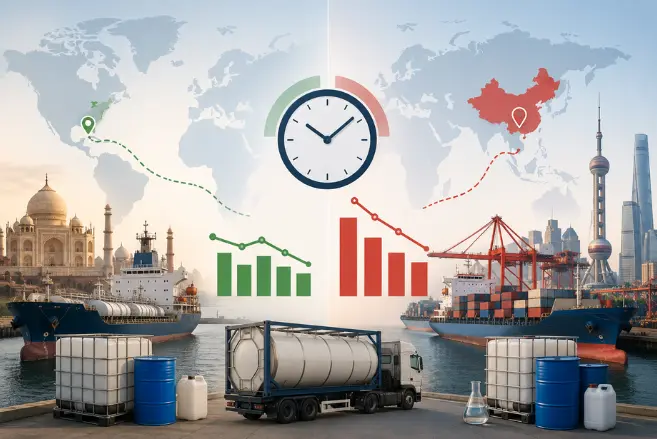
The PO said 30 days. Your supplier quoted “ready in three to four weeks,” you padded it to 35, and you built the production schedule around a mid-March arrival. The container clears Nhava Sheva on day 68. Somewhere between the quote and the berth, 38 days of slack vanished into documentation, a missed sailing, and a Cape of Good Hope diversion nobody flagged when you placed the order.
That gap is the real lead-time problem in Asian chemical sourcing, and the trap is thinking there is a single “lead time” to plan against. There isn’t. The number a supplier gives you is production-ready time at the gate, and that number swings harder by chemical than by anything else: a stocked commodity ships in days, a made-to-order specialty takes weeks, a multi-step custom synthesis takes longer still. What you actually wait on is production (the chemical-specific swing factor) plus paperwork plus a booking that has to fit a hazmat slot plus 18 to 35 days of ocean. Quote one piece, plan around all of them, and you are perpetually short. So the answer to “how long?” is “it depends on your chemical and its production route.” What follows is the framework to estimate yours, plus how India and China production lead times tend to differ by chemical type.
Concretely: a warehoused commodity like citric acid or isopropyl alcohol can leave the gate within days of a purchase order, while a made-to-order blend has to be scheduled, produced, and QC-released before it ever sees a container.
What is the real total lead time from India and China — and why is the quote always wrong?
There is no clean number to plan against, because the total is dominated by a stage that changes with every chemical you buy. Don’t ask “what’s the lead time from Asia”; ask “what’s the production route for this specific chemical,” then stack the lane and the clearance on top. It lives in production and the paperwork around it.
Estimate it as a sum of stages you can actually track. Production readiness is the variable that matters most, and it is purely a function of what you ordered: near zero for a stocked commodity sitting in a tank, a week or two for a made-to-order specialty that has to be campaigned onto a reactor, weeks to months for a custom or multi-step synthesis. Documentation (CoA, SDS/MSDS, Certificate of Origin, DG declaration) is 5–10 days. Booking and port processing is another 5–10, and longer for hazmat that needs a DG vessel slot. Then ocean transit, the freight-and-lane bucket, runs anywhere from 10 days (Shanghai–US West Coast) to 35 (Shanghai–Rotterdam via the Cape). The trade-off: the supplier owns the production stage and quotes it honestly for your specific item, but you own the planning gap on documentation, booking, and transit — and you own the work of pricing production correctly for each chemical instead of borrowing someone else’s average.
How do I estimate the lead time for my specific chemical?
Start from the production route, because that is what separates a three-day shipment from a three-month one. Ask your supplier one question before anything else: is this material in stock, made to order on a scheduled campaign, or custom-synthesized? A stocked commodity grade is days to a ready container. A made-to-order specialty waits for reactor time and a minimum batch, so think one to several weeks even before paperwork. A custom or multi-step synthesis carries the longest and least predictable production tail, and that is where padding pays off most.
Then layer the rest onto that production base: add 5–10 days of documentation, add the DG penalty if your chemical is hazmat (a vessel-slot booking that non-haz cargo skips), add the lane transit from the table below, and add destination customs and clearance. The recommendation is to keep this as a per-chemical worksheet, not a house rule — a stocked acid and a campaign-produced intermediate from the very same supplier can land a month apart, so the honest move is to time each material on its own and let the route, not a blended benchmark, set your plan.
Production lead time: when is China faster, and when does India win?
The origin that wins depends on what chemical type you’re buying, because the gap shows up in production, not transit. For a high-volume commodity grade, China is usually faster to a ready container: the production base is deeper and more is held in stock at the major hubs feeding Shanghai, Ningbo, and Qingdao, so a Chinese manufacturer can often present a stocked lot inside a week where an Indian counterpart may need to schedule a run. That edge is real for stocked commodities and means little for anything made to order.
India flips the advantage on specialty and custom-synthesis chemistry. Its fine-chemical and intermediate sector is built for smaller, regulated, documentation-heavy batches, and Indian suppliers tend to arrive with cleaner REACH and EU-market paperwork. The honest trade-off: India’s faster paperwork can be eaten by longer production scheduling for a non-stocked specialty, and its port and monsoon seasonality widens the range. Recommendation: sort your basket by chemical type first, then qualify a stocked Chinese source for your commodity volume and an Indian source for your regulated specialty and custom grades, and time each one independently rather than assuming one origin is faster across the whole list.
How long is ocean transit from Asia to the US and Europe right now?
Direct answer: 10–18 days to the US West Coast, roughly 28–40 days to the US East Coast, and 28–40 days to North Europe. Transit is the one piece you can quote as a lane range, because it’s freight- and route-dependent rather than chemical-dependent — every chemical on the same sailing arrives the same day. The wide East Coast and Europe ranges reflect Red Sea diversions, not normal variance. These are realistic port-to-port windows you can plan against; pad them, don’t treat them as guarantees, and remember they are only the middle of the equation: door-to-door is your chemical’s production time plus this transit plus customs and clearance.
| Lane | Routing | Realistic port-to-port transit |
|---|---|---|
| Shanghai / Ningbo → Los Angeles–Long Beach | Trans-Pacific (unaffected) | ~12–18 days |
| Nhava Sheva (JNPT) → Los Angeles–Long Beach | Trans-Pacific (unaffected) | ~18–24 days |
| Shanghai → New York / Savannah | via Cape of Good Hope | ~33–40 days |
| Mundra / Nhava Sheva → New York | via Cape of Good Hope | ~28–35 days |
| Shanghai → Rotterdam | via Cape of Good Hope | ~33–40 days |
| Mundra → Rotterdam | via Cape of Good Hope | ~25–32 days |
India’s geographic edge to Europe is real: from Mundra, the Cape routing is shorter than from Shanghai because you’re already west of the diversion’s worst penalty. That’s why India has become genuinely competitive for European buyers since the Suez disruption, and that is a structural shift, not a temporary one. For a deeper origin comparison, see our breakdown of India vs China chemical sourcing.
How much does Red Sea rerouting actually add to chemical lead times?
For Europe and US East Coast lanes, the Cape of Good Hope diversion adds roughly 7–14 days of transit versus the Suez Canal route, and it has held through 2025–2026, so plan for it as the baseline, not the exception. For Asian intra-region and US West Coast destinations, the impact is minimal because those lanes never touched the Suez corridor.
The cost shows up too. The extra distance burns more bunker fuel and ties up the vessel longer, which carriers pass through as a freight premium; that premium has moved a lot quarter to quarter, so confirm the current number with your forwarder rather than budgeting last year’s. The planning consequence: a Mundra–Rotterdam shipment that used to be an 18–22 day Suez run now sits in the 25–32 day Cape range. If your contracts were written against the old transit, your safety stock is structurally too thin. Recommendation — re-baseline every Europe and East Coast lane to Cape transit times and recompute safety stock before you renew. See how to source bulk chemicals for the full sourcing workflow.
What are the hidden lead-time killers nobody quotes?
The quote never includes the four things that actually blow up your schedule: holiday shutdowns, port congestion, hazmat booking scarcity, and DG documentation gaps. Each adds days that compound, and only the buyer feels them.
Holiday shutdowns are the single biggest one. Chinese manufacturers reduce or stop production for 2–4 weeks around Chinese New Year (late January to mid-February), and the post-holiday backlog adds another 2–3 weeks. Golden Week in early October is a shorter but real second hit. An order placed in early January for “30-day” delivery can realistically land 50–60 days out once the Spring Festival is in the path. The fix is calendar discipline: place China-origin Q1 orders by late November.
Hazmat and DG paperwork are the quieter killers. Hazardous cargo competes for limited DG slots on each sailing, and a missed slot means waiting for the next vessel, often a week. Add 3–7 days to port processing for hazmat versus general cargo. And a single defective DG declaration, an SDS that doesn’t match the booked UN number, or a CoA held up by required third-party lab testing (common for pharma- and food-grade) can cost 7–15 business days. The trade-off worth naming: chasing the lowest-cost forwarder often costs you the DG booking expertise that prevents exactly these delays. Recommendation — pre-stage your DG documentation and confirm the hazmat slot before you assume the quoted ship date is real.
How should you size safety stock and use dual-origin to absorb the variance?
Set safety stock to roughly 1.5× your observed lead-time range: 1.5 times the gap between your worst observed lead time and your average, for that specific chemical and origin. Sizing to the average alone is what stocks you out, because the average ignores the long-tail months where a CNY shutdown and a Cape diversion stack on top of each other.
Origins behave differently here, and that matters for the math. China-origin commodity from an established manufacturer tends to have lower routine variance but carries a sharp seasonal cliff around Chinese New Year. India-origin specialty tends to run wider variance from port seasonality and documentation complexity, but without the single-event cliff. So you may want a thicker buffer on the India lane for variance and a calendar-timed pre-buy on the China lane for the holiday.
Dual-origin is the structural hedge that lets you carry less inventory overall. Qualify both an Indian and a Chinese source for your critical materials and split the volume (commodity weight to China, specialty and EU-regulated grades to India) so a single-origin disruption never stops your line. The honest trade-off: dual-origin means two qualifications, two CoA baselines, and slightly higher per-unit cost on the secondary source, but it converts a stockout into a sourcing decision. To lock that flexibility into your agreements, see smart contracting for chemical supply.
India vs China at a glance
| Factor | China | India |
|---|---|---|
| Production lead (commodity) | Often fastest; deep stocked base (Shanghai, Ningbo, Qingdao) | Competitive but more campaign-scheduled |
| Production lead (specialty / custom) | Capable, less documentation-native | Strong; REACH/EU paperwork often cleaner |
| Best transit lane to Europe | Shanghai → Rotterdam ~33–40 days (Cape) | Mundra → Rotterdam ~25–32 days (Cape) — shorter |
| Transit to US West Coast | ~12–18 days (unaffected) | ~18–24 days (unaffected) |
| Major shutdown window | Chinese New Year (late Jan–mid Feb) + Golden Week (early Oct) | No single national production cliff; monsoon/port seasonality |
| Best-fit use | High-volume commodity at scale and price | Specialty, custom synthesis, EU-regulated grades |
Read this as a way to pick an origin by chemical type, not as a lead-time number. The table tells you where to source a commodity versus a specialty; it does not tell you how long your material will take, because that lives in the production route. Run your own stage-by-stage timing on each chemical and origin you buy — a stocked commodity and a campaign-produced intermediate behave nothing alike even from the same supplier.
Frequently Asked Questions
What is the average total lead time for bulk chemicals from China to India?
There is no single average that holds across chemicals, because the total is driven by production lead time, which changes with the material. Build it as a sum: production readiness (near zero for a stocked commodity, one to several weeks for a made-to-order specialty, longer for custom synthesis), documentation (5–10 days), booking and port processing (5–10 days, plus a DG vessel slot for hazmat), and port-to-port transit on the China–India lane (10–16 days). Estimate the production stage for your specific chemical first, then add the rest; a stocked commodity and a campaign-produced specialty from the same supplier can land weeks apart.
Is India faster than China for chemical deliveries to European buyers?
Since the Red Sea reroutings, India-origin lead times to Europe have become competitive with China. Port-to-port from Mundra to Rotterdam via the Cape of Good Hope is roughly 25–32 days; from Shanghai to Rotterdam on the same routing it is roughly 33–40 days. Shorter transit plus India’s stronger documentation infrastructure for EU-regulated markets makes India genuinely competitive for European buyers through 2025–2026.
How does Chinese New Year affect bulk chemical procurement lead times?
Chinese manufacturers typically reduce or cease production for 2–4 weeks around the Spring Festival, which falls between late January and mid-February. The impact extends further: post-holiday backlogs add another 2–3 weeks of delay for orders placed in December or January. Place China-origin orders for Q1 delivery by late November, or plan for 20–30 day lead-time extensions on January orders.
What documentation delays most commonly extend lead times for chemical imports from India or China?
Third-party testing requirements are the most frequent cause. When destination customs or your incoming-QC spec requires testing by a specific accredited lab (common for pharmaceutical- and food-grade chemicals), CoA issuance can slip 7–15 business days. REACH pre-registration verification for EU-bound imports and FDA prior notice for US imports add another 3–7 days when they aren’t pre-arranged with the supplier.
How should procurement teams set safety stock for India vs China lead-time differences?
Size safety stock against lead-time variance, not just the average. India-origin chemicals generally show higher variance (a wider range) from port seasonality and documentation complexity for regulated markets. China-origin commodity from established manufacturers shows lower routine variance but a sharp seasonal cliff around Chinese New Year. A practical rule: set safety stock to cover about 1.5× the observed lead-time range (max lead time minus average) for your specific chemical-and-origin combination.
Search 1,300+ industrial chemicals by name or CAS, or send us your spec — we quote by the drum, tote, or container.
Browse the Chemical Index → Request a Quote