
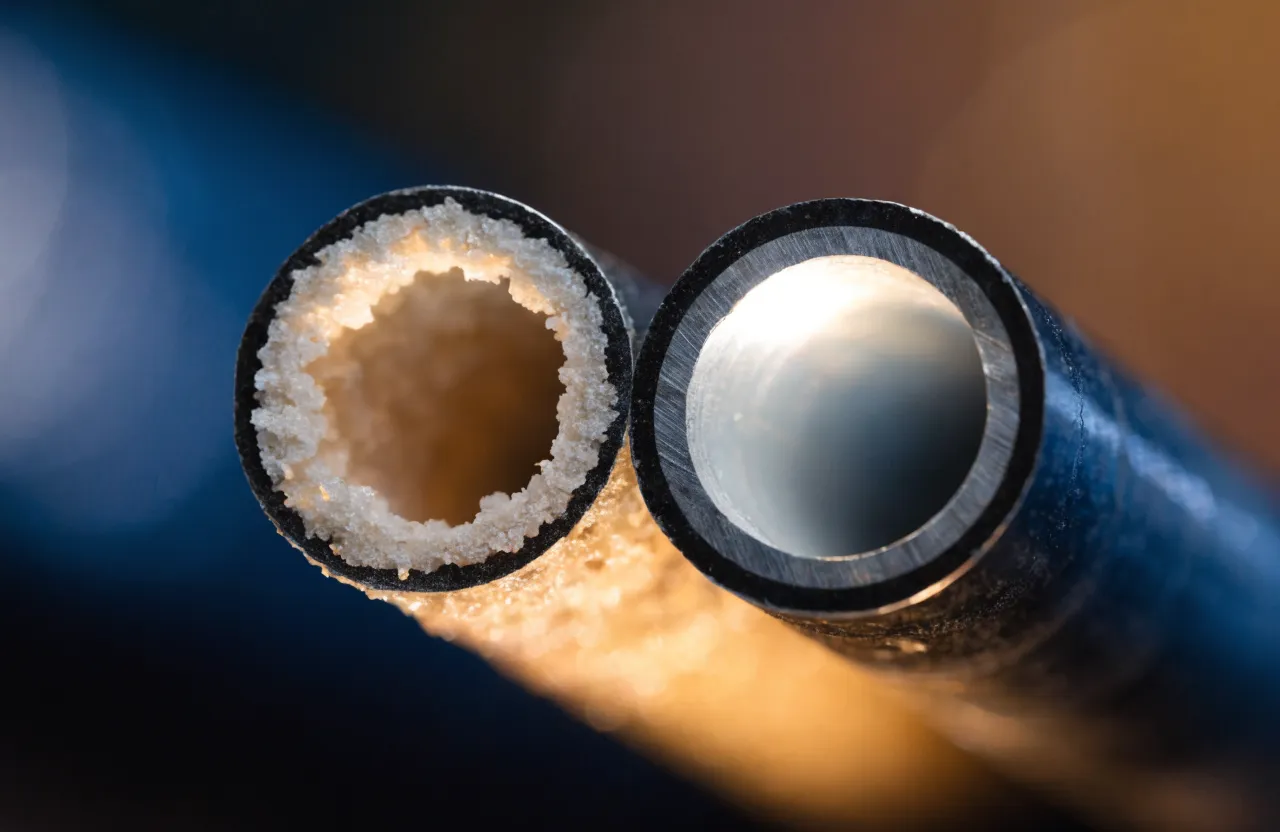
A heat exchanger that ran at design duty last quarter is creeping toward its high-temperature trip. Cooling-tower cycles look normal, but the approach temperature has drifted up a few degrees and the pumps are working harder to move the same flow. Pull a tube and the cause is obvious: a hard, off-white crust of calcium carbonate, around a millimeter thick, lining the bore. That millimeter is expensive. Published cooling-water figures put roughly 7.5% added energy cost on a 1 mm scale layer, rising past 70% as the deposit thickens (Water Treatment Basics). A scale inhibitor, dosed at single-digit ppm, is what keeps that layer from forming.
The short version: Scale inhibitors (antiscalants) are water-treatment additives that stop mineral scale, mainly calcium carbonate, calcium sulfate, barium and strontium sulfate, and silica, from depositing on heat-transfer and membrane surfaces. They work at sub-stoichiometric ppm doses through *threshold inhibition*: a small amount of inhibitor adsorbs onto the first scale crystals, distorts their growth, and holds dissolved hardness in solution well above its normal saturation point. The workhorse chemistries are organophosphonates (HEDP, ATMP, DTPMP, PBTC, and EDTMP) plus polycarboxylate/polyacrylate polymers. Which phosphonate you pick is driven by scale type, calcium tolerance, temperature, and how much oxidizing biocide (chlorine or bromine) the water carries. Confirm the choice with a jar or recirculation trial on your own water.
Part of our Chelating Agents & Sequestrants guide — compare EDTA, gluconate, phosphonate and iron-chelate chemistries and find the right grade for your process.
What an antiscalant actually is
An antiscalant, or scale inhibitor, is a chemical dosed into water to keep dissolved minerals from crystallizing and depositing as scale on pipe walls, heat exchangers, boiler tubes, or reverse-osmosis (RO) membranes. The defining feature is that it is a *threshold inhibitor*, not a chelant.
A true chelant or sequestrant binds metal ions stoichiometrically, roughly one mole of chelant per mole of hardness. Controlling a recirculating water that carries hundreds of ppm of calcium that way would demand an impractical, costly dose. A threshold inhibitor does the job at a fraction of stoichiometric, because it acts on crystal surfaces rather than reacting with every dissolved ion. Organophosphonates show both behaviors: they sequester metals at stoichiometric concentration and inhibit precipitation at sub-stoichiometric concentration (ScienceDirect, Scale Inhibitor overview).
The practical takeaway: if you are dosing an antiscalant at near-stoichiometric rates, you have either specified the wrong chemistry or you are fighting a fouling or corrosion problem that looks like scale. A few ppm should hold a heavily supersaturated water; that is the whole point of the chemistry.
The scales antiscalants control
Different waters throw different scales, and the scale type is the first input to inhibitor selection.
| Scale | Where it shows up | Notes |
|---|---|---|
| Calcium carbonate (CaCO₃) | Cooling water, boilers, RO, any heated hard water | The most common scale; inverse solubility, so it worsens as temperature and pH rise |
| Calcium sulfate (CaSO₄, gypsum) | Concentrated cooling water, RO reject, oilfield | Forms when sulfate and calcium both run high; harder to redissolve than carbonate |
| Barium / strontium sulfate (BaSO₄, SrSO₄) | Oilfield (seawater–formation water mixing), some RO | Extremely insoluble and tenacious; near-impossible to remove once set, so prevention is the only strategy |
| Silica / silicate | RO and high-cycle cooling | Solubility-limited (often near 120–150 mg/L as SiO₂); polymerizes into a glassy deposit that resists acid cleaning |
For calcium carbonate, the standard predictor is the Langelier Saturation Index (LSI), developed in 1936, which compares actual pH to the saturation pH calculated from temperature, calcium hardness, M-alkalinity, and total dissolved solids. A positive LSI means the water tends to deposit CaCO₃; a negative LSI means it tends to dissolve it (Water Treatment Basics, LSI). For high-TDS brackish and RO concentrate, the Stiff–Davis index is the better tool. Calculate the relevant index on your actual water before you size a dose; it tells you how hard the inhibitor has to work.
How antiscalants work at ppm doses
Three mechanisms run in parallel, and a good antiscalant uses all three.
Threshold inhibition. Scale forms by nucleation and then crystal growth. A phosphonate adsorbs onto the active growth sites of the first microscopic nuclei, occupies them, and slows or halts further growth. Because the inhibitor targets crystal surfaces and nuclei, which are a tiny fraction of the total dissolved mass, a sub-stoichiometric dose stabilizes a water carrying far more hardness than the inhibitor could ever bind (LinkedIn, S. Mukherjee on threshold inhibitors).
Crystal modification (distortion). The adsorbed molecule deforms the crystal habit. Instead of growing into hard, interlocking, adherent crystals, the scale develops into rounded, distorted particles that do not bond to surfaces or to each other.
Dispersion. Many antiscalants impart a negative charge to suspended particles, keeping them apart and in suspension so they leave with blowdown or reject rather than settling onto a tube wall.
This is why ppm doses work: inhibition is a surface effect, closer to catalysis than to titration. Typical doses reflect that. Open recirculating cooling systems run roughly 0.5–6 ppm of active phosphonate, with the higher end used where the inhibitor is also providing carbon-steel corrosion protection (IRO Water Treatment). RO antiscalants typically run about 0.5–4 mg/L into the feed (Carewater Solutions). The trade-off to respect: more is not better. At high pH and high calcium, an overdose of phosphonate can itself precipitate as calcium-phosphonate, which becomes its own deposit.
Choosing a phosphonate: the selection table
The five common organophosphonates differ in scale specificity, calcium tolerance, resistance to oxidizing biocides, and thermal/hydrolytic stability. Those four properties, weighed against your water chemistry, decide the pick.
| Phosphonate | CAS | Scale specificity | Ca tolerance | Oxidant (chlorine/bromine) stability | Thermal / hydrolytic stability | Typical use |
|---|---|---|---|---|---|---|
| HEDP | 2809-21-4 | CaCO₃ (general purpose) | Lowest of the five | Moderate; degrades over time under chlorine, faster under bromine | Good | General cooling-water CaCO₃ control; also a carbon-steel corrosion inhibitor |
| ATMP | 6419-19-8 | CaCO₃ and general scale; strong metal sequestrant | Low | Poor; degrades under oxidants, releasing orthophosphate | Moderate | Cooling water, cleaners, and sequestration where oxidant load is low |
| DTPMP | 15827-60-8 | CaCO₃ plus calcium/barium/strontium sulfate | Higher | Moderate | Excellent at high temperature and high alkalinity (effective above ~210 °C) | High-hardness, high-temperature, and oilfield sulfate-scale duty |
| PBTC | 37971-36-1 | CaCO₃; performs at high calcium | Highest of the five | Excellent; stable to chlorine and bromine | Excellent | Chlorinated / high-oxidant and high-temperature cooling water |
| EDTMP | 1429-50-1 (acid; supplied as the sodium salt, EDTMPS) | CaCO₃ and scale with strong chelation | Moderate | Moderate | Good, with high threshold effect | High-pressure boilers, cooling water, and peroxide/bleach stabilization |
Reported calcium tolerance generally ranks PBTC > DTPMP > EDTMP > ATMP > HEDP, with HEDP the least tolerant in high-calcium, high-pH water (WaterCare Chem, HEDP vs ATMP).
A few selection points follow directly from the table. Oxidant load is the swing factor. ATMP and HEDP are aminophosphonate/diphosphonate chemistries that are degraded by chlorine and bromine; as they break down they release orthophosphate, which can form sticky calcium-phosphate scale and feed microbial growth (HTMC Group; US Patent 5,449,476). PBTC carries a single phosphonate group on a tricarboxylic backbone, which is why it is the most oxidant-stable of the group and the default where halogen biocides or hypochlorite are in use (PMC, PBTC NMR study). For sulfate scale and severe hardness at temperature, DTPMP carries five phosphonate groups and is the oilfield workhorse for barium and strontium sulfate as well as calcium carbonate (academia.edu, DTPMP evaluation). For a general calcium-carbonate program in low-oxidant cooling water, HEDP and its disodium and tetrasodium salts remain the economical baseline. The honest qualifier: these are rankings, not guarantees. Scale type, water chemistry, and oxidant exposure interact, so confirm any pick with a recirculation or beaker trial on the water you actually run.
Phosphonates also inhibit corrosion
Selection is not only about scale. HEDP and PBTC also act as carbon-steel corrosion inhibitors, which is why an alkaline cooling program often runs a phosphonate at the higher end of its dose band (Biedunkova et al., 2025, *Engineering Reports*). They are typically paired with a yellow-metal inhibitor and, depending on the program, with zinc or molybdate. The interaction has limits worth knowing: published work shows that above roughly 1,200 ppm chloride and 42.5 °C, an HEDP/molybdate/zinc blend can stop controlling corrosion (IRO Water Treatment). The fuller treatment lives in our guide to corrosion inhibitors for cooling and process water.
Dosing and monitoring
Set the dose to hold a target active-inhibitor residual, then verify it against the system’s concentration cycles. For cooling water, monitor phosphonate residual, conductivity (cycles of concentration), calcium hardness, M-alkalinity, and pH, and recalculate LSI as cycles change. Where an oxidizing biocide is in play, track ORP or free halogen, because that load is exactly what degrades the more oxidant-sensitive phosphonates. For boiler feedwater, the threshold and thermal-stability behavior of the inhibitor matters more than in ambient cooling service. For RO, dose into the feed ahead of the membranes and watch normalized differential pressure and permeate flux for the first signs of scaling. A practical rule: if residual drops faster than cycles explain, you are losing inhibitor to degradation or to precipitation, and the chemistry, not the dose rate, is the thing to change.
Phosphorus discharge: the regulatory context
Phosphonates are phosphorus-bearing molecules, and that has a discharge dimension worth stating plainly. Phosphorus entering surface water is a recognized driver of nutrient pollution and eutrophication, where excess nutrients fuel algal blooms that lower dissolved oxygen and harm aquatic habitat (US EPA, nutrient pollution). Typical alkaline all-organic cooling programs that use phosphonates as scale inhibitors carry roughly 0.3–2.5 ppm phosphorus as P in the circulating water (Power Engineering). Phosphonates and their breakdown products have been measured in treated wastewater and receiving rivers (MDPI, *Water* 2020).
Phosphorus and phosphonate discharge is regulated in some jurisdictions and not others, and effluent limits vary widely by location and permit; confirm the rules that apply to your discharge point before you build a program around a phosphorus-based inhibitor. Where limits are tight, some operators move toward phosphorus-reduced or non-phosphorus chemistries; that is a site-specific engineering and compliance decision, not a blanket recommendation.
Buying scale inhibitors and phosphonates
Tell us your scale type, water analysis (hardness, alkalinity, pH, TDS, sulfate, silica), operating temperature, and biocide regime, and request a sample to run your own jar or recirculation trial before you commit to a program.
Frequently asked questions
What is an antiscalant?
An antiscalant, also called a scale inhibitor, is a chemical dosed into water to prevent dissolved minerals such as calcium carbonate, calcium sulfate, barium sulfate, and silica from crystallizing and depositing as scale on heat exchangers, boiler tubes, pipework, and RO membranes. It works at low ppm doses rather than by binding every dissolved ion.
How do scale inhibitors work?
They work through three parallel mechanisms: threshold inhibition (adsorbing onto the first scale crystals and blocking their growth), crystal modification (distorting the crystal so it cannot form a hard, adherent deposit), and dispersion (charging suspended particles so they stay in suspension and leave with blowdown or reject). Because these are surface effects, a sub-stoichiometric dose controls a water carrying far more hardness than the inhibitor could chemically bind.
What is threshold inhibition?
Threshold inhibition is the phenomenon in which a sub-stoichiometric amount of inhibitor stabilizes a supersaturated solution against precipitation. A few ppm of phosphonate adsorb onto the active growth sites of nascent scale crystals and halt growth, so a water carrying hundreds of ppm of hardness stays clear with only a trace of inhibitor. This is the opposite of a chelant, which must be dosed roughly one mole per mole of the ion it controls.
HEDP vs ATMP vs PBTC: which should I use?
It depends on oxidant load and water chemistry. PBTC is the most stable to chlorine and bromine and to high temperature, so it suits chlorinated or hot cooling water. HEDP is a cost-effective general calcium-carbonate inhibitor and corrosion inhibitor in low-oxidant systems but has the lowest calcium tolerance of the group. ATMP is a strong sequestrant for general scale but degrades readily under oxidizing biocides, releasing orthophosphate. Confirm the choice with a trial on your actual water.
What scales do antiscalants control?
The common targets are calcium carbonate (the most frequent, in cooling, boilers, and RO), calcium sulfate (gypsum), barium and strontium sulfate (especially in oilfield water), and silica or silicate. Calcium-carbonate scaling tendency is usually predicted with the Langelier Saturation Index for normal waters and the Stiff–Davis index for high-TDS and RO concentrate.
Do phosphonate scale inhibitors also prevent corrosion?
Several do. HEDP and PBTC provide carbon-steel corrosion inhibition in addition to scale control, which is why cooling programs often run a phosphonate at the higher end of its dose band, typically alongside a yellow-metal inhibitor and sometimes zinc or molybdate. The corrosion-inhibition performance has limits that depend on chloride level, temperature, and the rest of the program, so it should be validated on the system.
Editorial note. This article is general technical guidance for water-treatment, cooling, boiler, RO, and oilfield professionals and purchasing teams. Inhibitor selection, dose, and performance depend on your specific water chemistry, temperature, biocide regime, equipment, and discharge requirements, and must be validated on your own system; the Certificate of Analysis governs the grade you buy. Phosphorus and phosphonate discharge is regulated in some jurisdictions; confirm the effluent limits that apply to your site before building a program. Phosphonates are acidic and can cause skin and eye irritation or burns, so review the current Safety Data Sheet (SDS) and use appropriate PPE before handling. Products are sold for industrial and professional use only and are not offered for potable-water or any medical use. Nothing here is a medical, health, safety, or environmental-benefit claim. RawSource makes no warranty, express or implied, and assumes no liability for use of this information.
Search 1,300+ industrial chemicals by name or CAS, or send us your spec — we quote by the drum, tote, or container.
Browse the Chemical Index → Request a Quote