
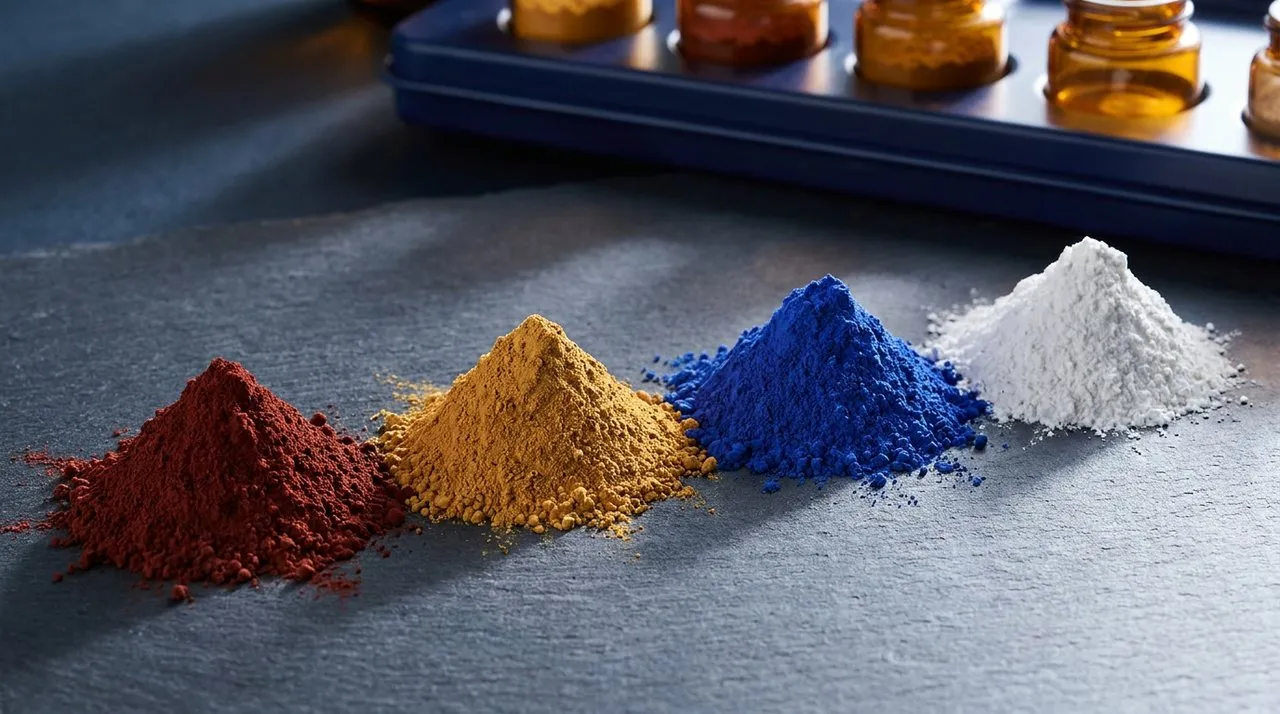
A brief lands on your desk for a “natural” red iron oxide for a foundation. The certificate of analysis (CoA) that comes back describes a lab-precipitated synthetic oxide, not crushed ore. That is not a sourcing error. It is the only red iron oxide a cosmetic formulator should accept, because mined hematite carries lead and arsenic loads that no foundation can pass. The word “natural” satisfied the marketing line. The synthetic specification is what protects the buyer.
That gap between the label term and the regulated material is where colorant sourcing goes wrong. This guide is written for the formulator and the procurement lead, not the end consumer. It maps the colorants a personal-care line actually buys, the physical properties that decide whether one will work in your formula, what the FDA and EU rules require you to confirm, and how to write a specification that survives a QC audit.
Pigment or dye: the first line of the spec
The first decision a colorant forces is physical, before any regulation enters: is it a pigment or a dye? A pigment is an insoluble particulate. It colors by dispersion, sitting in the formula as discrete particles that scatter and absorb light, which is what delivers opacity and hiding power. A dye is soluble. It dissolves in the carrier (water, oil, or solvent) and colors by transmission, giving transparent, usually brighter shades.
Almost every mineral colorant a personal-care line buys is a pigment. The bright, saturated FD&C and D&C colors are dyes or their insolubilized “lake” form, used where minerals cannot reach the shade. The distinction governs how you mill and incorporate the colorant, what dispersibility you must specify, and whether you get coverage or sheerness, so it belongs on the first line of the specification.
The working palette a cosmetic line buys
The list is shorter than the catalog suggests. A handful of mineral pigments plus a few plant carotenoids cover most of the color a line needs, with synthetic certified dyes filling the bright shades minerals cannot produce. The table below is keyed to identifiers and to the physical property that decides where each one fits, not to any claim about the skin.
| Colorant | Origin / type | CI number | CAS | Headline physical property |
|---|---|---|---|---|
| Iron oxides (red/yellow/black) | Synthetic mineral oxide | 77491 / 77492 / 77499 | 1309-37-1 / 51274-00-1 / 12227-89-3 | Opaque earth tones; high lightfastness, pH-stable |
| Titanium dioxide | Synthetic mineral oxide | 77891 | 13463-67-7 | High-refractive-index white; maximum opacity and hiding |
| Zinc oxide | Synthetic mineral oxide | 77947 | 1314-13-2 | White pigment; lower hiding power than titanium dioxide |
| Mica | Mineral silicate | 77019 | 12001-26-2 | Platelet substrate for pearlescent effect pigments |
| Ultramarines | Synthetic mineral silicate | 77007 | 57455-37-5 | Blue and violet; alkali-stable, acid-sensitive |
| Beta-carotene | Plant carotenoid | 75130 | 7235-40-7 | Yellow-orange; oil-soluble, light-sensitive |
Titanium dioxide (TiO2, PubChem CID 26042) is the white workhorse, valued for a high refractive index near 2.7 that drives opacity at low loadings. PubChem lists a density of 3.9 to 4.2 g/cm³ and water solubility below 1 mg/mL, with a 1-in-10 aqueous suspension reading close to neutral. Zinc oxide (ZnO) is the other white, with a density near 5.61 g/cm³ and lower hiding power than titanium dioxide at the same loading; the French-process grade reads pH 7.37 against 6.95 for the American process, and most cosmetic specifications call for the higher-purity French route.
Mica is the platelet substrate behind shimmer and effect pigments, coated with titanium dioxide or iron oxides to throw color and pearl. Ultramarines deliver the blues and violets the oxides cannot, as a sodium-aluminum-sulfur silicate. On the plant side, beta-carotene (C40H56, CID 5280489) is the headline carotenoid, melting at 176 to 184°C, oil-soluble, with a water solubility near 0.0006 g/L, so aqueous formulas take a dispersed grade. Other carotenoids in the catalog, such as astaxanthin and lutein, are more often specified under non-color functional roles than as listed color additives; check the declared function before you classify them as color.
Why a “natural” mineral pigment is synthetic
Cosmetic-grade mineral pigments are synthetically produced because purity, not origin, is the binding constraint. Mined iron oxide, titanium ore, and zinc minerals carry variable heavy-metal loads (lead, arsenic, mercury, antimony) at levels that fail the limits FDA sets in 21 CFR Part 73 and the EU sets in Annex IV. Synthesis controls particle size, shade consistency, and impurity profile lot to lot, which a crushed ore cannot guarantee.
Precipitated iron oxides hit a repeatable hue: the red grade is Fe2O3 (CAS 1309-37-1) with a density near 5.25 g/cm³, insoluble in water and soluble in acids; the yellow is the hydrated oxide FeOOH (CAS 51274-00-1), and the black is magnetite Fe3O4 (CAS 12227-89-3). All three sit in the same Colour Index family: CI 77491 red, CI 77492 yellow, CI 77499 black.
Treat “natural,” “mineral,” and “plant-derived” as sourcing-origin descriptors only, useful for a marketing narrative and nothing more. None has an agreed regulatory definition for color additives, and origin is not a measure of purity or safety. A “naturally mined” cosmetic pigment should prompt a hard look at the heavy-metal panel before it earns a place in the formula. Ask for the manufacturing route on the technical data sheet (TDS) and the heavy-metal panel on the CoA, and let the synthetic, precipitated grade that meets the Part 73 spec be the answer.
The physical properties that decide a colorant
Identifiers tell you what a colorant is. These four properties tell you whether it will work in your formula.
- Opacity and hiding. This is the single biggest split. Titanium dioxide gives maximum coverage from its high refractive index; zinc oxide covers less at the same loading; transparent iron-oxide and mica grades give sheer, buildable color. Spec the opacity you need, because a high-hiding white in a product meant to be sheer is a reformulation, not a tweak.
- Hue, undertone, and shade range. Iron oxides cover the red-yellow-brown-black earth range and blend to most skin tones; ultramarines supply blue and violet; carotenoids supply yellow-orange. Minerals cannot reach a clean bright pink or true green, which is where certified dyes and lakes come in. Match the shade target to the chemistry before you chase a single pigment to do everything.
- Lightfastness and chemical stability. Iron oxides and titanium dioxide hold color across pH swings and under heat and light. Ultramarines are alkali-stable but acid-sensitive, and will dull and can release hydrogen sulfide below about pH 4, so keep them out of low-pH systems. Carotenoids oxidize and shift hue under light, so they need encapsulation or an antioxidant-protected dispersion and a tighter shelf-life claim.
- Dispersibility and solubility. Pigments must be wetted and milled to break agglomerates and develop full color; surface-treated grades (for example, stearate-, silicone-, or jojoba-coated) disperse more easily and resist re-agglomeration, so name the surface treatment in the spec. Solubility sets the phase: insoluble pigments are dispersed, oil-soluble carotenoids go into the oil phase or ship as a cold-water-soluble (CWS) dispersion for aqueous systems.
The trade-off to state plainly: mineral oxides win on stability and opacity but give a muted, earth-weighted palette; plant carotenoids and certified dyes extend the shade range but cost you stability, process tolerance, or a per-batch certification step. Pick the family that matches what the formula has to survive, not the one that reads best on the label.
What the FDA and EU rules require you to confirm
Color additives are regulated through positive lists. A color is permitted for a use only if it is listed for that use, and a US-compliant pigment is not automatically EU-compliant. The job at the spec stage is to confirm the listing for your use and region.
| Dimension | United States (FDA) | European Union |
|---|---|---|
| Governing rule | FD&C Act §721; 21 CFR Parts 73 and 74 | Regulation (EC) No 1223/2009, Annex IV |
| How colors are classed | Certified (Part 74, synthetic organic) vs exempt from certification (Part 73, mineral and plant) | Single positive list (Annex IV), each entry keyed to a CI number |
| Pre-market status | Each color additive must be listed for its intended use | Only Annex IV-listed colorants are permitted |
| Use restrictions | Per color: eye area, external application, ingestion | Per entry: product-type columns and conditions |
| “Natural” defined? | No | No |
Two consequences follow for the buyer. First, certified colors carry a per-batch obligation: a Part 74 dye or lake needs a current FDA certification lot number, and a shipment without one should be refused. Second, “exempt from certification” does not mean “no spec.” Mineral and plant pigments under Part 73 still carry purity limits and permitted-use restrictions. Check the FDA Color Additive Status List for the use field, and cross-reference EU Annex IV (Regulation 1223/2009) for any product sold into the EU. Do not assert that a colorant is “approved” in your copy; confirm that it is a listed color additive for your specific product type and region, and record the listing on the spec.
One regulatory note that trips up sourcing: titanium dioxide and zinc oxide hold a dual identity. Both are listed color additives and are also separately regulated as over-the-counter sunscreen UV filters. That second status is a distinct drug-regulatory pathway with its own requirements; if a product makes a sun-protection claim, confirm it against that pathway rather than treating the pigment listing as sufficient.
Grades and bulk supply
Write the specification around the CI number, the regulatory listing, and the purity panel, not the trade name or an origin word. A vague purchase order for “natural red colorant” invites substitution; a line for “Red iron oxide, CI 77491, CAS 1309-37-1, meeting 21 CFR 73 limits” does not. The spec discipline is the same one we apply to emollient ester selection and to the pigments behind a liquid lipstick formulation.
1. Put the CI number and CAS on every line. It is the identifier the FDA status list, EU Annex IV, and the INCI label all share. 2. Require the heavy-metal panel on the CoA. Lead, arsenic, and mercury results against the Part 73 or Annex IV limit, per lot, with the lab and method named. 3. Confirm the permitted-use field. State whether the color goes into eye-area, externally applied, or rinse-off product, and check it against the regulatory listing for your region. 4. Name the surface treatment and particle grade. Coated vs uncoated, and the target particle size, because both move dispersibility and final shade. 5. For dispersions, spec the active percentage. A 10% CWS beta-carotene is 10% pigment; price and dose against the active, not the gross weight. 6. Lock the manufacturing route for minerals. Synthetic, precipitated grades for cosmetic use, with the process named on the TDS.
See the Titanium Dioxide product page. Send your CI numbers, shade targets, and regulatory region to the Sourcing Desk through any linked product page to request grades, CoA, and pricing.
Frequently asked questions
What is the difference between a pigment and a dye in cosmetics?
A pigment is an insoluble particulate that colors by dispersion and gives opacity and hiding power; a dye is soluble and colors by transmission, giving transparent, brighter shades. Most mineral cosmetic colorants (iron oxides, titanium dioxide, ultramarines) are pigments, while the bright FD&C and D&C colors are dyes or their insolubilized lake form. The choice sets dispersibility, milling, and whether you get coverage or sheerness.
Are these colorants approved for cosmetic use?
Color additives are regulated through positive lists, so the right question is whether a colorant is listed for your specific use and region, not whether it is generically “approved.” In the US, mineral and plant pigments are listed under 21 CFR Part 73 (exempt from certification) and synthetic organic colors under Part 74 (certified per batch); the EU lists permitted colors in Annex IV to Regulation 1223/2009. Confirm the listing and the permitted-use field against the FDA Color Additive Status List or Annex IV before formulating, and record it on the spec.
Which cosmetic colorants have the best lightfastness?
Iron oxides and titanium dioxide hold their color well across pH, heat, and light, which is why they anchor foundations and color cosmetics that must survive storage and shelf life. Ultramarines are stable in alkaline systems but lose color and can release hydrogen sulfide below about pH 4. Plant carotenoids such as beta-carotene have the weakest lightfastness and need encapsulation or a protected dispersion.
How do you improve pigment dispersibility in a formula?
Pigments must be wetted and milled to break agglomerates and develop full color strength. Surface-treated grades, coated with stearates, silicones, or jojoba esters, disperse more easily and resist re-agglomeration, so the surface treatment and target particle size belong in the specification. For oil-soluble carotenoids, use a dispersed or cold-water-soluble grade matched to the formula phase.
Do “natural” or “plant-derived” colorants need FDA certification?
Most do not. Mineral and plant colors such as iron oxides, titanium dioxide, mica, ultramarines, zinc oxide, and beta-carotene are listed under 21 CFR Part 73 and are exempt from batch certification; only synthetic organic FD&C and D&C colors under Part 74 require an FDA-certified lot number per batch. “Natural” and “plant-derived” are origin descriptors with no regulatory definition and are not a substitute for the purity panel and the use listing.
How should procurement specify a cosmetic colorant?
Spec around the CI number, the CAS, the regulatory listing, the permitted-use field, the heavy-metal panel, and the manufacturing route, rather than a trade name or an origin word. For dispersions, state the active percentage and price against the active. This removes the ambiguity that lets a substitution slip into a lot.
—
*Methodology: physical properties cited here are drawn from PubChem compound records (CIDs 26042, 5280489) and the RawSource product catalog; regulatory framing follows 21 CFR Parts 73 and 74, the FDA Color Additive Status List, and Regulation (EC) No 1223/2009, Annex IV. Confirm every limit, listing, and permitted use against the current CoA and the applicable regulatory source before formulating.*
Editorial note. This article is general technical and regulatory guidance for cosmetic and personal-care formulators and procurement teams. It is not legal, medical, or safety advice, and nothing here is a cosmetic-efficacy or health claim. “Natural,” “clean,” and similar origin terms have no agreed regulatory definition for color additives and are not a measure of purity or safety; purity is established by the heavy-metal panel and the applicable color-additive listing, not by origin. Color additives are regulated: confirm that any colorant is a listed color additive for your specific product type and region (for example, FDA 21 CFR Parts 73 and 74 and the Color Additive Status List in the US, and EU Annex IV to Regulation 1223/2009) before formulating or marketing. Physical properties and identifiers are typical reference values; the Certificate of Analysis (CoA) governs the lot you buy. Products are sold for industrial and professional use only. RawSource makes no warranty, express or implied, and assumes no liability for use of this information.
Search 1,300+ industrial chemicals by name or CAS, or send us your spec — we quote by the drum, tote, or container.
Browse the Chemical Index → Request a Quote