
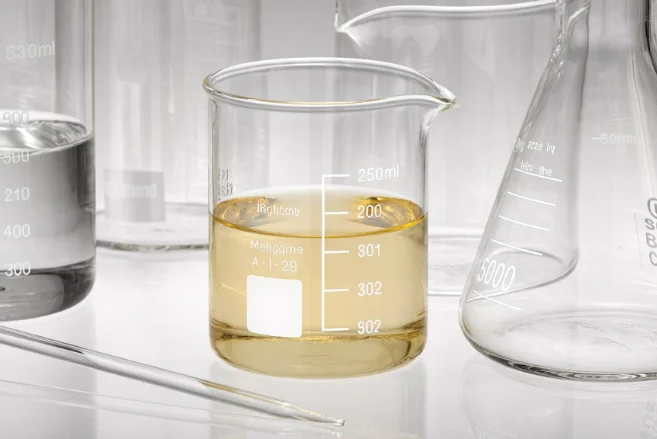
Vegetable glycerin (glycerol, glycerine; INCI Glycerin; CAS 56-81-5) is a clear, viscous, sweet-tasting humectant and solvent derived from plant oils, used across food, personal care, pharmaceutical, and industrial applications. Chemically it is glycerol — the same molecule whatever the feedstock — and “vegetable” refers only to its plant-oil origin (soybean, coconut, palm) rather than to a synthetic petrochemical route. Buyers who source it in volume care about two things above all: the grade (food/USP versus technical) and a current Certificate of Analysis (CoA) for the exact lot. This page covers the chemistry, the grades, and the use cases sector by sector.
Properties at a Glance
Glycerol is a trihydric alcohol — three hydroxyl groups on a three-carbon backbone — which is why it is so strongly water-miscible and hygroscopic. Those three -OH groups pull water out of the surrounding air, the property formulators exploit when they reach for a humectant. The figures below are typical reference values; the CoA for your lot governs.
| Property | Value |
|---|---|
| Molecular formula | C3H8O3 |
| Molar mass | 92.09 g/mol |
| CAS number | 56-81-5 |
| Appearance | Clear, colorless, viscous liquid |
| Taste | Sweet |
| Boiling point | ~290 °C (decomposes) |
| Solubility | Miscible with water; hygroscopic |
| Function | Humectant, solvent, plasticizer, carrier |
Grades: USP/Food vs Technical
The single most consequential decision in a glycerin RFQ is grade, because it sets both the purity floor and the price. Pharmaceutical and food work calls for USP/food grade — typically 99.5% minimum and produced under controlled conditions; industrial work that does not contact food or skin can usually run on technical grade at around 96%, which costs less. Confirm grade against your own specification and jurisdiction; do not assume a technical lot meets a food or USP requirement.
| Grade | Typical purity | Source | Typical use |
|---|---|---|---|
| USP / food | 99.5% min | Vegetable or synthetic | Food, oral-care, cosmetic, excipient applications |
| Technical / industrial | ~96% | Vegetable or synthetic | Resins, antifreeze, polyols, humectant in non-food goods |
Note that “vegetable” and “USP” are independent axes. A USP lot can be made from plant oils or by synthesis from propylene — the monograph governs purity, not feedstock. Buyers who specifically need a plant-derived supply chain (for a kosher, halal, or vegan-labeled finished product) should state that requirement explicitly in the RFQ, because the chemistry alone will not tell them apart.
Uses in Food & Beverage
In food and beverage, glycerin earns its place as a humectant first. Its hygroscopic nature lets it attract and hold moisture, which keeps baked goods, soft candies, and protein bars from drying out across a long shelf life — useful in high-sugar confections, where retained moisture prevents the grainy, recrystallized texture that signals a stale product. It also carries a mild, low-glycemic sweetness, so it appears in sugar-free gums and reduced-sugar formats where formulators want body and a touch of sweetness without sucrose.
A third role is as a carrier and stabilizer: glycerin disperses flavors and extracts, and in frozen desserts it depresses the freezing point enough to limit ice-crystal growth through freeze-thaw cycles. The trade-off worth naming is that it is calorically dense (about 4.3 kcal/g) and intensely hygroscopic, so over-dosing a dry product can leave it tacky — formulators balance the humectant load against the texture they want. Food and beverage use requires food-grade material; confirm grade and applicable food-additive status for your jurisdiction.
In beverages it adds body and a smooth mouthfeel and helps keep flavor systems and extracts in solution, which is why it turns up in flavored waters, ready-to-drink formats, and some energy drinks. It is the same humectant role, applied to a liquid: glycerin holds the formulation together and softens the sharp edges of high-intensity sweeteners. Because it is a syrupy liquid, dosing is by weight and blends easily into a water phase without a separate dispersion step.
| Product | Function | Why it is used |
|---|---|---|
| Baked goods | Retains moisture | Extends soft texture and shelf life |
| Sugar-free snacks | Provides sweetness | Body and mild sweetness without sucrose |
| Frozen desserts | Limits ice-crystal growth | Smoother texture through freeze-thaw |
| Beverages | Adds body, keeps flavors in solution | Smoother mouthfeel, stable flavor system |
Personal Care & Cosmetics
Under the INCI name Glycerin, it is one of the most widely used humectants in personal care. Formulators add it to moisturizers, serums, cleansers, shampoos, and conditioners because it draws water into a formulation and improves spreadability and feel. In hair products it is used to retain moisture and as a co-solvent for fragrance and active ingredients. Typical use levels sit in the low single-digit percentages; push the concentration too high in a low-humidity environment and the humectant can draw moisture from the formulation rather than the air, which is the practical ceiling formulators design around. The descriptions here are informational and describe established cosmetic functions, not a medical or therapeutic claim.
Pharmaceutical Applications (Informational)
In pharmaceutical manufacturing, glycerin is a long-established excipient — an inactive ingredient. It is described in compendia as a vehicle and sweetening agent in oral syrups, a humectant and solvent in topical bases, and a plasticizer in soft-gel capsule shells. The points below describe these uses for reference only; they are not medical, health, or efficacy claims, and RawSource does not sell into regulated pharmaceutical manufacturing.
- Syrup base and sweetener/vehicle in oral liquids
- Humectant and co-solvent in topical creams, gels, and ointments
- Plasticizer in soft-gelatin capsule shells
Pharmaceutical use requires USP/EP-grade material and full documentation; confirm compendial status and suitability for your application.
Industrial & Other Applications
The largest volumes of glycerin move through industrial channels, where technical grade is the norm. As a polyol it is a building block for polyurethanes — alkoxylated into polyether polyols for flexible and rigid foams — and a raw material in alkyd resins for coatings, where its three hydroxyls anchor the polyester network. Its low freezing point and water miscibility make it a component in antifreeze and de-icing fluids, and its humectant behavior carries into the tobacco and vape sector, where it is used as a humectant and aerosol-forming base in e-liquids. Printing inks and a range of process fluids also use it as a humectant and viscosity modifier.
- Polyurethanes/polyols: precursor to polyether polyols for foams
- Alkyd resins: polyol component in coatings
- Antifreeze/de-icing: freezing-point depressant, water-miscible
- Tobacco/vape: humectant and aerosol base in e-liquids
- Printing: humectant and viscosity modifier in inks
One handling point matters across all of these uses: glycerin is strongly hygroscopic, so it should be stored in closed containers to keep it from picking up water and drifting off-spec. It is stable, non-flammable in normal use, and ships without the hazard constraints of many solvents — but storage and grade still need confirming against your own specification and the SDS for the material as received.
Vegetable vs Synthetic Glycerin
The vegetable-versus-synthetic distinction is about feedstock, not molecule. Vegetable glycerin is recovered from plant fats and oils — historically as a co-product of soap-making (saponification), and today largely through hydrolysis or transesterification of triglycerides, the latter as a by-product of biodiesel production. Synthetic glycerin is built from propylene via a petrochemical route. The finished glycerol is chemically identical either way: same formula (C3H8O3), same CAS (56-81-5), same physical properties. The reason a buyer chooses one is supply-chain and labeling, not performance — a plant-derived feedstock is what supports a vegan, kosher, or halal claim on the finished product, so that requirement belongs in the spec, not left to assumption.
Sourcing Vegetable Glycerin in Bulk
See the Vegetable Glycerin product page. A clean RFQ moves fastest when it states three things up front: the grade you need (USP/food vs technical), the volume and packaging (drums, totes, or bulk), and whether you require a Certificate of Analysis — plus any vegetable-feedstock or kosher/halal/vegan requirement, since the chemistry alone will not distinguish those. For a wider view of how to structure a chemical purchase, see our guide to chemical procurement.
Methodology and sources
Identity and property context for Vegetable Glycerin (Glycerin, Glycerol) (CAS 56-81-5) in this guide is anchored to the compound's PubChem record. Hazard-communication framing follows OSHA's Hazard Communication Standard, 29 CFR 1910.1200. Always defer to the supplier's current SDS and CoA for the specific grade and lot you handle.
Frequently Asked Questions
What is vegetable glycerin used for?
Vegetable glycerin is a humectant, solvent, and carrier used across several sectors. In food it retains moisture and adds mild sweetness; in personal care it is a moisturizing humectant; in pharmaceutical manufacturing it serves as an excipient and syrup base; and industrially it is a building block for polyols, alkyd resins, antifreeze, and a humectant in e-liquids and inks.
Is vegetable glycerin the same as glycerol or glycerin?
Yes. Glycerol, glycerin, and glycerine are the same compound (CAS 56-81-5; INCI name Glycerin). “Vegetable glycerin” simply specifies that the glycerol was derived from plant oils rather than from a synthetic route. The molecule and its formula, C3H8O3, are identical regardless of feedstock.
What is the difference between vegetable and synthetic glycerin?
The difference is the feedstock, not the molecule. Vegetable glycerin comes from plant fats and oils via hydrolysis or transesterification; synthetic glycerin is made from propylene. The finished glycerol is chemically identical — same formula, CAS, and properties. Buyers choose vegetable-derived material mainly to support vegan, kosher, or halal labeling on a finished product.
Is vegetable glycerin safe?
Glycerin is a widely used ingredient; food-grade glycerin is listed by the U.S. FDA as Generally Recognized As Safe (GRAS) for its intended food uses, and it is not classified as a hazardous substance under standard GHS criteria. This is general information, not safety advice — always consult the current Safety Data Sheet (SDS) and confirm regulatory status and suitability for your specific application and jurisdiction.
What is the difference between USP and technical grade glycerin?
USP (and food) grade glycerin is typically 99.5% minimum purity and meets compendial or food specifications for food, oral-care, cosmetic, and excipient use. Technical/industrial grade is typically around 96% and is intended for non-food, non-skin applications such as resins, polyols, and antifreeze. Match the grade to your application and confirm it against the CoA.
Is vegetable glycerin vegan and plant-derived?
Vegetable glycerin is, by definition, derived from plant oils such as soybean, coconut, or palm, which is what makes it suitable for vegan, kosher, or halal finished-product labeling. Because USP glycerin can also be made synthetically and the molecules are identical, state a plant-feedstock requirement explicitly in your RFQ and request documentation to confirm origin.
What is the chemical formula of vegetable glycerin?
The chemical formula is C3H8O3, with a molar mass of 92.09 g/mol and CAS number 56-81-5. It is a trihydric alcohol (glycerol) — three hydroxyl groups on a three-carbon backbone — which accounts for its water-miscibility and strongly hygroscopic, humectant behavior.
Disclaimer: Information on this page is provided for general reference and compiled from authoritative public sources. Values are typical and not a guaranteed specification; the Certificate of Analysis (CoA) for the lot purchased governs. Products are sold for industrial and professional use only. Nothing here is a medical, health, or efficacy claim. Always consult the current Safety Data Sheet (SDS) and confirm regulatory status, classification, and suitability for your application and jurisdiction.
RANK_MATH_TITLE: Vegetable Glycerin Uses: Food, Pharma & Bulk | RawSource RANK_MATH_DESCRIPTION: Vegetable glycerin (glycerol, CAS 56-81-5) is a plant-derived humectant for food, cosmetic, pharma & industrial use. USP & technical grades in bulk.Search 1,300+ industrial chemicals by name or CAS, or send us your spec — we quote by the drum, tote, or container.
Browse the Chemical Index → Request a Quote