
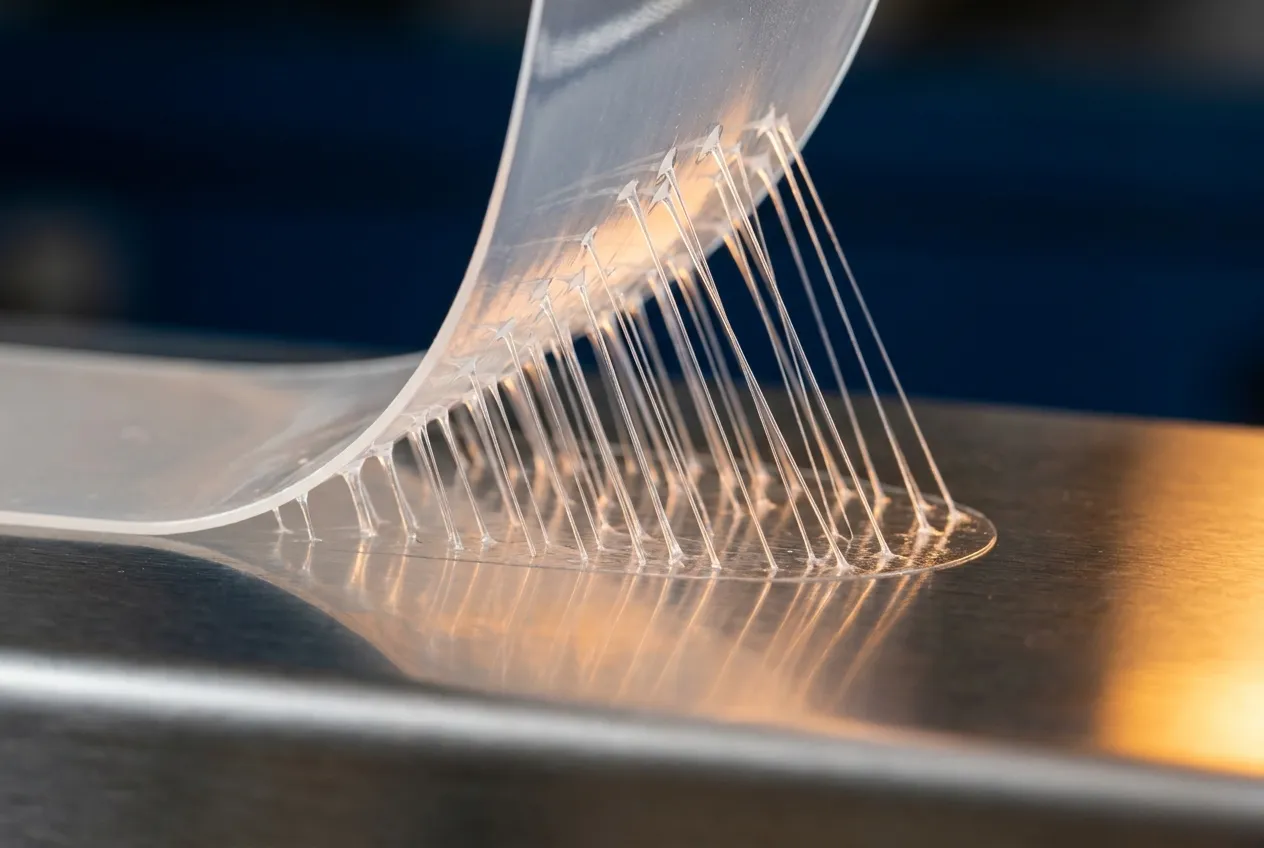
A silicone tape that still sticks at minus 50 and plus 200 degrees, a skin patch that holds for a week without lifting and peels off without tearing skin: both are the same two-part system in different balance. The resin that makes either one tacky is trimethylsiloxysilicate, the silicone MQ resin.
The short version: a silicone pressure-sensitive adhesive (PSA) is a blend of a high-molecular-weight silicone gum, which gives cohesion and elasticity, and an MQ resin, which gives the tack and adhesion. Trimethylsiloxysilicate is that resin. The ratio of gum to resin is the primary formulation lever, and it is what a PSA maker tunes to hit the target tack, peel, and clean removal.
How a silicone PSA works
A silicone PSA is not one polymer; it is a balanced pair. The silicone gum is a very high-molecular-weight polydimethylsiloxane that supplies internal strength, elasticity, and clean cohesive behavior. The MQ resin, trimethylsiloxysilicate, is the hard, three-dimensional silicate network that supplies the tack, the quick-stick, and the adhesion to the substrate.
On their own neither is a good adhesive: the gum is cohesive but not tacky, the resin is tacky but brittle. Blended, and then bodied or cured (by condensation or addition chemistry depending on the system), they form an adhesive that flows enough to wet a surface yet holds enough to resist shear. The MQ resin is the silicate-cored part that makes it stick.
The gum-to-resin ratio is the lever
The single most important formulation variable is how much MQ resin sits against the gum.
| Direction | Effect |
|---|---|
| More MQ resin | higher tack, higher peel adhesion, faster quick-stick, but lower cohesion and more residue risk |
| More gum | higher cohesion, cleaner removal, higher shear holding, but lower tack |
That balance is tuned to the substrate, the service temperature, and whether the bond must be permanent or cleanly removable. A high-temperature industrial tape, a release-liner adhesive, and a wear-a-week skin patch sit at very different points on the same curve.
Where MQ resin fits
- Industrial silicone tapes and bonding: wide temperature range, chemical and weathering resistance, electrical insulation. MQ resin sets the tack; the gum and cure set the temperature and shear performance.
- Skin-contact and transdermal adhesives: patches and wound-care adhesives need an adhesive that holds on skin but removes gently and, for transdermal systems, lets the active diffuse through. These use low-irritation, drug-compatible silicone PSA systems (comparable to the BIO-PSA and SilGrip families), where the MQ resin level is balanced for adhesion versus gentle removal. This article describes the resin’s role only; it is not medical or regulatory advice.
- Release liners and laminates: controlled-release silicone systems where the resin tack is dialed against the gum.
The honest caveat: the MQ resin is the tack lever, but it is not every lever. Temperature range, cure, cohesion, and removal are set by the gum, the crosslinker, and the cure chemistry as much as by the resin, so a PSA is engineered as a system, not just by adding more resin.
Buying MQ resin in bulk
Silicone PSA and adhesive makers buy trimethylsiloxysilicate as 100% flake resin or as a solution, by the kilogram, drum, and tote, and they second-source by matching the M:Q ratio and solids of an incumbent grade rather than the INCI name alone.
Request a sample and confirm tack, peel, and removal against your own gum and cure system before committing to a bulk order.
Frequently asked questions
What is the tackifier in a silicone pressure-sensitive adhesive?
The MQ resin, trimethylsiloxysilicate. Blended with a high-molecular-weight silicone gum, the resin supplies the tack and adhesion while the gum supplies cohesion and elasticity.
How does the gum-to-resin ratio affect a silicone PSA?
More MQ resin raises tack, peel, and quick-stick but lowers cohesion; more gum raises cohesion and clean removal but lowers tack. The ratio is tuned to the substrate, temperature, and whether the bond is permanent or removable.
Is MQ resin used in medical and transdermal adhesives?
Yes, as the tackifying resin in low-irritation silicone PSA systems for skin-contact, wound-care, and transdermal patches, balanced for adhesion and gentle removal. The resin’s role is described here as a fact; formulation and regulatory suitability are the manufacturer’s responsibility.
How do I second-source an MQ resin grade?
Match the M:Q ratio, the solids or supplied form, and the solvent of the incumbent grade, not just the INCI or trade name, then validate tack, peel, and shear on your own system.
Editorial note. This article is general technical guidance for adhesive manufacturers, written for industrial and professional use. It is not medical, regulatory, or efficacy advice; references to skin-contact and transdermal use describe the resin’s function only, and suitability and compliance are the manufacturer’s responsibility. Ratios and performance figures are typical literature ranges to validate by trial; the Certificate of Analysis governs the material you buy. RawSource makes no warranty, express or implied, and assumes no liability for use of this information.
Search 1,300+ industrial chemicals by name or CAS, or send us your spec — we quote by the drum, tote, or container.
Browse the Chemical Index → Request a Quote