
- ▸ Organic synthesis: Reagent and chemical intermediate
- ▸ Laboratory: Strong-acid reagent for analytical and research use
- ▸ Agrochemicals: Sodium salt used as a pre- and post-emergent herbicide
A grade-specific Safety Data Sheet (SDS) — with the complete hazard classification, handling precautions, and transport information — is supplied with every shipment and available on request. Confirm all safety and regulatory details against the SDS for your specific grade.
Request SDS →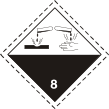
Transport classification per the UN Model Regulations / 49 CFR 172.101 Hazardous Materials Table. Confirm against the grade-specific SDS (Section 14) before shipping.
⚠ WARNING: This product can expose you to Trichloroacetic Acid, which is known to the State of California to cause cancer. For more information go to www.P65Warnings.ca.gov.
Trichloroacetic acid (CAS 76-03-9, C2HCl3O2) is a strong chlorinated carboxylic acid, typically supplied as a crystalline solid. It is used as a reagent and intermediate in organic synthesis and as an acidic laboratory reagent; its sodium salt has been used as a herbicide.
Regulatory & registration requirements
- TSCA (US):
- REACH (EU):
- EC number: 200-927-2
Source: EPA TSCA Inventory (July 2025 release) · ECHA CHEM — retrieved 2026-07-12
Regulatory restriction status
Trichloroacetic Acid (TCA) (CAS 76-03-9) appears on the regulatory list(s) below. This is public regulatory information about the substance — not a statement about any specific supplier’s material, and not a safety claim. Confirm the current status for your jurisdiction and intended use.
- California Proposition 65: listed for cancer, listed 13 Sep 2013. A California Proposition 65 warning applies (see the warning above).
Sources: ECHA Candidate List / Annex XIV / Annex XVII (echa.europa.eu); U.S. EPA TSCA; UN Stockholm Convention / EU POPs Regulation; California OEHHA Proposition 65 list. Retrieved 2026-07-13.
Frequently Asked Questions
What is trichloroacetic acid used for?
Trichloroacetic acid (TCA, C2HCl3O2, CAS 76-03-9) is a strong chlorinated carboxylic acid supplied as a crystalline solid. It is used as a reagent and intermediate in organic synthesis and as a strong-acid laboratory reagent; its sodium salt has been used as a herbicide. We supply the crystal form in bulk for industrial and laboratory use.
Is trichloroacetic acid an acid, and how strong is it?
Yes. Trichloroacetic acid is a carboxylic acid made strongly acidic by its three electron-withdrawing chlorine atoms, giving it a much lower pKa than acetic acid. This strong acidity drives its use as a reagent in synthesis and analysis. Handling details are on the SDS.
Is trichloroacetic acid crystal water soluble?
Yes. Trichloroacetic acid crystal is highly soluble in water and also dissolves in many organic solvents. It is also deliquescent, so it must be kept sealed and dry; storage guidance is detailed on the SDS.
How is trichloroacetic acid classified for shipping?
Trichloroacetic acid is assigned UN 1839 and is a corrosive solid. Packing group, labeling, and handling requirements are detailed on the SDS and must follow current DOT/IATA/IMDG rules. We supply compliant documentation with each order.
Where can I buy bulk trichloroacetic acid crystal and what does it cost?
We supply trichloroacetic acid crystal in bulk to industrial and laboratory buyers. Pricing is quote-based and depends on grade, volume, and packaging. Request a bulk quote with your target volume for current pricing, CoA, and SDS.
What is the REACH and TSCA regulatory status of Trichloroacetic Acid (TCA)?
Trichloroacetic Acid (TCA) (CAS 76-03-9) is subject to U.S. TSCA Inventory requirements; supplying it into the EU requires valid REACH registration ((EC) No 1907/2006). RawSource cannot verify a third-party supplier's registrations — buyers should require documented TSCA and REACH compliance for their jurisdiction and volume (EC 200-927-2).