
- ▸ RTV silicone crosslinker: Cures one-part silicone sealants and adhesives on exposure to atmospheric moisture, reacting completely during the cure.
- ▸ Sealants: Acts as a barrier-sealant component.
- ▸ Waterproofing: Functions as a waterproofing agent.
- ▸ Intermediate: Used as an organosilicon synthesis intermediate.
A grade-specific Safety Data Sheet (SDS) — with the complete hazard classification, handling precautions, and transport information — is supplied with every shipment and available on request. Confirm all safety and regulatory details against the SDS for your specific grade.
Request SDS →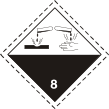
Transport classification per the UN Model Regulations / 49 CFR 172.101 Hazardous Materials Table. Confirm against the grade-specific SDS (Section 14) before shipping.
Methyltriacetoxysilane (CAS 4253-34-3) is an acetoxy-functional organosilane that hydrolyzes on contact with atmospheric moisture, releasing acetic acid as it cures. It is used as a crosslinker in one-component (RTV) silicone sealants and adhesives, where it reacts completely during curing, and as a waterproofing and sealant component. It also serves as an organosilicon intermediate.
Regulatory & registration requirements
- TSCA (US):
- REACH (EU):
- EC number: 224-221-9
Source: EPA TSCA Inventory (July 2025 release) · ECHA CHEM — retrieved 2026-07-12
Solutions Using This Product
Process-solution guides on this site that specify this chemistry:
- Crosslinker Silanes for Moisture-Cure (RTV) Sealants (Coatings & Construction)
Frequently Asked Questions
What is methyltriacetoxysilane?
Methyltriacetoxysilane (CAS 4253-34-3) is an acetoxy-functional organosilane that hydrolyzes on contact with atmospheric moisture, releasing acetic acid as it cures. RawSource supplies it in bulk as a crosslinker for one-component (RTV) silicone sealants and adhesives and as an organosilicon intermediate.
What is methyltriacetoxysilane used for?
It is used chiefly as a crosslinker in one-part (RTV) silicone sealants and adhesives, where it reacts completely during moisture cure; it also serves as a waterproofing and sealant component and as an organosilicon synthesis intermediate. The acetoxy cure is why these sealants give off an acetic-acid (vinegar) odor while curing.
Why does methyltriacetoxysilane release acetic acid?
Its three acetoxy groups hydrolyze when exposed to atmospheric moisture, forming silanol bonds and releasing acetic acid as the cure byproduct. This is the mechanism by which acetoxy-cure RTV silicones crosslink, and the silane is consumed in the reaction.
How does methyltriacetoxysilane differ from methyltrimethoxysilane?
Both are trifunctional crosslinking silanes, but methyltriacetoxysilane is acetoxy-functional and releases acetic acid on cure, while methyltrimethoxysilane is alkoxy-functional and releases methanol. Acetoxy systems cure fast (vinegar smell); alkoxy systems are neutral-cure. CAS 4253-34-3 for the acetoxy grade.
What bulk packaging and documentation are available?
RawSource supplies methyltriacetoxysilane in moisture-protected packaging in bulk, with a Certificate of Analysis and Safety Data Sheet per shipment; it must be kept sealed and dry to prevent premature hydrolysis. The HS code is 2931.90; request a bulk quote with your target volume.
What is the REACH and TSCA regulatory status of Methyltriacetoxysilane?
Methyltriacetoxysilane (CAS 4253-34-3) is subject to U.S. TSCA Inventory requirements; supplying it into the EU requires valid REACH registration ((EC) No 1907/2006). RawSource cannot verify a third-party supplier's registrations — buyers should require documented TSCA and REACH compliance for their jurisdiction and volume (EC 224-221-9).