
- ▸ Adhesion promoter: Improves resin bonding to inorganic surfaces.
- ▸ Coupling agent: Bonds fillers and substrates to organic polymers.
- ▸ Surface modification: Amine functionalization of silica and metal oxides.
- ▸ Sealants & coatings: Adhesion/cohesion additive.
A grade-specific Safety Data Sheet (SDS) — with the complete hazard classification, handling precautions, and transport information — is supplied with every shipment and available on request. Confirm all safety and regulatory details against the SDS for your specific grade.
Request SDS →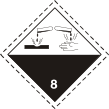
Transport classification per the UN Model Regulations / 49 CFR 172.101 Hazardous Materials Table. Confirm against the grade-specific SDS (Section 14) before shipping.
3-Aminopropyltrimethoxysilane (CAS 13822-56-5), or APTMS, is the trimethoxy amino-functional silane coupling agent. It acts as an adhesion and cohesion promoter, bonding inorganic substrates such as glass, silica, and metals to organic resins in adhesives, sealants, and coatings.
Regulatory & registration requirements
- TSCA (US):
- REACH (EU):
- EC number: 237-511-5
Source: EPA TSCA Inventory (July 2025 release) · ECHA CHEM — retrieved 2026-07-12
Solutions Using This Product
Process-solution guides on this site that specify this chemistry:
- Adhesion Promoters for Sealants on Difficult Substrates (Coatings & Construction)
- Silane Coupling Agents for Filled Polymers (Plastics & Polymers)
Frequently Asked Questions
What is APTMS (3-aminopropyltrimethoxysilane) used for?
APTMS (CAS 13822-56-5, C6H17NO3Si) is the trimethoxy amino-functional silane coupling agent. It acts as an adhesion and cohesion promoter, bonding inorganic substrates such as glass, silica, and metals to organic resins in adhesives, sealants, and coatings, and is used for amine surface functionalization of silica and metal oxides. RawSource supplies it in bulk to formulators.
What is the difference between APTMS and APTES?
APTMS is the trimethoxysilane (CAS 13822-56-5) and APTES is the triethoxysilane (CAS 919-30-2). Both carry the aminopropyl group, but APTMS hydrolyzes faster and releases methanol while APTES releases ethanol. Choose based on cure speed and by-product needs; confirm identity by CAS on the CoA.
How does APTMS work as an adhesion promoter?
Its trimethoxysilyl group hydrolyzes and condenses onto inorganic surfaces (glass, silica, metal oxides), while its amine group reacts with or anchors organic resins, building a covalent bridge across the inorganic-organic interface that improves bond strength and durability. Loading and conditions depend on the substrate and resin system.
What CAS number and HS code apply to APTMS?
The CAS number is 13822-56-5 and it classifies under HS 2931.90 (organo-inorganic compounds, other). As a trimethoxysilane it is moisture-sensitive; confirm packaging and the destination tariff line when ordering. Note the closely related diamino silane N-(2-aminoethyl)-3-aminopropyltrimethoxysilane is a different CAS item.
How is bulk APTMS supplied and quoted?
RawSource supplies APTMS in industrial bulk packaging (drums, totes, and IBCs) to manufacturers. Pricing is volume- and grade-dependent, so request a bulk quote with your target quantity and grade; CoA and SDS accompany each shipment.
What is the REACH and TSCA regulatory status of 3-Aminopropyltrimethoxysilane (APTMS)?
3-Aminopropyltrimethoxysilane (APTMS) (CAS 13822-56-5) is subject to U.S. TSCA Inventory requirements; supplying it into the EU requires valid REACH registration ((EC) No 1907/2006). RawSource cannot verify a third-party supplier's registrations — buyers should require documented TSCA and REACH compliance for their jurisdiction and volume (EC 237-511-5).
What is the CAS number of 3-aminopropyltrimethoxysilane?
The CAS number of 3-aminopropyltrimethoxysilane is 13822-56-5.