
SODIUM SILICATE- ▸ Adhesives and binders: Bonding agent for paper, board, and foundry molds.
- ▸ Detergents: Alkaline builder in cleaning formulations.
- ▸ Foundry: Mold and core binder.
- ▸ Construction: Cement waterproofing and fireproofing agent.
- ▸ Silica and zeolite feedstock: Starting material for silica gels and zeolites.
A grade-specific Safety Data Sheet (SDS) — with the complete hazard classification, handling precautions, and transport information — is supplied with every shipment and available on request. Confirm all safety and regulatory details against the SDS for your specific grade.
Request SDS →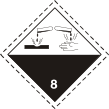
Transport classification per the UN Model Regulations / 49 CFR 172.101 Hazardous Materials Table. Confirm against the grade-specific SDS (Section 14) before shipping.
Sodium silicate (water glass, Na2O·xSiO2, CAS 1344-09-8) is a versatile alkaline silicate supplied as liquid solutions and spray-dried powders across a range of SiO2:Na2O weight ratios. It is used in detergents, adhesives, water treatment, foundry binders, and construction. The two numbers that decide which grade you need are the SiO2:Na2O weight ratio and the form — everything else on the spec sheet follows from those.
The ratio is the lever. A low ratio means proportionally more Na2O, so the grade is more alkaline and more soluble — that is what cleaning and detergent builders want. A high ratio means proportionally more SiO2, which is less alkaline but binds, films, and gels better, so it suits adhesives and deflocculation. Most industrial demand sits between roughly 2.0 and 3.3, and a grade tuned for one job is usually a compromise in the other.
Ratio and form: how the grade maps to the job
| SiO2:Na2O weight ratio | Character | Typical form | Where it fits |
|---|---|---|---|
| ~2.0 | More alkaline, highly soluble | Liquid or spray-dried powder | Detergents, soaps, heavy-duty cleaning, alkaline builders |
| ~2.5 | Balanced alkalinity and binding | Liquid or powder | General-purpose cleaning, paper and board, mid-duty binders |
| ~3.2–3.3 | Less alkaline, stronger film and gel | Liquid (most common) | Adhesives, deflocculation, foundry cores, sealing and densifying |
Form follows logistics as much as chemistry. Liquid grades ship at a known solids content and go straight into a dosing line. Spray-dried powders carry the cost of removing water at the plant but cut freight and storage, and they dissolve back to solution on site — the trade-off is that powder needs make-up equipment and clean water, while liquid arrives ready to meter.
Applications by sector
Detergents and soaps
Lower-ratio grades (~2.0–2.4) act as a builder: they supply alkalinity, buffer wash-water pH, and help keep loosened soil suspended so it does not redeposit on the substrate. Silicate builders also passivate metal surfaces inside washing equipment, which is one reason they survived in machine-dishwash and industrial cleaners after phosphate restrictions tightened. The practical limit is that very high alkalinity can be aggressive to soft metals and skin, so dose is matched to the soil and the surface.
Adhesives
Higher-ratio liquid grades (~3.2–3.3) bond corrugated board, paper tubes, laminations, and cores; the silicate films and sets as water leaves, giving a rigid inorganic bond. The same film-forming behavior makes silicate adhesives inherently non-combustible, so they appear in fireproof and high-temperature bonding where an organic glue would char. The catch is brittleness and water-sensitivity of the cured bond, which limits where a straight silicate adhesive can be used without modification.
Water and wastewater treatment
As a coagulation aid, activated silica from sodium silicate strengthens floc so it settles faster in clarifiers. Silicate also sequesters dissolved metals such as iron and manganese and forms a thin protective film on distribution-system pipe to limit corrosion and reduce metal pickup. Overfeeding can scale equipment, so feed rate is the variable to watch.
Foundry and refractory binders
In the CO2 process, sodium silicate coats sand and is gassed with carbon dioxide to set molds and cores in seconds; ester-cured no-bake systems hold a longer working window. Silicate binders are valued because they are inorganic and low-emission compared with many organic resin binders, and they tolerate high pour temperatures. The known trade-off is shakeout: silicate-bonded sand can be harder to break down and reclaim after casting.
Construction, ceramics, and drilling
In construction, sodium silicate seals and densifies concrete by reacting with free lime to fill pore structure and harden the surface. In ceramics, a small dose of high-ratio silicate acts as a deflocculant, dispersing clay so a casting slip flows at lower water content. It also serves in drilling fluids and in passivation and corrosion-inhibition duties where an alkaline silicate film protects metal. Dosing in slips is narrow — too much silicate reverses the effect and thickens the slip again.
Related: sodium metasilicate
Sodium metasilicate is a discrete, defined-composition silicate (roughly a 1:1 ratio) rather than a variable-ratio water glass. Its high alkalinity makes it a workhorse in heavy-duty and CIP cleaning, where strong, fast pH lift is the goal. If your spec calls out “metasilicate,” it is a different, more aggressive product than a standard water-glass grade — name it explicitly on the RFQ so we quote the right material.
Handling and safety
Sodium silicate is alkaline and an irritant to skin, eyes, and the respiratory tract; the higher-alkalinity, lower-ratio grades are the more aggressive. Handle with appropriate PPE, avoid contact with acids, and follow the grade-specific SDS for storage, exposure limits, and first aid. Consult the current SDS before handling, mixing, or transport — it governs.
Bulk supply and RFQ
RawSource supplies sodium silicate in bulk: liquid solutions in IBC totes and bulk tankers, and spray-dried powder in bags. To quote accurately we need four things — the SiO2:Na2O ratio or grade, liquid or powder, target volume, and any CoA or specification you work to. Send those and we return delivered pricing with a Certificate of Analysis and the SDS.
Regulatory & registration requirements
- TSCA (US):
- REACH (EU):
- EC number: 215-687-4
Source: EPA TSCA Inventory (July 2025 release) · ECHA CHEM — retrieved 2026-07-12
Solutions Using This Product
Process-solution guides on this site that specify this chemistry:
- Corrosion Inhibitors for Metal-Safe Cleaners (Home & Industrial Care)
- Foliar Silicon: Potassium Silicate and Silicic Acid (Agriculture)
- Concrete Densifiers & Silicate Hardeners (Coatings & Construction)
Frequently Asked Questions
What is sodium silicate?
Sodium silicate (CAS 1344-09-8) is an alkaline silicate compound, Na2O·xSiO2, supplied as liquid solutions or spray-dried powders across a range of SiO2:Na2O weight ratios. It is used in detergents, adhesives, water treatment, foundry binders, and construction.
What is water glass?
Water glass is the common name for sodium silicate, usually the liquid solution form. The name reflects its glassy, soluble silicate character. “Water glass” and “sodium silicate solution” refer to the same family of products.
What does the SiO2:Na2O ratio mean?
The ratio is the weight of silica to soda in the grade. A low ratio (~2.0) is more alkaline and more soluble, which suits detergents and cleaning. A high ratio (~3.2–3.3) is less alkaline but films and gels better, which suits adhesives and deflocculation. Confirm the exact ratio on the CoA for your grade.
Liquid or powder: which form do I need?
Liquid grades arrive at a set solids content and meter straight into a process. Spray-dried powder cuts freight and storage but needs make-up water and mixing on site to return it to solution. Choose by your dosing setup and logistics, and specify the form on the RFQ.
What is sodium silicate used for?
Main uses are detergent and soap builders, paper and corrugated adhesives, water and wastewater coagulation aids, foundry mold and core binders (CO2 and no-bake), concrete sealing and densifying, ceramic deflocculation, drilling fluids, and corrosion-inhibiting passivation.
Sodium silicate vs sodium metasilicate — what is the difference?
Sodium silicate (water glass) is a variable-ratio family; sodium metasilicate is a discrete, defined-composition silicate at roughly a 1:1 ratio with higher alkalinity. Metasilicate is favored for heavy-duty and CIP cleaning. Specify which one your application requires so the right grade is quoted.
Is sodium silicate safe to handle?
Sodium silicate is alkaline and an irritant to skin, eyes, and the respiratory tract, with lower-ratio grades being more aggressive. Use appropriate PPE, keep it away from acids, and follow the grade-specific SDS for storage, exposure, and first aid before handling.