
If your PO says only CAS 68439-46-3, which C9-11 alcohol ethoxylate are you buying?
You might be buying any of three. The US EPA classifies CAS 68439-46-3 as a UVCB chemical substance with molecular formula “Unspecified” (EPA Substance Registry Services). PubChem’s ChemIDplus-deposited record (SID 135272209) lists C9-11 Pareth-3, C9-11 Pareth-6 and C9-11 Pareth-8 as synonyms under that one number. The HERA alcohol ethoxylates assessment goes further, attaching C9-11EO4, C9-11EO6 and C9-11EO8 materials to it.
A purchase order that names the CAS without an EO mole number is not ambiguous in a subtle way. It is ambiguous in the way that matters: the supplier picks the grade.
Regulatory status: one CAS, multiple regulatory identities
ECHA registers CAS 68439-46-3 under EC 614-482-0, naming it “Alcohols, C9-11, ethoxylated.” The molecular formula in that record reads (C2H4O)0-3(CH2)8-10CH4O (ECHA CHEM substance record 100.112.306, field molFormula, retrieved 2026-10-31).
Besides EC 614-482-0, ECHA’s substance index carries further list numbers such as 931-514-1 and 953-766-1, the latter described as “>2.5 EO” (ECHA CHEM substance search, retrieved 2026-10-31). Under REACH Regulation (EC) No 1907/2006, the registration dossier name tied to EC 614-482-0 is “Alcohols, C9-11 ethoxylated, < 2.5 EO” (ECHA, regulatoryProcessLookupTable, retrieved 2026-10-31). Higher-EO variants appear under CLP notifications per Regulation (EC) No 1272/2008 rather than the REACH registration name.
It tells you nothing about EO content.
The EPA TSCA Inventory lists CAS 68439-46-3 as a single active substance class under 15 U.S.C. §2607. No separate listing exists per EO grade.
One state-level regulation deserves attention. New York’s Environmental Conservation Law (6 NYCRR subpart 352-1, adopted September 18, 2024) caps 1,4-dioxane at 2 ppm in household cleansing products as of December 31, 2023, tightening to 1 ppm as of December 31, 2025 (ECL §37-0117). Ethoxylated surfactants are a primary source of 1,4-dioxane as a manufacturing by-product. The New York DEC cites FDA indicator terms including “PEG,” “polyoxyethylene” and the suffix “-eth-” as flags. All C9-11 Pareth grades fall squarely into that indicator list.
No waivers remain effective after December 30, 2025. Products used primarily in industrial manufacturing processes are excluded from the rule’s scope, but if the finished good is a household or commercial cleaner sold in New York, the limit applies regardless of EO grade.
Which grade are you looking at?
The three grades share a C9-11 linear primary alcohol backbone. The differentiator is ethoxylation degree: how many moles of ethylene oxide were added per mole of alcohol, using KOH or NaOH catalysis followed by acid neutralization (HERA).
| Property | C9-11 Pareth-3 (~3 EO) | C9-11 Pareth-6 (~6 EO) | C9-11 Pareth-8 (~8 EO) |
|---|---|---|---|
| INCI name | C9-11 Pareth-3 | C9-11 Pareth-6 | C9-11 Pareth-8 |
| Approx. EO moles | 3 | 6 | 8 |
| Cloud point (1% aq.) | Below the ASTM D2024 method floor of 30 °C for many lots | Within the 30-95 °C window measurable per ASTM D2024 | Higher end of the 30-95 °C window |
| Primary fit | Low-foam wetting, industrial CIP | General-purpose detergency, I&I cleaners | High-detergency household cleaners, emulsification |
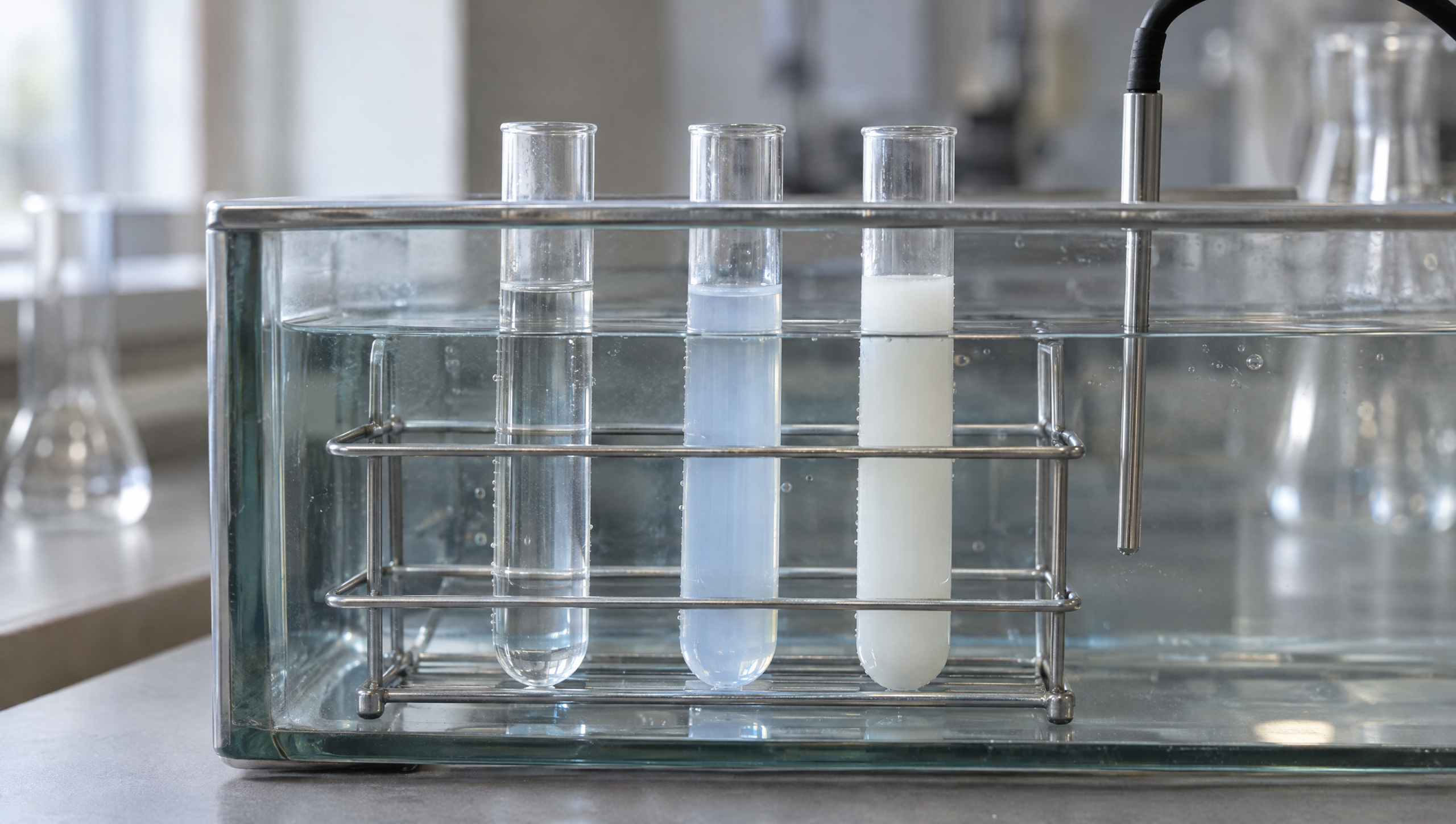
ASTM D2024-09(2023) defines cloud point as the temperature at which dissolved components separate as a second phase, applicable at 0.5-1.0% surfactant in DI water where the transition occurs within 1 °C. Nonionics with a measurable cloud point generally contain 50-75% EO by weight (ASTM D2024, Scope 1.2).
The 3 EO grade often falls below that EO-weight threshold, which is precisely why a low cloud point is both expected and useful as a differentiator: if the incoming lot produces a clear cloud-point result by D2024, it is not the 3 EO grade.
Why the EO number decides the application
A formulator selecting a nonionic for an all-purpose cleaner needs detergency and rinsability. Higher EO grades deliver that. Specifying Pareth-8 when the formula was developed on Pareth-3 introduces foam the filling line was not designed for and shifts the cloud point high enough that the warm-water performance window changes. The reverse error, using Pareth-3 in a formula built for Pareth-8, drops detergency and may leave the product visually hazy at room temperature.
ASTM D4252-89(2025) underscores the point: its Significance and Use section states that “ethoxylate characteristics need careful control because variations change end-use properties.” The standard covers methods for hydroxyl number, cloud point, EO content, iodine number and polyethylene glycol content, all of which shift with EO degree. This is not a quality-control subtlety. It is the difference between a product that works and one that does not.
| Application | Preferred EO grade | Key property needed | Wrong-grade consequence |
|---|---|---|---|
| Industrial CIP, low-foam rinse | ~3 EO | Fast wetting, minimal foam at elevated temperature | 6 or 8 EO foams in the CIP loop, triggering antifoam addition or line shutdown |
| I&I all-purpose cleaner | ~6 EO | Balanced detergency, moderate foam, clear solution at use dilution | 3 EO gives hazy dilution, poor soil suspension; 8 EO overfoams in trigger sprayers |
| Household surface cleaner | ~8 EO | High detergency, good emulsification of oily soils | 3 EO leaves residue; 6 EO may underperform on greasy kitchen soil |
| Sulfation feedstock (to make ether sulfate) | ~3 EO | Low EO for target active weight after sulfation | Higher EO raises molecular weight, lowering active-matter yield per kg |
The sulfation use case is worth flagging separately. ASTM D4252 notes that AE serve as feedstock for anionic surfactants after sulfation. If the EO degree drifts, the resulting ether sulfate has a different molecular weight and different performance. The error compounds downstream.
What to verify before qualifying a lot
State the EO target on the RFQ. Write “C9-11 Pareth-6, CAS 68439-46-3, ~6 moles EO” or equivalent. The INCI name alone disambiguates because PCPC assigns separate names per EO grade despite the shared CAS.
Require cloud point or hydroxyl number on every CoA. These are the two fastest analytical proxies for EO content. Cloud point per ASTM D2024 needs only a water bath, a thermometer, and a 1% solution. Hydroxyl number per ASTM E1899 (range 0.5 to 367) is more precise but requires titration. Either one, lot over lot, will catch a grade swap that the CAS number alone cannot.
Cross-reference the supplier’s trade name. Major producers assign distinct trade names per EO grade within a product family. Confirm that the trade name on the CoA maps to the EO grade on your spec sheet. If the supplier changes trade names after a reformulation or plant change, treat it as a requalification event.
Check 1,4-dioxane if the end product is a household cleaner sold in New York. The 1 ppm cap under 6 NYCRR subpart 352-1 has no remaining waivers after December 30, 2025. Because 1,4-dioxane is a by-product of ethoxylation and cannot be identified from ingredient labels alone, the New York DEC states that testing is required. Request a 1,4-dioxane residual value on the CoA or run incoming QC on the raw material.
Watch for database artifacts. One PubChem substance record (SID 349865591) pairs CAS 68439-46-3 with the name “1-ETHOXYNONANE,” a single defined compound that is not an alcohol ethoxylate surfactant. Database mismatches like this can propagate into automated SDS generators and customs filings. Verify substance identity against the ECHA record (EC 614-482-0), not against an arbitrary PubChem depositor entry.
The real trade-off is analytical cost versus risk. Running cloud point on every incoming drum adds time. Not running it means trusting that the supplier’s internal grade-control system never slips, and that every intermediary in the supply chain relabeled correctly. For a high-volume line where an off-spec batch means a full-day hold and a rework, the bench check pays for itself on the first catch.
Request pricing and specification
Request current pricing, availability and a lot-specific specification sheet for Alcohols, C9-11 Ethoxylated by stating the target EO mole number (Pareth-3, Pareth-6 or Pareth-8), required packaging format, and any 1,4-dioxane residual limit your finished product must meet.
Related on RawSource
- Alcohols, C9-11 Ethoxylated product page: pricing, availability and lot-specific specifications for C9-11 Pareth grades discussed in this article.
- Disodium Laureth Sulfosuccinate: another ethoxylated surfactant where EO degree affects performance and regulatory classification.
- Cocamidopropyl Hydroxysultaine: amphoteric surfactant commonly co-formulated with C9-11 alcohol ethoxylates in I&I cleaners.
- Ammonium Laureth Sulfate vs. Sodium Laureth Sulfate: ether sulfate context relevant to the sulfation feedstock use case covered above.
- Ammonium Lauryl Sulfate: CoA verification practices applicable to alcohol ethoxylate procurement.
- Lauramine Oxide: oxide surfactant frequently blended with nonionic ethoxylates in household and I&I cleaner formulations.
Frequently asked questions
Why does ECHA show multiple EC list numbers for CAS 68439-46-3?
Can hydroxyl number distinguish the EO grade on a CoA?
How much unreacted alcohol is typical in commercial alcohol ethoxylates?
Does the 1,4-dioxane concern apply to industrial-process cleaners sold in New York?
Sources & methodology
Figures are RawSource sourcing data unless attributed to a named source. Regulatory citations are current as of publication. Chemical identities verified by CAS number against the RawSource catalog.
Search 1,300+ industrial chemicals by name or CAS, or send us your spec — we quote by the drum, tote, or container.
Browse the Chemical Index → Request a Quote