
- ▸ Polyethylene crosslinking: Generates radicals to cure PE for wire, cable, and pipe.
- ▸ Rubber vulcanization: Cures natural and synthetic rubber compounds.
- ▸ Silicone rubber curing: Peroxide cure agent for silicone elastomers.
- ▸ Polymerization initiator: Initiates free-radical polymerization.
- ▸ Flame-retardant synergist: Boosts flame retardants in polystyrene foams.
A grade-specific Safety Data Sheet (SDS) — with the complete hazard classification, handling precautions, and transport information — is supplied with every shipment and available on request. Confirm all safety and regulatory details against the SDS for your specific grade.
Request SDS →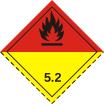
Transport classification per the UN Model Regulations / 49 CFR 172.101 Hazardous Materials Table. Confirm against the grade-specific SDS (Section 14) before shipping.
Dicumyl peroxide (CAS 80-43-3) is a dialkyl organic peroxide supplied as a free-radical crosslinking and vulcanizing agent. It crosslinks polyethylene, cures natural and synthetic rubber and silicone rubber, and acts as a polymerization initiator. It is also used as a synergist for flame retardants in polystyrene foams.
Regulatory & registration requirements
- TSCA (US):
- REACH (EU):
- EC number: 201-279-3
Source: EPA TSCA Inventory (July 2025 release) · ECHA CHEM — retrieved 2026-07-12
Regulatory restriction status
Dicumyl Peroxide (DCP) (CAS 80-43-3) appears on the regulatory list(s) below. This is public regulatory information about the substance — not a statement about any specific supplier’s material, and not a safety claim. Confirm the current status for your jurisdiction and intended use.
- REACH SVHC Candidate List (EU): listed 27 Jun 2024 on the basis of toxic for reproduction (Art. 57(c)). SVHC status triggers EU supplier-communication and notification duties above 0.1% w/w; it is not, by itself, a ban on sale.
Sources: ECHA Candidate List / Annex XIV / Annex XVII (echa.europa.eu); U.S. EPA TSCA; UN Stockholm Convention / EU POPs Regulation; California OEHHA Proposition 65 list. Retrieved 2026-07-13.
Solutions Using This Product
Process-solution guides on this site that specify this chemistry:
- Peroxide Crosslinking for XLPE & Rubber (Plastics & Polymers)
- Vinyl Silanes for Moisture-Crosslinked PE Pipe & Cable (Plastics & Polymers)
Frequently Asked Questions
What is dicumyl peroxide used for?
Dicumyl peroxide (DCP, CAS 80-43-3) is a dialkyl organic peroxide used as a free-radical crosslinking and vulcanizing agent. It crosslinks polyethylene for wire, cable, and pipe, cures natural, synthetic, and silicone rubber, initiates free-radical polymerization, and acts as a flame-retardant synergist in polystyrene foams.
What is another name for dicumyl peroxide?
It is commonly abbreviated DCP and is also referred to as bis(alpha,alpha-dimethylbenzyl) peroxide or dicumyl peroxide. The unambiguous identifier for ordering is CAS 80-43-3 (formula C18H22O2).
How does dicumyl peroxide crosslink polymers?
On heating above its decomposition temperature, DCP cleaves to generate free radicals that abstract hydrogen from polymer chains, creating carbon-carbon crosslinks between them. This peroxide cure is widely used for polyethylene, rubber, and silicone elastomers; activation temperature governs cure timing.
How is dicumyl peroxide shipped and classified for transport?
It is associated with UN 3110 (dicumyl peroxide) and HS code 2909.60 (organic peroxides). Organic peroxides require temperature-controlled handling; consult the SDS for the full transport and storage profile before booking freight.
What is the cost of bulk dicumyl peroxide?
Bulk pricing depends on form, grade, packaging, volume, and destination. Request a quote with your target quantity and ship-to location; a CoA and SDS accompany each shipment.
What is the REACH and TSCA regulatory status of Dicumyl Peroxide (DCP)?
Dicumyl Peroxide (DCP) (CAS 80-43-3) is subject to U.S. TSCA Inventory requirements; supplying it into the EU requires valid REACH registration ((EC) No 1907/2006). RawSource cannot verify a third-party supplier's registrations — buyers should require documented TSCA and REACH compliance for their jurisdiction and volume (EC 201-279-3).
What is the CAS number of Dicumyl Peroxide?
The CAS number of Dicumyl Peroxide is 80-43-3.