Specialty Additives Available — Bulk Only

Maleic Anhydride (MAH)

MAH
CAS 108-31-6 · Formula C4H2O3 · MW 98.06 g/mol

The reactive anhydride monomer that underpins unsaturated polyester resins and maleic-modified chemistries. Industry references record its use in unsaturated polyester and alkyd-type resins, copolymerization reactions, coatings and paper-sizing resins, lube-oil dispersants and corrosion inhibitors, and the manufacture of fumaric and tartaric acids, plus its role as a Diels-Alder dienophile.

Request SDS
UN Number
UN 2215
Hazard Class
Class 8
HS Code
2917.14
At a Glance
Material Family
Specialty Additives
Record Type
Pure compound
Primary Role
Film Formation · Synthesis Intermediate
Functional Roles
MALEIC ANHYDRIDE
FILM FORMING
Applications & Use Cases
  • Unsaturated polyesters: Primary raw material for UPR.
  • Copolymers: Comonomer in maleic-anhydride copolymerization.
  • Lubricant additives: Feedstock for dispersants and corrosion inhibitors.
  • Paper and coating resins: Used in paper-sizing and coating resins.
  • Acid manufacture: Precursor to fumaric and tartaric acids.
Physical Properties
Physical Description
Maleic anhydride appears as colorless crystalline needles, flakes, pellets, rods, briquettes, lumps or a fused mass. Melts at 45 °C. Shipped both as a solid and in the molten state. Vapors, fumes and dusts strong irritate the eyes, skin and mucous membranes. Flash point 103 °C. Autoignition temperature 477 °C. Used to make paints and plastics and other chemicals
Appearance
Orthorhombic needles from chloroform; commercial grades furnished in fused form, as briquettes
Odor
Irritating, choking odor
Boiling Point
387 to 199 °C at 760 mmHg
Melting Point
53 °C
Flash Point
102 °C (closed cup)
Solubility
Solubility at 25 °C: 227 g/100 g acetone; 112 g/100 g ethyl acetate; 52.5 g/100 g chloroform; 50 g/100 g benzene; 23.4 g/100 toluene; 19.4 g/100 g o-xylene; 0.60 g/100 g carbon tetrachloride; 0.25 g/100 g ligroin; soluble in dioxane; soluble in alcohol with ester formation
Density
1.43 at 15 °C
Vapor Density
Relative vapor density (air = 1): 3.4
Vapor Pressure
Vapor pressure, Pa at 20 °C: 21
LogP
1.62 (calculated)
Autoignition Temperature
470 °C
Viscosity
Viscosity in mPa.s (cP): 0.61 at 60 °C; 1.07 at 90 °C; 0.6 at 150 °C
Corrosivity
Corrosive material
Heat Of Combustion
-1389.5 kJ/mol
Heat of Vaporization
54.8 kJ/mol
pH
pH of water solutions: 2.42 at 1X10⁻² M; 2.62 at 5X10⁻³ M; 3.10 at 1X10⁻⁴ M
Ionization Potential
9.90 eV
Odor Threshold
Odor threshold 0.3 ppm (0.001223 mg/L)... reported for off-gases in manufacture
Safety & Handling
Full SDS available on request

A grade-specific Safety Data Sheet (SDS) — with the complete hazard classification, handling precautions, and transport information — is supplied with every shipment and available on request. Confirm all safety and regulatory details against the SDS for your specific grade.

Request SDS →
DOT / UN Transport Classification
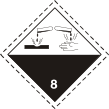
DOT hazard class 8 placard
UN / DOT NumberUN 2215
Hazard Class / DivisionClass 8
Packing GroupIII
Proper Shipping NameMaleic anhydride

Transport classification per the UN Model Regulations / 49 CFR 172.101 Hazardous Materials Table. Confirm against the grade-specific SDS (Section 14) before shipping.

HS / Tariff Classification
Harmonized System (HS) Code — 6-digit international heading
2917 . 14
Chapter 29
Organic chemicals
Heading 29.17
Internationally harmonized (WCO HS)
Subheading 2917.14
6-digit international code — national tariff line adds further digits
Chemical Identity
CAS Number
108-31-6
Molecular Formula
C4H2O3
Molecular Weight
98.06 g/mol
IUPAC Name
furan-2,5-dione
INCI Name
MALEIC ANHYDRIDE
PubChem CID
InChI Key
FPYJFEHAWHCUMM-UHFFFAOYSA-N
Synonyms & Trade Names
MALEIC ANHYDRIDE furan-2,5-dione 2,5-Furandione Toxilic anhydride Maleic acid anhydride cis-Butenedioic anhydride Dihydro-2,5-dioxofuran Maleinanhydrid RCRA waste number U147 2,5-Furanedione Anhydrid kyseliny maleinove Anhydride, Maleic 2,5-dihydrofuran-2,5-dione MALEICANHYDRIDE C4H2O3
Full Description

Maleic anhydride (CAS 108-31-6) is a reactive anhydride and major chemical intermediate. Industry references record its use in unsaturated polyester and alkyd-type resins, copolymerization reactions, coatings and paper-sizing resins, lube-oil dispersants and corrosion inhibitors, and the manufacture of fumaric and tartaric acids, plus its role as a Diels-Alder dienophile. Supplied as a bulk intermediate.

Frequently Asked Questions

What is maleic anhydride used for?

Maleic anhydride (MAH, CAS 108-31-6) is a major reactive intermediate. It is the primary raw material for unsaturated polyester and alkyd-type resins, a comonomer in copolymerization, a feedstock for lube-oil dispersants and corrosion inhibitors, a paper-sizing and coating resin component, and a precursor to fumaric and tartaric acids. It is also a classic Diels-Alder dienophile.

What are the alternative names for maleic anhydride?

Maleic anhydride is also called MAH, cis-butenedioic anhydride, 2,5-furandione, and dihydro-2,5-dioxofuran. Its CAS number is 108-31-6 and its formula is C4H2O3. All refer to the same reactive anhydride intermediate.

What happens when maleic anhydride reacts with water?

Maleic anhydride hydrolyzes in water to form maleic acid (cis-butenedioic acid). This ring-opening is why the anhydride must be kept dry in storage and handling. The reaction is exothermic; refer to the SDS for moisture-control and handling guidance.

What HS code and UN number apply to maleic anhydride?

Maleic anhydride classifies under HS 2917.14 (maleic anhydride). For transport it is assigned UN 2215 (MALEIC ANHYDRIDE). RawSource ships in compliance with applicable DOT/IMDG requirements and provides shipping documentation with each order.

What is the cost of bulk maleic anhydride?

Bulk maleic anhydride pricing varies with volume, form (molten, briquette, or flake), packaging, and destination. We do not list spot pricing — request a bulk quote and RawSource will return current pricing along with CoA and SDS for the lot.

Disclaimer. Information on this page — including properties, identifiers, hazard, transport (DOT/UN) and tariff (HS) classifications, and applications — is provided for general reference and is compiled from authoritative public sources (e.g. PubChem/ECHA, 49 CFR 172.101, the Harmonized Tariff Schedule). Values are typical and are not a guaranteed specification; the Certificate of Analysis (CoA) for the lot purchased governs. Products are sold for industrial and professional use only. Nothing here is a medical, health, or efficacy claim or advice. Always consult the current Safety Data Sheet (SDS) before handling, storage, transport or disposal, and confirm regulatory status, classification and suitability for your application and jurisdiction. Hazard, transport and tariff classifications must be verified for your specific shipment. RawSource makes no warranty, express or implied, and assumes no liability for use of this information. Trademarks. Third-party trademarks and brand names are the property of their respective owners; any reference is nominative — used only to identify a comparable product — and does not imply affiliation with, sponsorship by, or endorsement by the trademark owner.