
ZINC OXIDE- ▸ Rubber: Vulcanization activator (largest end use).
- ▸ Coatings: White pigment and anticorrosive additive.
- ▸ Ceramics and glass: Flux and opacifier in glazes and frits.
- ▸ Electronics: Active material in varistors and surge arresters.
- ▸ Agriculture and feed: Zinc micronutrient source.
A grade-specific Safety Data Sheet (SDS) — with the complete hazard classification, handling precautions, and transport information — is supplied with every shipment and available on request. Confirm all safety and regulatory details against the SDS for your specific grade.
Request SDS →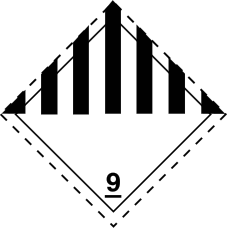
Transport classification per the UN Model Regulations / 49 CFR 172.101 Hazardous Materials Table. Confirm against the grade-specific SDS (Section 14) before shipping.
Zinc oxide (CAS 1314-13-2), an inorganic ZnO powder. Roughly half to sixty percent of consumption goes to the rubber industry as a vulcanization activator. It also functions as a white pigment and anticorrosive in coatings, a flux and opacifier in ceramics and glass, the active material in electronic varistors, and a zinc micronutrient in feed and agriculture.
Regulatory & registration requirements
- TSCA (US):
- REACH (EU):
- EC number: 215-222-5
Source: EPA TSCA Inventory (July 2025 release) · ECHA CHEM — retrieved 2026-07-12
Solutions Using This Product
Process-solution guides on this site that specify this chemistry:
- H2S Scavengers for Gas, Liquid & Multiphase Streams (Oil, Gas & Mining)
- In-Can Preservatives & Dry-Film Biocides for Coatings (Coatings & Construction)
- Sulfur Silanes for Silica Tire-Tread Coupling (Plastics & Polymers)
Frequently Asked Questions
What is zinc oxide used for?
Roughly half to sixty percent of zinc oxide (CAS 1314-13-2) consumption is in rubber as a vulcanization activator. It also serves as a white pigment and anticorrosive in coatings, a flux and opacifier in ceramics and glass, the active material in electronic varistors, and a zinc micronutrient in feed and agriculture.
What is the chemical formula for zinc oxide?
Zinc oxide is ZnO (CAS 1314-13-2), an inorganic white powder. It is the most common industrial zinc compound by volume across rubber, coatings, and ceramics.
Is zinc oxide water soluble?
No. Zinc oxide is essentially insoluble in water but dissolves in acids and strong bases. Its insolubility suits its use as a filler, pigment, and rubber activator in solid systems.
Is zinc oxide the same as zinc carbonate?
No. Zinc oxide is ZnO; zinc carbonate is ZnCO3. They are different compounds with different end uses, though both are inorganic zinc salts used as fillers, pigments, and feed micronutrients.
How does zinc oxide ship and what does bulk cost?
Crude zinc oxide carries UN 3077 for transport classification; the SDS specifies handling. RawSource supplies it as a bulk powder with CoA available, and pricing depends on grade and volume, so request a current bulk quote.
What is the REACH and TSCA regulatory status of Zinc Oxide (Zinc White)?
Zinc Oxide (Zinc White) (CAS 1314-13-2) is subject to U.S. TSCA Inventory requirements; supplying it into the EU requires valid REACH registration ((EC) No 1907/2006). RawSource cannot verify a third-party supplier's registrations — buyers should require documented TSCA and REACH compliance for their jurisdiction and volume (EC 215-222-5).